
The Gramercy Mandoline Slicer: Is This Premium Kitchen Gadget Truly Worth Your Money and Counter Space?
Thinking about a mandoline slicer? Good for you. This guide cuts right to the chase, helping everyday home cooks and aspiring chefs figure out if a more advanced option, like the Gramercy Mandoline Slicer for Kitchen with 12 Slice Settings, Black Edition, really delivers on its promises. We’re not here for fluffy reviews; we’re dissecting the value proposition of a slicer that boasts features like a stainless steel frame, rotating blade, and a complete safety package.
Quick Answer
For serious home cooks who regularly prepare fresh ingredients and demand precision, the Gramercy Mandoline Slicer with its comprehensive safety features and versatile 12 slice settings offers significant value, justifying its mid-to-premium positioning. It’s an investment in efficiency and consistency, provided you’ll use its capabilities beyond basic slicing.
What to Look For in a Mandoline Slicer (The Buying Criteria)
Don’t just grab the first slicer you see. Mandolines are serious tools, and a bit of foresight can save you a whole lot of frustration (and maybe a trip to the emergency room). Here are the real factors that separate the workhorses from the duds.
Blade Type and Versatility
This is the heart of any mandoline. Most basic models use a straight blade. They’re fine for simple, uniform slices. But what if you want julienne, waffle cuts, or fancy crinkle chips? That’s where versatility comes in. The Gramercy mandoline, for instance, features a rotating blade system that integrates various cutting styles without needing to swap out external attachments. This is a huge convenience. Some higher-end slicers use V-blades, which excel at slicing soft or ripe produce like tomatoes, reducing tearing. Straight blades can sometimes struggle there. The trade-off for integrated systems like Gramercy’s? If one blade type dulls or breaks within the mechanism, replacement can be trickier than just popping in a new attachment.
Safety Features – Non-Negotiable, Folks
Seriously. This isn’t where you skimp. A mandoline’s blades are razor-sharp – they have to be to make those impossibly thin cuts. The Gramercy model comes with crucial elements: a non-slip base, which is absolutely vital for stability on your countertop, a sturdy hand guard to keep your fingers away from the cutting surface, and even gloves for an extra layer of protection. Many budget slicers cut corners here, offering flimsy guards or no base stability. Don’t be fooled by a low price if it compromises safety. Even with all these precautions, you still need to pay attention, of course. No gadget makes up for carelessness.
Construction Material & Durability
You want something that feels solid, not like it’s going to wobble itself into oblivion after a few uses. The stainless steel frame on the Gramercy mandoline is a big plus here. It lends weight and rigidity, which translates to better stability and a longer lifespan. Cheaper plastic models often flex under pressure, leading to uneven slices and a generally frustrating experience. While plastic has its place – it can be lighter and sometimes easier to store – it rarely stands up to heavy use over time. A stainless steel frame, though, might mean a slightly heavier unit, so consider storage. It’s built to last.
Slice Thickness Settings
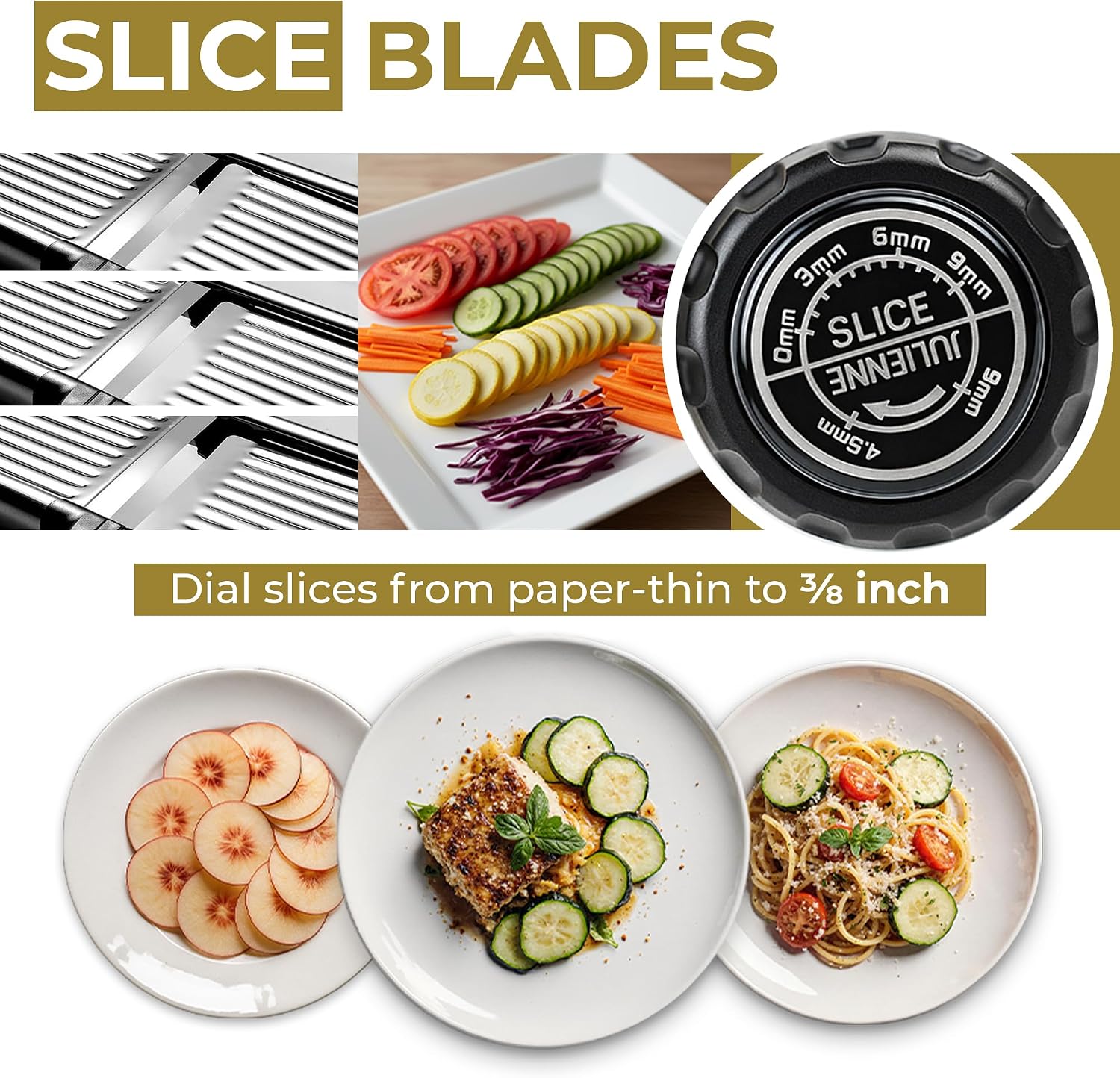
“Paper-thin to thick-cut” – that’s the dream, right? The Gramercy mandoline boasts an impressive 12 slice settings, allowing for extreme precision. Whether you’re aiming for delicate potato chips or thick gratin slices, you should be able to dial it in. Some cheaper models offer only 2-3 settings, which limits your culinary aspirations pretty severely. A good range of settings means you can tailor your cuts exactly to the dish. Too many settings, however, can sometimes make the dial feel overly complex for quick adjustments. There’s a sweet spot, and 12 is certainly on the generous side.
Ease of Cleaning & Storage
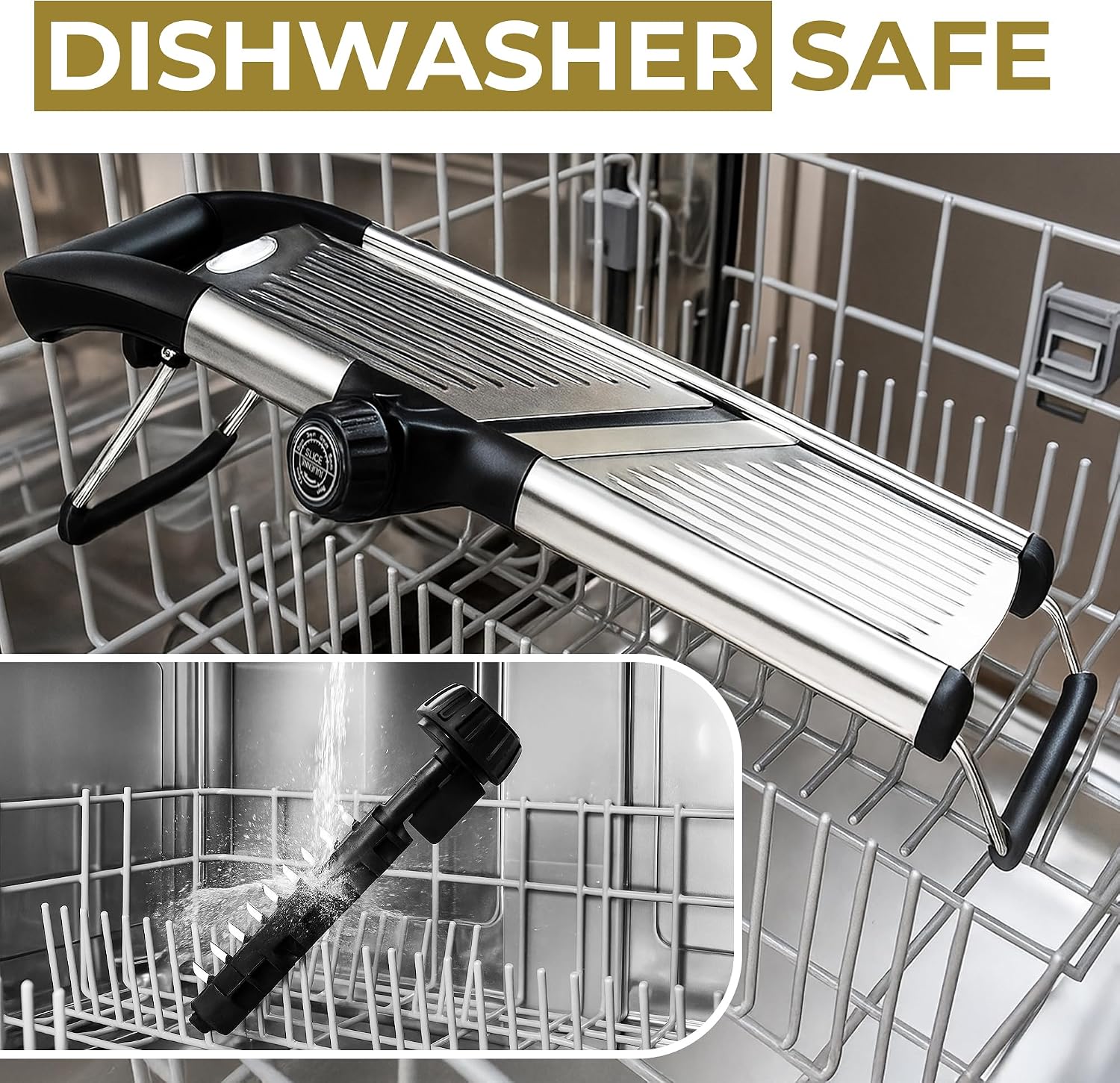
After all that efficient slicing, you still have to clean the thing. Is it a nightmare? Many mandolines are. Look for designs that allow blades to be safely rinsed without too much disassembly. Some components might be top-rack dishwasher safe, but often, a quick hand-wash is recommended for sharp blades to maintain their edge. The Gramercy’s integrated design, while great for versatility, means there are fewer detachable parts, which can simplify cleaning somewhat. But watch those blades – always. And then there’s storage. Does it fold flat? Does it come with a case? A substantial unit with a stainless steel frame will occupy more cupboard space than a basic handheld model. Think about where it’ll live when not in use.
Stability and Footprint
A mandoline needs to stay put. End of story. A non-slip base, like the one included with the Gramercy mandoline, prevents dangerous sliding during use. You’re applying pressure, sometimes a lot of it, and a wobbly device is a recipe for disaster. The footprint itself matters, too. Are you cooking in a sprawling kitchen or a compact apartment galley? A larger, more robust machine offers unparalleled stability but will certainly command more counter real estate. Smaller, more compact versions trade some stability for convenience, but for safety, the bigger and sturdier, the better.
How to Match the Product to Your Situation
Who are you in the kitchen? Different cooks have different needs, and not every mandoline is right for everyone.
The Occasional Entertainer
You love hosting dinner parties. Presentation matters. Delicate radish slices for a canapé, perfectly uniform cucumber ribbons for a salad, or a mountain of crispy root vegetable chips? You need something that can perform these specific, somewhat show-offy tasks without a lot of fuss. Consistency is key. You might not use it daily, but when you do, it needs to deliver. A high-quality model like the Gramercy mandoline would be a solid choice here because its 12 slice settings and varied cuts (like julienne, if available through the rotating blade system) make those impressive presentations easy. You’re not just slicing; you’re crafting.
The Everyday Health-Conscious Cook
You prep meals regularly. Maybe you’re making big batches of salad ingredients, slicing veggies for stir-fries, or preparing components for healthy lunches. Speed, efficiency, and safety are your top priorities. You want uniform slices not just for looks, but for even cooking. A robust, easy-to-clean machine that won’t give you grief every time you pull it out is crucial. The stability of the stainless steel frame and the comprehensive safety features (gloves, hand guard, non-slip base) of the Gramercy model make it a strong contender. You won’t be constantly fumbling with attachments, and that rotating blade will save precious time.
The Aspiring Home Chef
You’re serious about cooking. You’re experimenting with new recipes, trying out different cuisines, and striving for restaurant-quality results at home. You understand the nuances that proper technique and tools can bring. Precision and versatility aren’t just “nice-to-haves”; they’re essential. You’re willing to invest in a tool that can grow with your skills. The wide range of 12 slice settings and the various cut options offered by the Gramercy mandoline are designed for this kind of user. It’s a tool that lets you explore, rather than limiting you. You’ll appreciate the durability and consistent performance.
Decision Tree: Choosing Your Mandoline Slicer
-
Do you need more than just basic slices? (e.g., julienne, waffle, crinkle?)
- YES: → Consider models with integrated multi-blade systems or swappable cartridges.
- Is safety your absolute top priority? (gloves, sturdy guard, non-slip base)
- YES: → Look at premium models with a full suite of safety features, like the Gramercy mandoline.
- NO (I’m very careful): → Mid-range models might offer versatility but check guard quality closely.
- Is safety your absolute top priority? (gloves, sturdy guard, non-slip base)
- NO (Basic slices are enough): → A simpler, often more compact, straight-blade model will suffice.
- Do you want precise, consistent thickness options?
- YES: → Look for adjustable thickness dials, even on simpler models.
- NO (Mostly rough cuts): → Even the most basic slicers will do.
- Do you want precise, consistent thickness options?
- YES: → Consider models with integrated multi-blade systems or swappable cartridges.
-
Are you prepping large quantities regularly?
- YES: → Durability (stainless steel frame) and stability (non-slip base) are key. A premium model will withstand heavy use.
- NO (Occasional use): → A lighter, mid-range plastic model might be fine, but still prioritize safety.
A Comparison of Mandoline Slicer Types
Here’s how different tiers stack up when you’re looking for a mandoline.
| Type/Tier | Best For | Price Tier | Key Feature | Watch-Out |
|---|---|---|---|---|
| Basic Handheld | Quick, single-serve slicing, small kitchens. | Budget | Compact size, often simple fixed thickness. | Limited versatility, often flimsy safety features. |
| Mid-Range Adjustable | Regular home cooking, more versatile cuts. | Mid-range | Adjustable thickness, some julienne attachments. | Can still lack robust safety and long-term durability. |
| Premium Integrated | Serious home chefs, diverse, precise cuts. | Mid-to-Premium | Integrated multi-blade systems, sturdy build. | Higher cost, can be larger to store, complex to clean. |
| Professional French/Japanese | High-volume prep, specific culinary tasks. | Premium | Ultra-sharp blades, heavy-duty construction. | Very expensive, often specialized, intimidating for novices. |
- Basic Handheld: These are often very budget-friendly, but you typically get what you pay for in terms of durability and safety.
- Mid-Range Adjustable: Many home cooks start here, finding a good balance of features and cost, though quality can vary wildly.
- Premium Integrated: This tier, where the Gramercy mandoline sits, offers superior safety and versatility, making it a sound investment for consistent users.
- Professional French/Japanese: These are for the pros or the truly dedicated; they’re formidable tools, but they come with a steep learning curve and price tag.
Scenario-Specific Slicing Needs
How often you use it, and for what, should absolutely dictate your purchase.
Batch Prepping for the Week
You’ve got Sunday meal prep on lock. That means slicing a lot of potatoes for gratins, mountains of cucumbers for salads, or endless piles of onions for various dishes. For this kind of volume, a mandoline needs to be exceptionally stable and durable. A unit with a stainless steel frame and a solid non-slip base is non-negotiable. You don’t want to wrestle with a wobbly tool when you’re halfway through a massive zucchini. The Gramercy’s robust build and comprehensive safety gear become invaluable here, allowing for sustained, efficient work without fatigue or fear. Nobody wants to lose a fingertip on meal prep day.
Delicate Garnishes for Special Meals
This is where finesse comes into play. Think paper-thin lemon slices, translucent radish discs, or perfectly uniform truffle shavings (if you’re feeling fancy). The ability to achieve those paper-thin cuts with consistency is paramount. A mandoline with a broad range of slice settings, like the Gramercy’s 12 options, allows for this kind of precision. You need to be able to dial in exactly the right thickness, every time, without tearing or bruising your delicate ingredients. Flimsy mandolines often crush rather than slice at these extreme thinnesses.
Dealing with Tricky Vegetables
Ever tried slicing a ripe tomato paper-thin with a chef’s knife? It’s a skill. A good mandoline, especially one with a sharp V-blade or a well-engineered straight blade like Gramercy’s rotating blade system, makes quick work of these challenges. Think about slicing bell peppers for fajitas, eggplants for a parm, or even firm cheeses. The ability to handle a variety of textures and shapes without tearing or squishing is a mark of quality. The provided hand guard and gloves become particularly important here, as these ingredients can be slippery.
Common Mistakes People Make with Mandoline Slicers
Look, we’ve all been there. New gadget, new set of potential blunders. Avoid these if you want to keep your fingers and your sanity intact.
Ignoring Safety Gear
This is the big one. The absolute biggest. People get complacent, thinking, “Oh, I’m just doing a few slices.” And that’s when accidents happen. Always, always use the hand guard. Always consider the gloves, especially when you’re getting down to the last bit of a vegetable. The blades are sharper than you think, sharper than your sharpest knife, and they don’t discriminate. Don’t dismiss the non-slip base either; a mandoline that slides around is asking for trouble.
Underestimating the Blade’s Sharpness
They’re not just sharp; they’re surgical. A mandoline blade cuts differently than a knife. It glides through, often with surprisingly little resistance. This can be deceptive, making you think you have more control than you actually do, especially if you’re used to forcing a dull kitchen knife through a stubborn sweet potato. Treat it with extreme respect. Never touch the blade directly, even when cleaning.
Buying Too Basic or Too Complex for Your Needs
Some folks jump into a basic model, get frustrated by its limitations (lack of settings, poor safety), and decide all mandolines are useless. Others buy a professional-grade monster when they only need to slice cucumbers for a sandwich. That’s a waste of money and kitchen space. Think about your actual cooking habits. Do you really need those waffle fries or do you just want some uniform potato slices? The Gramercy mandoline sits at a sweet spot – offering extensive features without being overly specialized or intimidating for a dedicated home cook.
Improper Cleaning Techniques
Cleaning a mandoline can be perilous if you’re not careful. Blades can easily catch sponges or fingers. Many people try to scrub directly at the blade, which is dangerous and can dull the edge. Always use a brush if possible, or spray directly with water. Ensure blades are locked or safely retracted if your model allows it. And let it air dry, if you can. Putting it away wet can lead to rust, especially if there are any non-stainless components, though a stainless steel frame like Gramercy’s reduces this worry.
Why, How, What You Need to Know
A little more insight to round things out.
Why invest in a good mandoline slicer?
It’s about consistency, speed, and safety in food prep. A quality mandoline allows you to achieve uniformly thick or thin slices that are nearly impossible by hand, which translates to even cooking and professional presentation. This consistency saves time and reduces waste, making kitchen tasks more efficient. It also opens up new culinary possibilities, letting you tackle recipes that demand specific, precise cuts.
How do those 12 slice settings work, especially with a rotating blade?
With models like the Gramercy mandoline, the rotating blade system means that instead of swapping out separate blades for different cuts, you often just turn a dial or lever. This internal mechanism adjusts the depth or configuration of the cutting edge, offering a seamless transition between various thicknesses and potentially different cut types (like julienne or waffle). It simplifies operation and reduces the number of loose parts you have to store and keep track of.
What are safety gloves really for?
While a hand guard is essential for holding the food, safety gloves provide an additional layer of protection against accidental slips or brushes with the blade. They’re usually cut-resistant, meaning if your hand guard slips or you accidentally graze the blade while moving ingredients around, the glove can prevent serious injury. They give you extra peace of mind, especially when you’re dealing with the end bits of vegetables that are harder to secure in the guard.
Key Takeaways: Is the Gramercy Mandoline Slicer for You?
- Precision Matters: If you crave perfectly uniform slices and various cut styles, the 12 settings and rotating blade are compelling.
- Safety First: The included gloves, hand guard, and non-slip base are strong indicators of a thoughtful design. Don’t compromise here.
- Durability is an Investment: The stainless steel frame suggests longevity and stability, crucial for frequent use.
- Consider Your Use: For occasional, simple tasks, it might be overkill. For regular, diverse food prep, it’s a smart choice.
FAQ
Are mandoline slicers hard to use?
Not inherently, but they demand respect and a bit of practice. The motion itself is simple – slide food over the blade. The tricky part is maintaining a firm, consistent motion while keeping fingers safe.
Can I slice onions on a mandoline?
Absolutely, and it’s one of their standout applications. You can get perfectly uniform onion rings or super-thin slices for salads and sandwiches, far quicker than with a knife.
What’s the difference between a V-blade and a straight blade?
A V-blade has a diagonal cutting edge that makes two points of contact, which is often better for slicing soft fruits and vegetables as it tears less. A straight blade makes one full contact cut, which is generally fine for firmer produce.
How do I clean a mandoline slicer safely?
Always rinse immediately after use. Use a stiff brush for any stuck-on bits, never your bare hands or a sponge near the blade. Many models have parts that can go in the dishwasher, but always check manufacturer guidelines.
Is the hand guard truly necessary?
Yes, without a doubt. It’s your primary defense against serious injury. Using your bare hands is incredibly risky. Never skip the guard, even for “just one more slice.”
Can you make julienne fries with a mandoline?
Many mandolines, including the Gramercy with its versatile settings, can indeed produce julienne cuts, which are perfect for making homemade fries or matchstick vegetables. You’d typically adjust the blade settings for this specific cut.
What kind of vegetables work best?
Firmer vegetables like potatoes, carrots, cucumbers, zucchini, and beets are ideal. Softer items like ripe tomatoes can also be sliced beautifully if the blade is sharp and the design, like a V-blade or a precisely engineered rotating blade, minimizes tearing.
Final Recommendation
For those who cook regularly, appreciate precision in their food prep, and want a kitchen tool that truly elevates their culinary game, the Gramercy Mandoline Slicer for Kitchen with 12 Slice Settings, Black Edition is a solid contender. It’s not a budget impulse buy, but an investment. The robust stainless steel frame, the versatility of its rotating blade system with 12 slice settings, and especially the comprehensive safety package (think non-slip base, gloves, and hand guard) make it a genuinely smart choice for the discerning home cook.
If your current routine involves anything more than basic, occasional chopping, and you’re tired of uneven cuts or slow knife work, this Gramercy mandoline delivers the consistency and safety features that truly justify its standing in the mid-to-premium tier. It’s built to be a workhorse, not a dust collector. Just remember to use those safety features every single time; that’s the real secret to loving your mandoline.
#Gramercy #Mandoline #Slicer #Kitchen #Slice #Settings #Black #Edition #Slice #PaperThin #ThickCut #Stainless #Steel #Frame #Rotating #Blade #NonSlip #Base #Gloves #Guard #Included
![Titanium Cutting Board Double Sided Food Grade, Pure Titanium/PP for Kitchen, Cutting Board Easy to Clean[15.5”*10.5”+12”*8.5”]](https://www.decorwild.com/wp-content/uploads/2026/08/Review-TitaniumPP-Kitchen-Cutting-Boards-Double-Sided-Food-Grade-Easy-300x219.jpg)
![Titanium Cutting Board, Double Sided Food Grade Pure Titanium/PP, Cutting Board for Kitchen, Easy to Clean Large Size [18”*12.5”+15.5”*10.5”+12”*8.5”]](https://www.decorwild.com/wp-content/uploads/2026/08/Review-Pure-TitaniumPP-Double-Sided-Board-Large-Easy-Clean-Kitchen-300x240.jpg)