
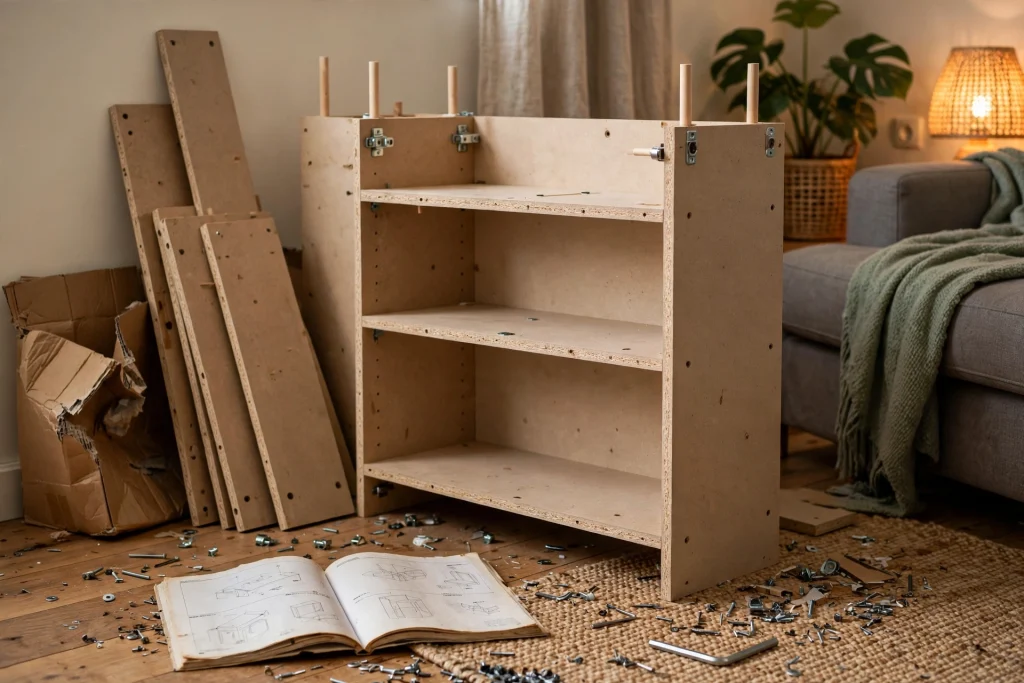
Twenty minutes. That’s what the booklet promised. It took me an hour and forty minutes, and I do this for a living.
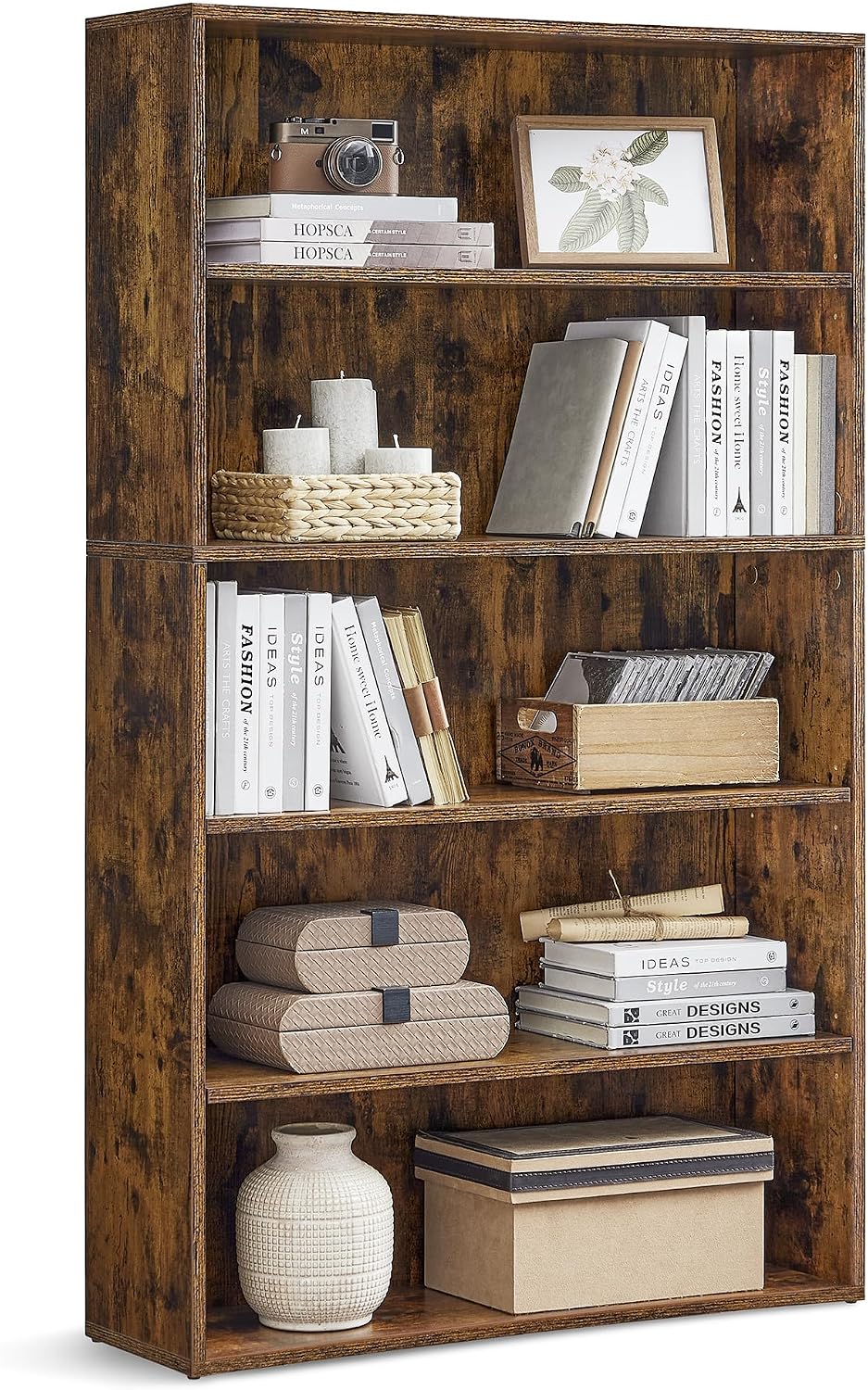
The VASAGLE 5-tier bookshelf is one of the best-selling flat-pack shelves on the internet. Thousands of five-star reviews. “Easy assembly,” they say. Let me tell you what easy assembly actually looks like when the box lands on your doorstep.
The Box Arrives Pre-Damaged
I’ve seen dozens of these flat-packed boxes arrive at clients’ doorsteps with the corners completely pulverized by delivery drivers, and mine was no exception. One corner was crushed inward about two inches. The cardboard had done its job — barely — but I opened it expecting the worst.
Inside: particleboard panels wrapped in thin foam sheets, a bag of hardware, and an instruction booklet printed on paper so thin you can see through it. The panels themselves survived. The edge banding on one shelf had a small chip. Cosmetic. I let it slide because it faces the wall.
First red flag: the hardware bag. The cam locks felt light. Too light. Good cam locks have some heft — they’re zinc alloy. These felt like they might be hollow. I made a mental note and kept going.
Step 3 Is Where It Falls Apart
The instruction booklet claims it’s a 20-minute setup, but if you don’t bring your own real screwdriver and a hammer, you’ll be stuck for far longer than the optimistic timeline suggests. The included hex wrench is the standard flat-pack joke — a thin L-shaped piece of metal that flexes when you apply real torque.
Steps 1 and 2 went fine. Attach the side panels to the base. Easy.
Step 3: insert the shelf support pegs and slide in the middle shelves. This is where I spent two hours on my hands and knees with a cheap hex wrench trying to force a misaligned bolt into the pre-drilled hole of the back panel brace. The holes were off by maybe 2 millimeters. Sounds like nothing. But when you’re trying to align a rigid particleboard panel across four connection points simultaneously, 2mm might as well be 2 inches.
I tried brute force. Bad idea. The cam lock started to strip — I could feel the metal giving way inside the particleboard. Once a cam lock strips in particleboard, it’s done. You can’t fix it. The hole is wallowed out and nothing will grip again.
I backed off, disassembled what I’d done, and started over with my own tools: a proper screwdriver with a comfortable grip and a rubber mallet for gentle persuasion. The mallet made the difference. Light taps to seat the panels instead of forcing the hardware.
Total assembly time: 1 hour 40 minutes. For someone doing this the first time with only the included tools? Budget two and a half hours and keep your phone nearby to look up what a cam lock is supposed to look like when it’s seated correctly.
The 10-Second Test That Exposes Everything
Here’s the skill I promised. You can do this in any store, on any flat-pack furniture, in ten seconds. All you need is your phone.
Turn on your phone’s flashlight. Hold it flat against the shelf surface — almost parallel, at a tight angle, maybe 10 degrees. Now look at the light raking across the surface.
What you’re looking for: every bump, dip, and uneven spot in the veneer or laminate will cast a tiny shadow. A quality surface looks smooth. A cheap one looks like the surface of the moon.
On this VASAGLE? The top shelf showed visible rippling under raking light. Not terrible — you won’t see it in normal room lighting — but it tells you the laminate wasn’t applied under proper pressure. Over time, those low spots are where the laminate is most likely to bubble or peel, especially if the shelf sits near a heat source.
Why does this work? Because overhead lighting hides surface defects. Raking light exaggerates them. Furniture manufacturers know this — it’s why showroom lighting is always overhead and diffused. Your phone flashlight is the great equalizer.
The physics: a surface that’s flat to within 0.1mm won’t cast visible shadows under raking light. The ripples I found suggest variations of 0.3-0.5mm. That’s within manufacturing tolerance for budget furniture, but it’s the difference between a shelf that looks good for five years and one that starts showing wear patterns in eighteen months.
Try this test on a solid wood shelf sometime. Night and day difference. That’s what an extra $150 buys you — not just better materials, but tighter manufacturing tolerances.
Loaded Up: The Wobble Question
Once assembled, I loaded it with books. Real books — hardcovers, textbooks, the heavy stuff. About 15kg per shelf, which is within the stated capacity.
Push test: one finger against the side. It swayed. Not dramatically, but visibly. The back panel is thin fiberboard held in with small nails — standard for this price point, but it provides almost zero lateral rigidity.
The included anti-tip wall anchor is not optional here. It’s mandatory. If you have kids, if you live in an earthquake zone, if a large dog might bump into it — anchor this thing. An unanchored 5-tier bookshelf loaded with books is a tipping hazard. The manufacturer knows this, which is why they include the anchor. Use it.
After two weeks loaded, I checked the cam locks. One had loosened slightly — about a quarter turn. I tightened it. This is normal for flat-pack furniture in the first month as the particleboard settles and compresses around the hardware. Check yours after two weeks. Then again after two months. After that, it should be stable.
Before You Click Add to Cart for This Bookshelf…
Budget 2+ hours for assembly and buy a $8 rubber mallet before the box arrives. The included hex wrench will get you through it, but a mallet for seating panels and a real screwdriver for the cam locks will save you forty minutes and possibly a stripped fitting. The 20-minute claim on the booklet is fiction — plan for 90 minutes minimum if you’ve done this before, 150 if you haven’t.
The Honest Truth About Sub-$80 Bookshelf Durability
Expect 3-5 years of good service, not a lifetime piece. The particleboard core will hold up fine under normal book loads, but the laminate surface will show wear at contact points within two years, and you’ll likely need to retighten hardware annually. At this price, that’s a fair trade — you’re paying for function, not heirloom quality. If you need something that survives a decade of moves, double your budget and look at solid pine options.
Is the VASAGLE 5-Tier Worth the Floor Space?
Yes, if you go in with realistic expectations and your own tools. It holds a lot of books for the money, the rustic brown finish looks decent in warm lighting, and once anchored to the wall it’s perfectly functional. It’s not premium furniture. It’s not trying to be. What it is: an honest budget shelf that does the job if you assemble it carefully and don’t expect it to survive five apartment moves.
What would make me not recommend it: if the box arrives with crushed panels (not just corners — actual panel damage), send it back immediately. Don’t try to assemble around a cracked shelf. And if you’re buying this for a child’s room, the anti-tip anchor isn’t a suggestion — install it the same day.
Measure your wall space and check that you own a rubber mallet before you order. Your knuckles will thank you.
This site contains affiliate links. We may earn a commission on qualifying purchases.