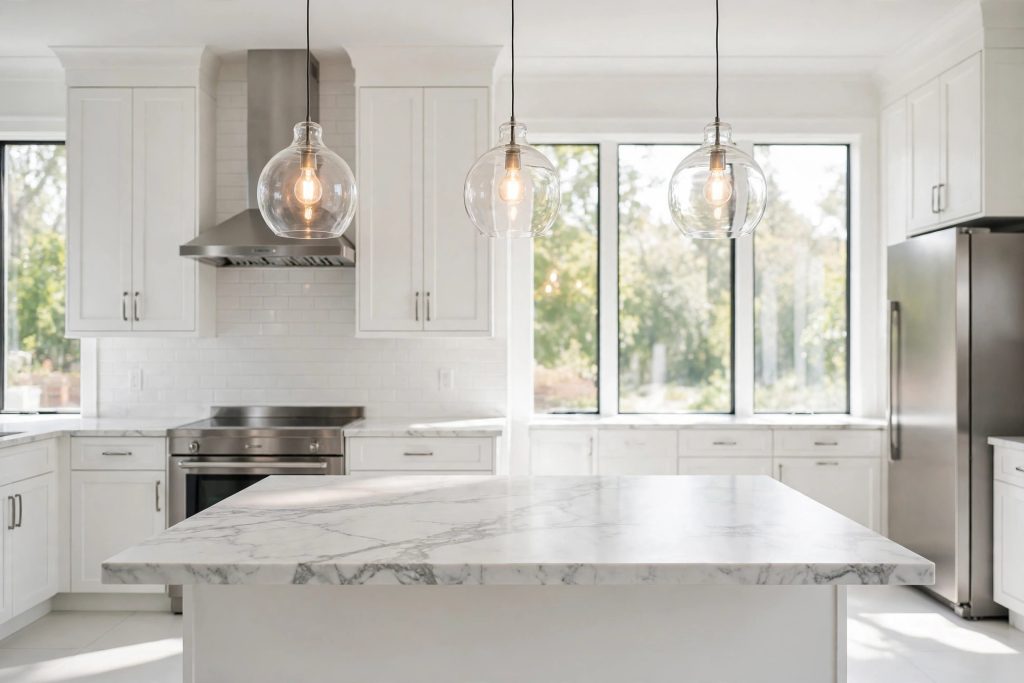
A standard kitchen counter is 25 inches deep, and a normal cutting board eats 12 of those inches front to back before you have chopped a single thing. That is the whole problem with halloween kitchen decor in one measurement. The mantel can take clutter. The porch can take clutter. The counter is a workbench that happens to sit in a decorated house, and every pumpkin you set down is rent paid out of the only workspace you have.
So the rule I work from is not “how much can I fit.” It is zones. Three of them. A heat zone around the burners and the toaster oven. A wet zone around the sink. And one working run — mine is the stretch between sink and stove, roughly 36 inches — that stays empty in October exactly the way it stays empty in March. Decor goes anywhere else. Nowhere else.
Start with the working run test, because it takes ten seconds and it settles arguments that styled photos never will. Put your biggest cutting board down where you actually prep. Put your biggest saucepan next to it. Then reach for something in the upper cabinet with your forearm passing over both. Whatever your elbow knocks, sweeps, or has to dodge was never decor. It was an obstacle with a face painted on it.
The heat zone is not a styling opinion
Keep every decoration at least 12 inches from an open flame or a burner. That figure is not mine. It is the clearance the National Fire Protection Association gives for candles near anything that can burn, and a working stove deserves the same respect as a candle, because the failure mode is identical and faster. Paper bats above a gas burner. Gauze runners draped toward a back element. A wooden tray parked beside a toaster oven that vents sideways. All fine in a photograph. All one distracted Tuesday away from a problem.
Steam does quieter damage on a slower clock. Adhesive decals within reach of a kettle or a boiling pasta pot take in moisture at the edges, curl, and let go — usually mid-October, usually onto whatever is cooking. I learned to read this early: if you slide your fingers along the bottom edges where the user can’t see, you can easily feel if the factory skipped the sanding stage on a tray or a wooden pumpkin, and that same underside check tells you whether a cheap piece will sit flat near heat or rock every time the counter vibrates. Rocking plus heat plus a battery pack is a combination I do not allow in my own kitchen, which is as close to a blanket recommendation as I get.
Go up, not out
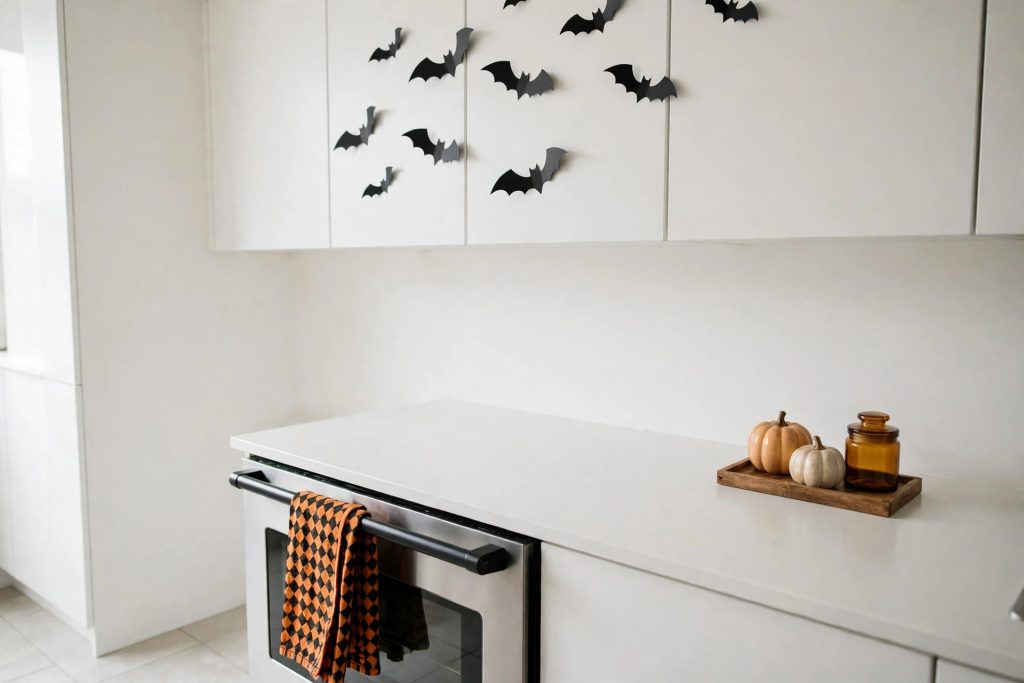
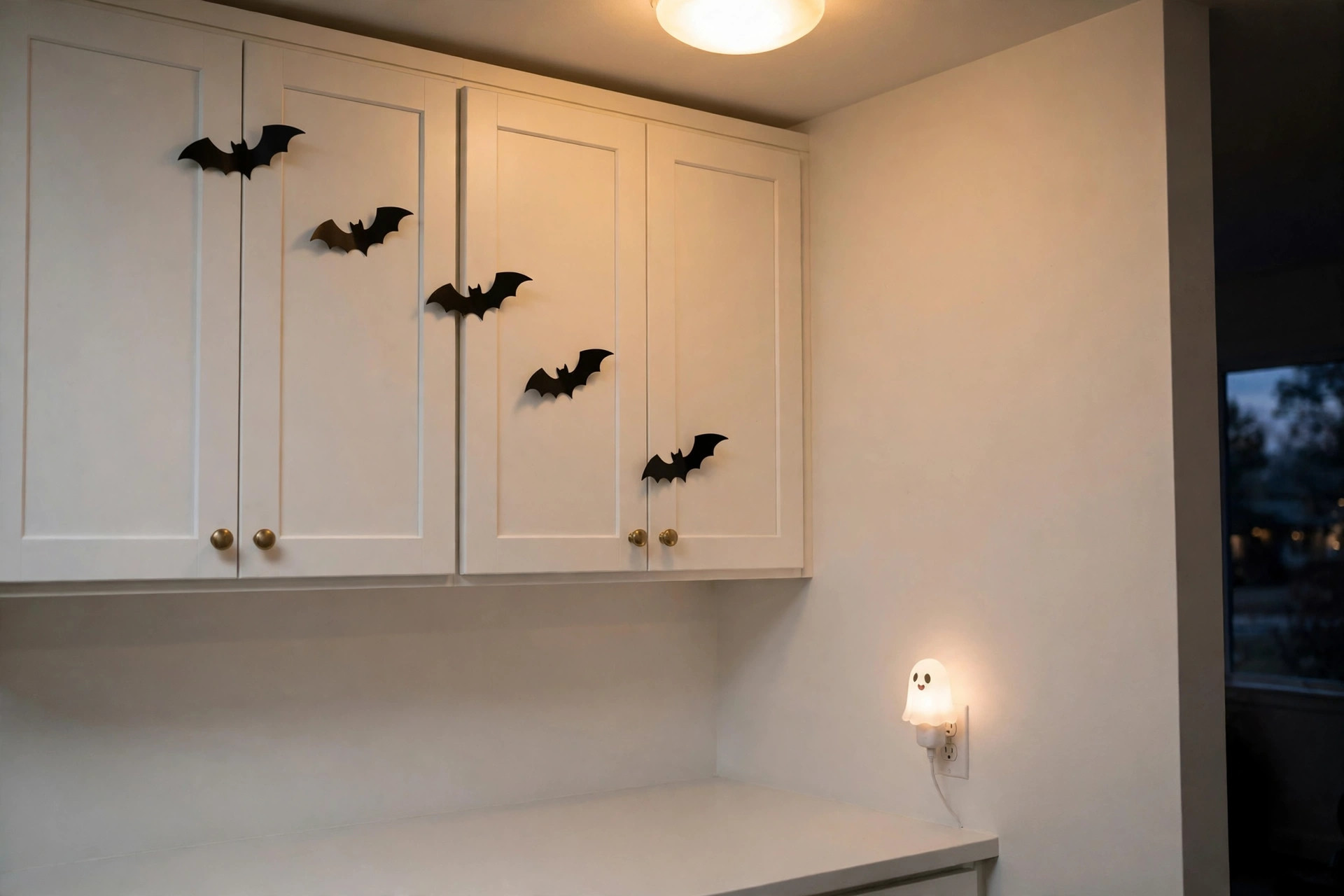
Cabinet doors are the largest unused surface in most kitchens, and they cost zero counter inches. Flat bat decals in a loose diagonal across the uppers read as a whole-room treatment from the doorway, which is where guests actually judge it. Keep the trail off the two doors you open fifty times a day — the adhesive survives longest on the doors that move least, and a bat peeling onto your wrist while you reach for coffee filters gets old by day three.
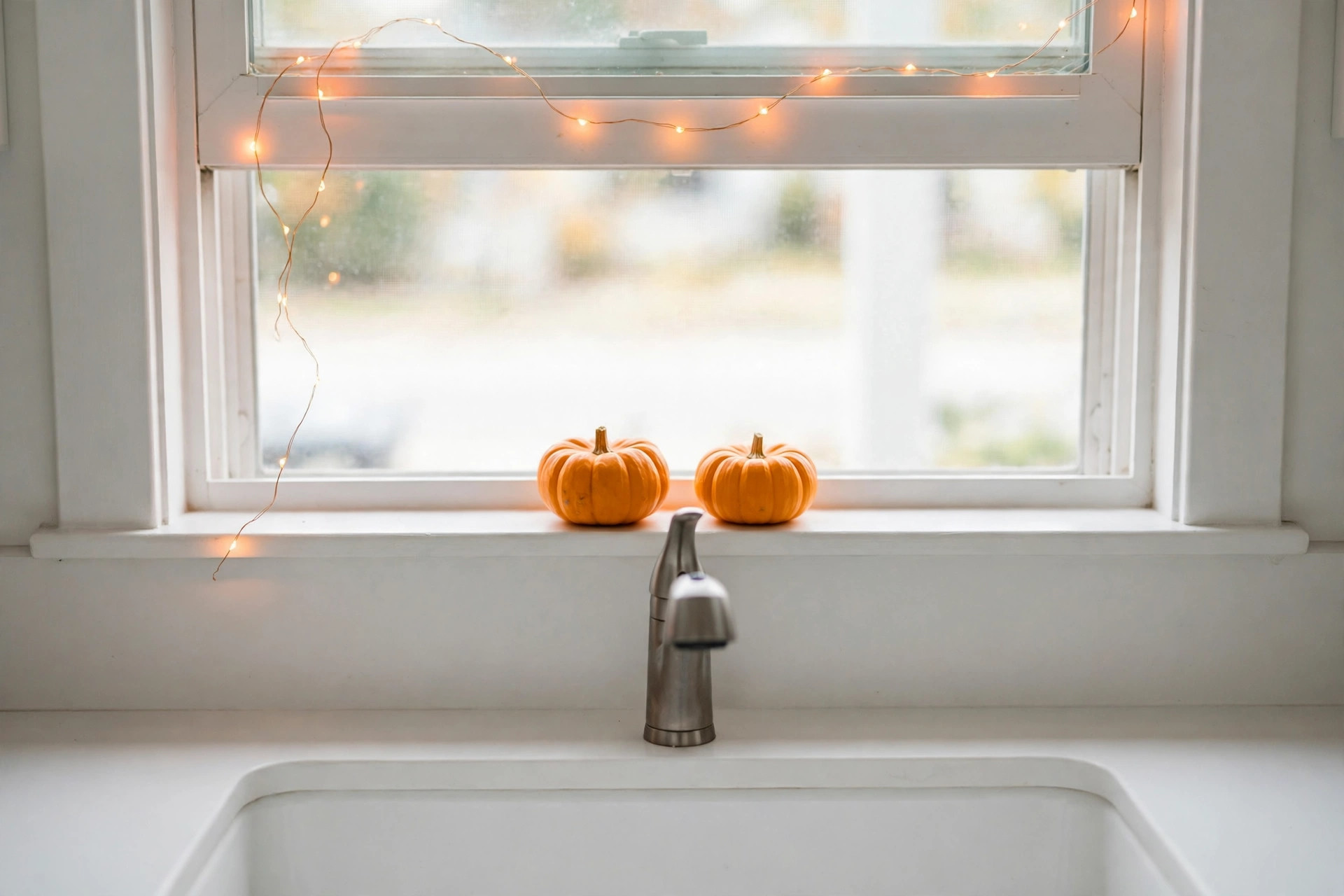
The strip above the cabinets and the window frame over the sink do the same job. Nobody preps food up there. A short battery strand along the window frame and two small pumpkins on the sill give you the evening glow shot without touching the workbench, the same keep-it-off-the-working-surface logic I used for the bathroom Halloween setup, where steam made the decisions instead of taste.
One tray. That is the entire counter budget.
If something must sit on the counter, it sits on one tray, in the dead corner where the counter turns or beside the fridge where no board has ever landed. One tray, roughly the footprint of a sheet pan. Everything on it lifts away in a single motion when you need the space for a turkey, a cooling rack, or a grocery bag that has to go somewhere right now.
Most paid reviewers will tell you a styled tray is easy to clean, but the moment you spill real maple syrup or hot coffee into those tiny crevices between five loose objects, you find out which arrangement was a system and which was a pile. Loose groupings fail this test. A tray passes it because the whole thing moves to the sink as one unit, gets wiped as one unit, and comes back as one unit. Honestly, half the guides ranking for this topic spend more of their word count warning you what to keep off the counter than telling you what to put on it. That ratio is the most honest data point in the whole category. The products are not the hard part. The square inches are.
What goes on the tray, then. Two or three pieces, varied heights, nothing with a battery pack dangling off the back edge into the splash zone. Battery boxes are heavier than the strand they power, and a box that slides off the counter edge will take the lights and whatever they are wrapped around down with it. Tuck the pack behind the tallest piece on the tray, or do not put that strand on the counter at all.
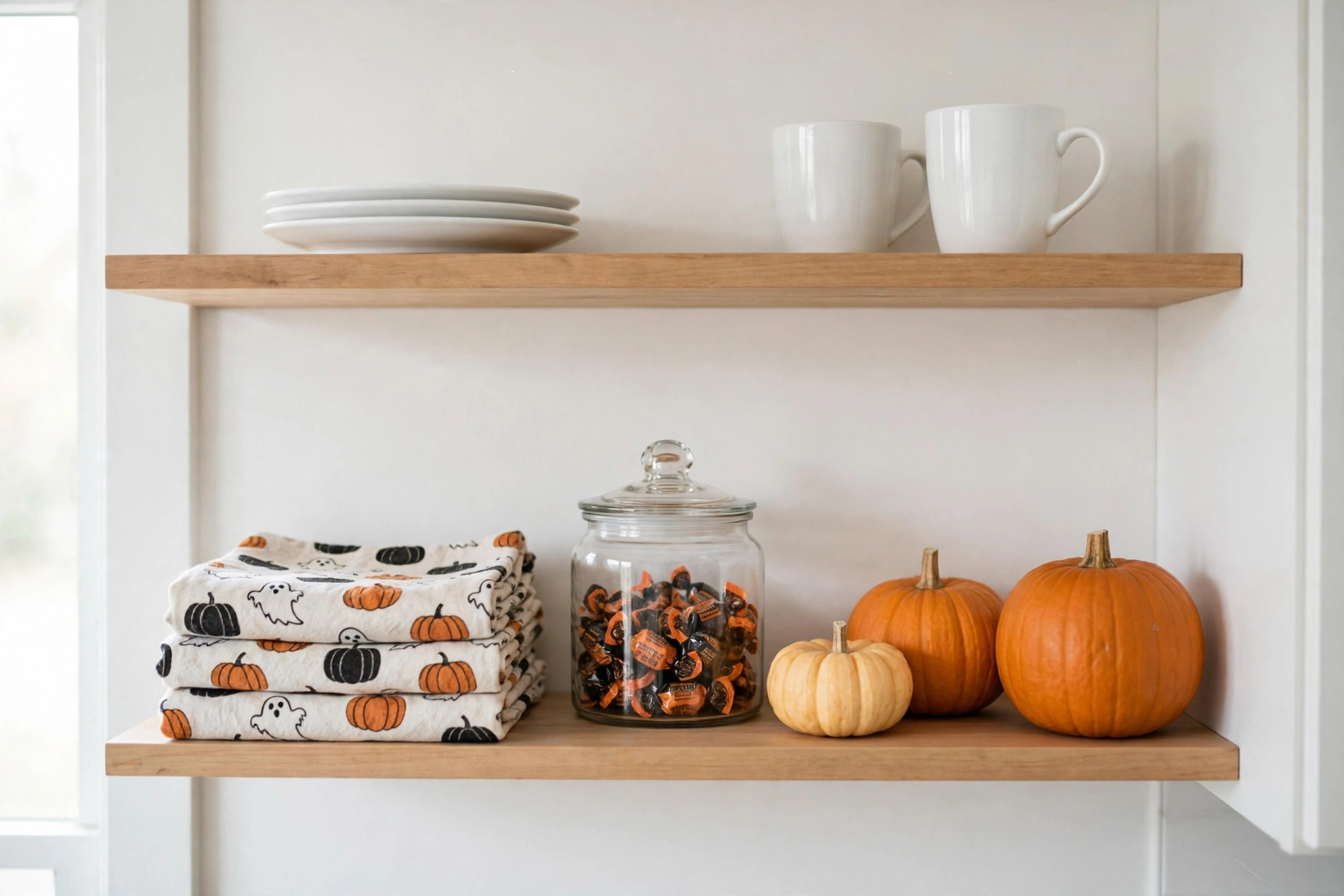
The honest truth about Halloween kitchen towels
A towel swap is the only Halloween kitchen decor that costs exactly zero square inches. The towel was already hanging on the oven handle. The new one hangs in the same place, does the same job, and carries the entire seasonal signal by itself in a small kitchen. Same logic applies to a soap dispenser swap at the sink and a candy jar replacing the jar that already lives on your open shelf. Replacement beats addition, every single time, in a room measured in inches.
Judge the towel like equipment, not like a picture. Wash it twice before October starts. If the print fades or the fabric shrinks enough to change how it hangs, that happened in your machine on your schedule instead of mid-season. Check the weight, too — a thin decorative towel that cannot dry a wet pan is a costume, not a towel, and you will reach past it for the real one all month. I have not tested every printed set on the market and I am not going to pretend otherwise; the two-wash test sorts the category faster than any listing copy.
Shelf styling follows the same replacement rule. Swap two everyday mugs for seasonal ones. Group three small pumpkins where a fruit bowl already sits. The shelf keeps working. Nothing migrates down to the counter, which is the entire point — the same discipline that keeps a Halloween dining table setup usable when dinner actually lands on it.
Before you click add to cart for that garland
Measure the run you plan to cover and add half again. A garland listed at 6 feet drapes to about 4 feet of coverage once you allow any swag at all, and kitchen runs — under-cabinet stretches, shelf fronts — are longer than people guess. Then check where the strand ends. If the end lands mid-prep-zone, the strand is the wrong length for your kitchen no matter how good the color is. Buy for the measurement, not the photograph. Turns out that sentence covers most of this category, and most of the entryway Halloween setup mistakes I have already made so you do not have to.
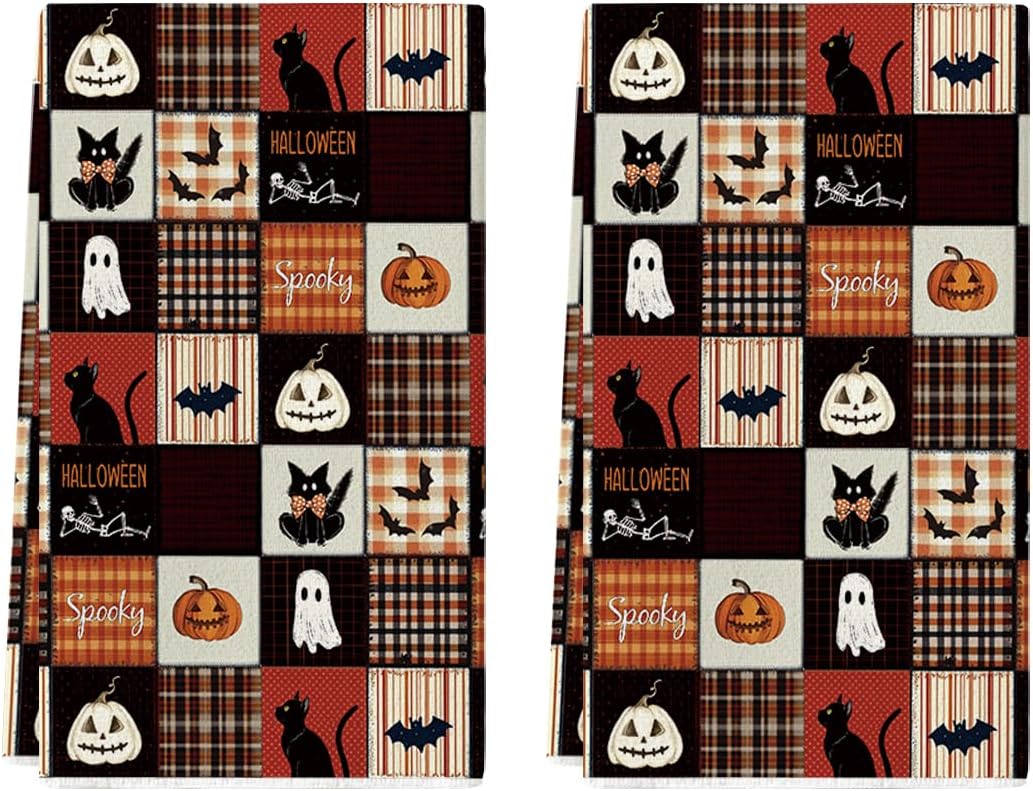
The zero-inch move: replaces the towel already on the handle · wash twice before October to check fade and shrinkage

Lives on the outlet, not the counter · flameless evening glow by the sink or coffee corner
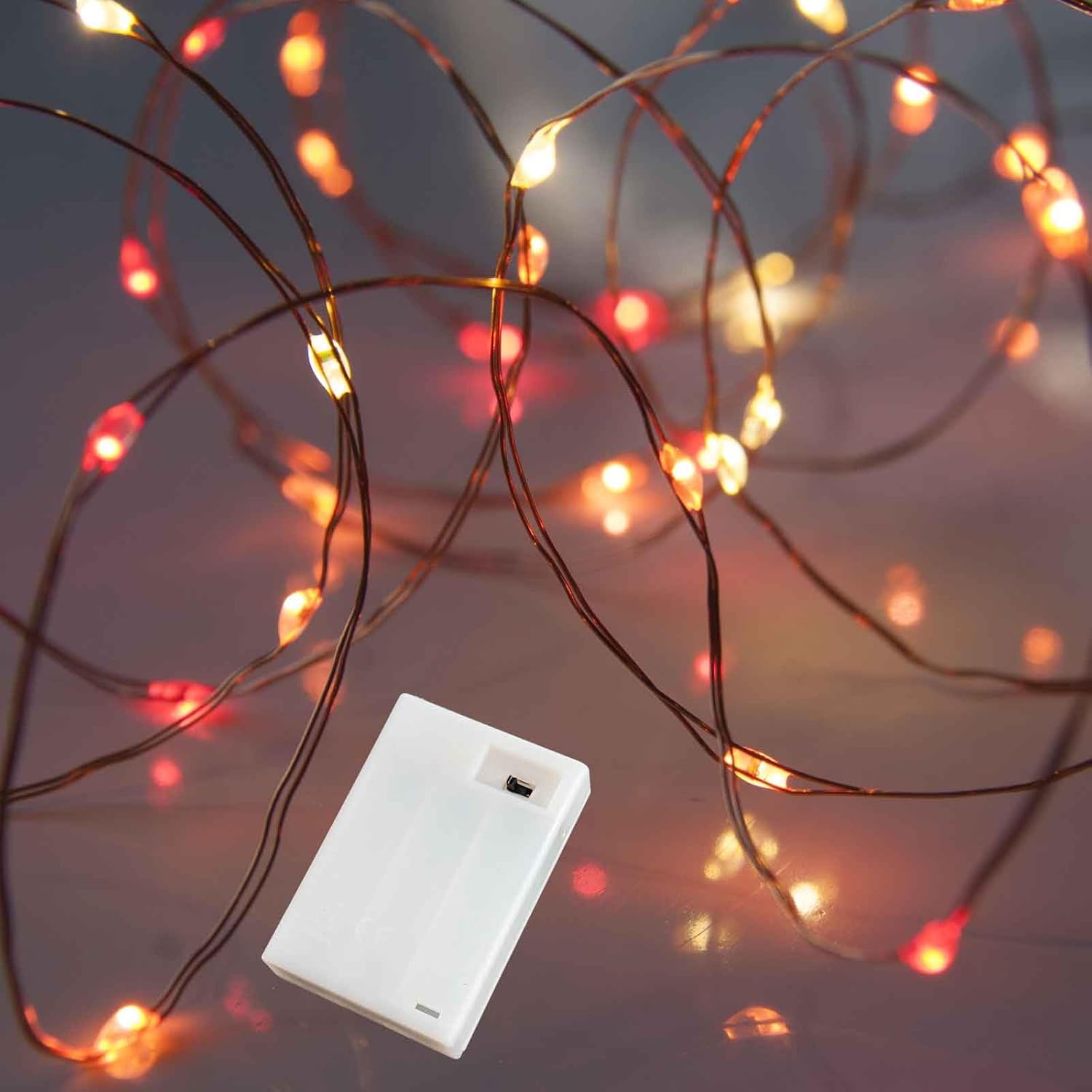
For the window frame or above-cabinet run · keep the battery pack tucked behind a tall piece, out of the splash zone
Frequently asked questions
Can you put Halloween decorations on kitchen counters safely?
Yes, if every piece stays at least 12 inches from burners and open flame and sits outside your main prep run. The National Fire Protection Association gives 12 inches as the minimum distance between a candle and anything that can burn, and paper, gauze, and dried botanicals near a cooktop deserve the same clearance. One tray in a dead corner, holding two or three pieces, is the setup that survives a month of actual cooking.
What Halloween kitchen decor takes up no counter space at all?
Swapped textiles and flat decals take up no counter space at all. A Halloween dish towel replaces the towel already on your oven handle, bat decals sit flat on cabinet doors, and a strand of battery lights along the window frame or above the cabinets adds the evening glow while every inch of worktop stays clear for cooking.
How do I decorate a small kitchen for Halloween?
Use one tray, one textile swap, and one vertical surface — that is a complete small-kitchen Halloween. Pick the dead corner for a single tray with two or three pieces, change the dish towel and the soap dispenser, and put decals or a short light strand up high where no food prep happens. Anything beyond those three moves starts spending counter space a small kitchen does not have.
This site contains affiliate links. We may earn a commission on qualifying purchases.