This article contains affiliate links. If you buy through them, we may earn a commission at no extra cost to you.
Nobody tells you the doors are the product. A French-door air fryer oven is sold on capacity, presets, convection fans, a number with QT after it — and the thing that decides whether you keep it is whether two doors, opened a thousand times by tired people, still meet in the middle and seal. I know this because I returned one. Not the Ninja. The one before it, a handsome machine whose doors closed with a whisper of misalignment that the maker called within tolerance and I called a heat leak with good branding. Everything in it baked with a lopsided tan, darker on the side where the gap breathed. I own an oven thermometer because of that oven. I am not proud of this. I am informed by it.
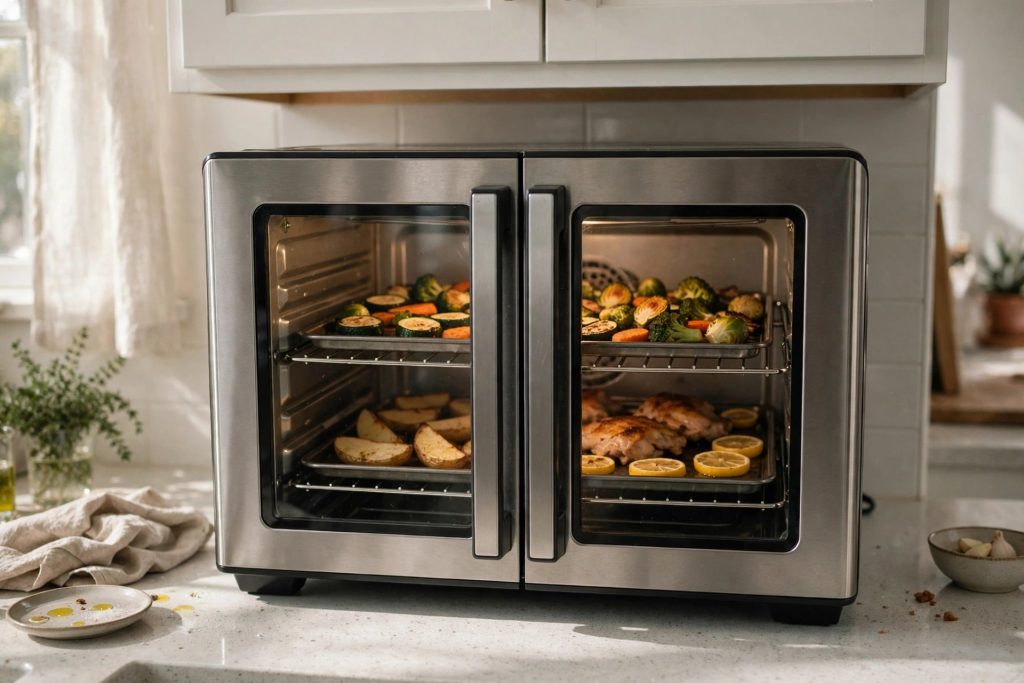
The Ninja DT201, the Foodi 10-in-1 XL Pro, passes the door test in a way I check for now before I read a single preset name. The doors close evenly. The seal feels like a seal. Inside, it is a big honest box: two cooking levels, true surround convection that actually moves air to the back corners, and enough width for the sheet-pan dinners this format exists for. Two levels is the real feature, by the way, not the ten functions. Ten functions is a menu. Two levels is a weeknight: protein up top, vegetables underneath, one machine, one timer argument instead of two.
The capacity number is doing quiet lying
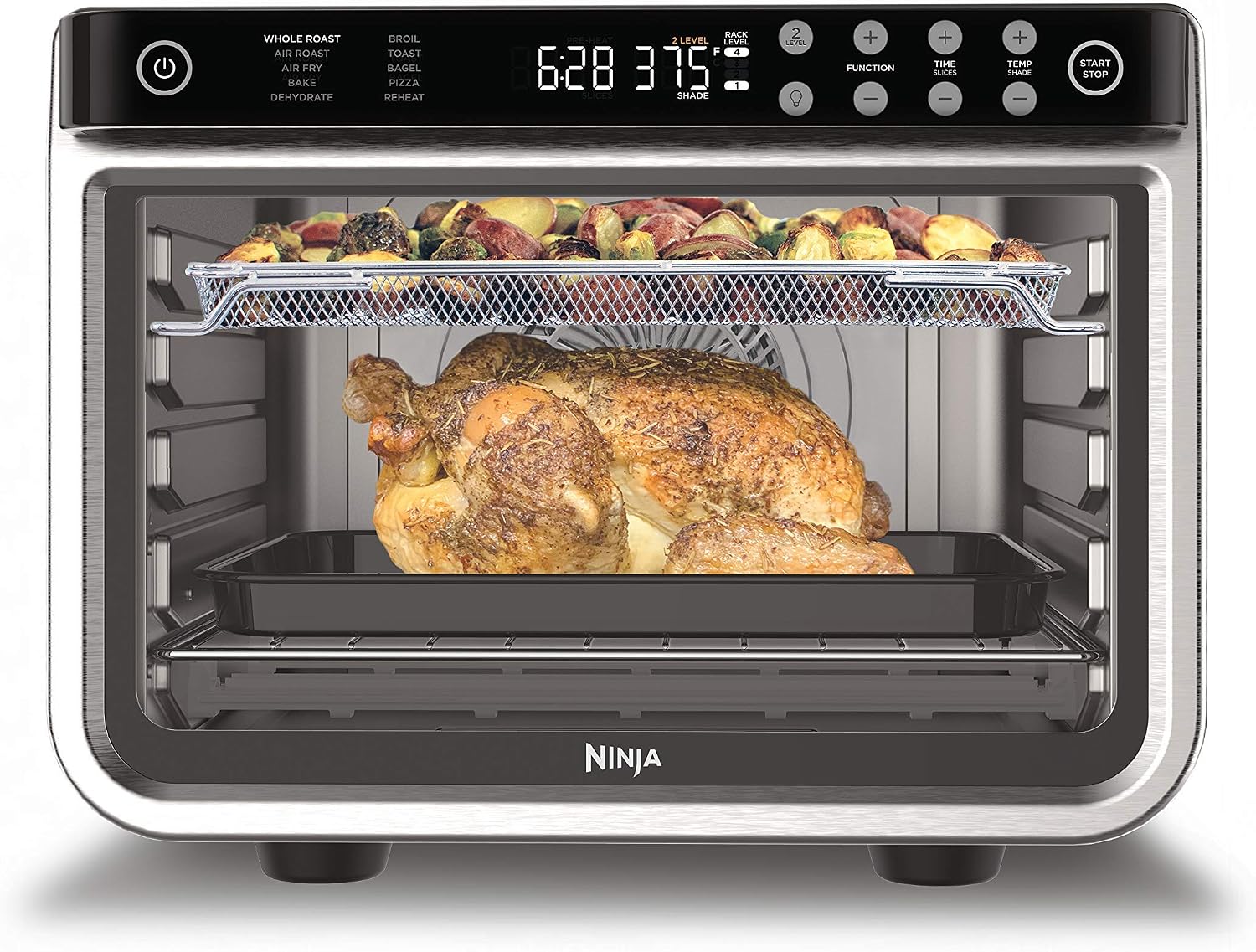
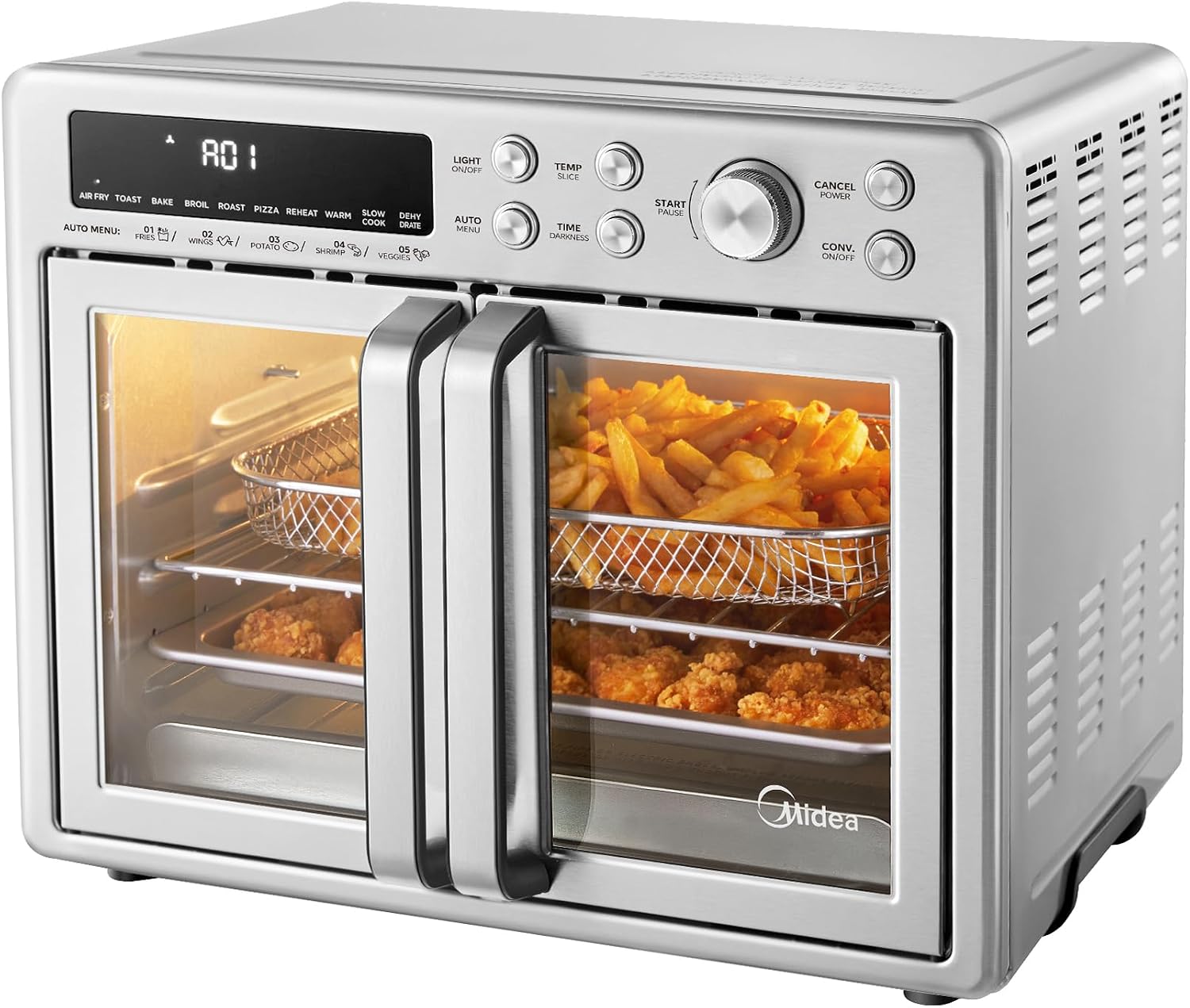
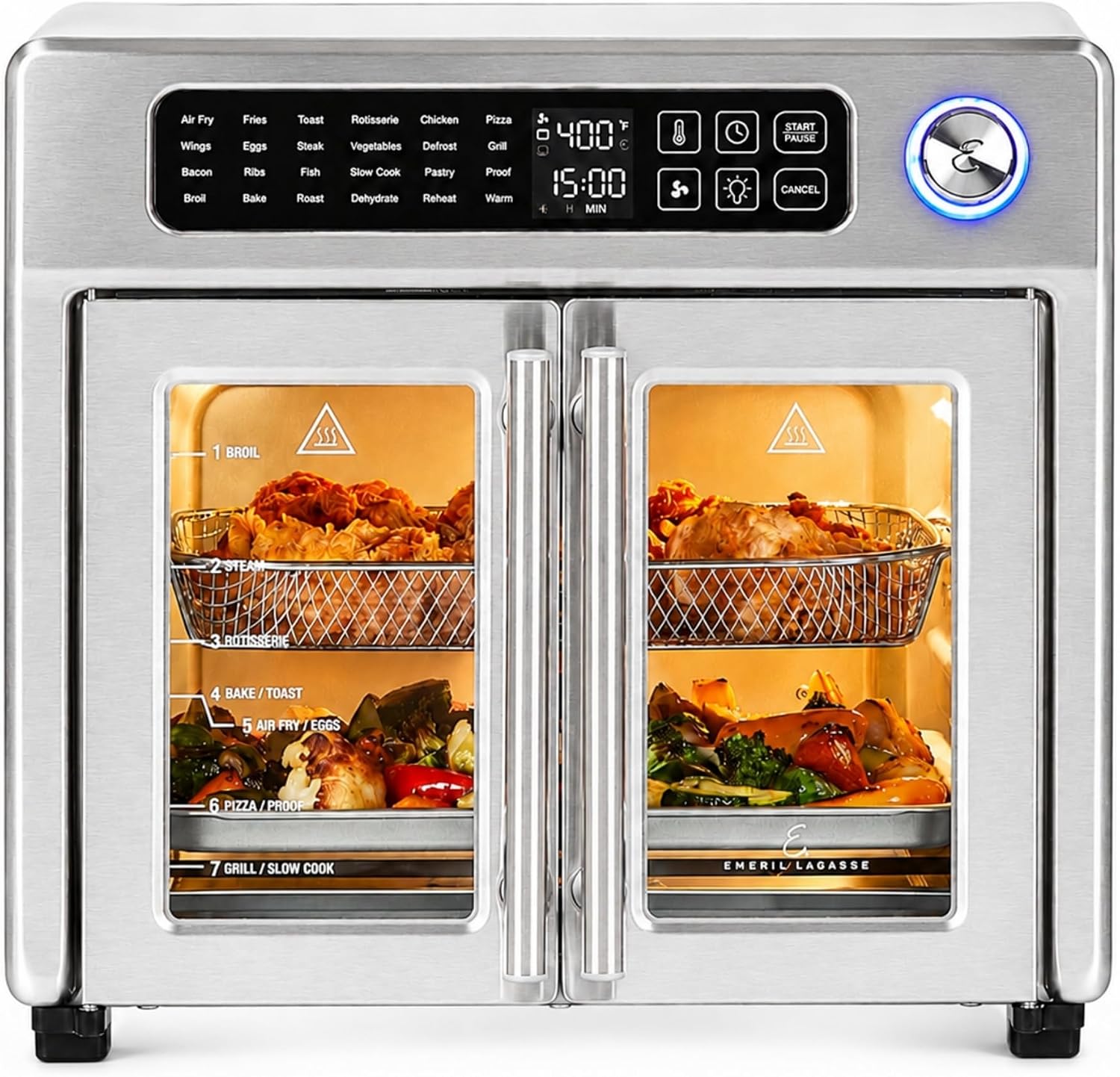
Twenty-six quarts, twenty-four quarts — the French-door category measures volume the way luggage does, generously and in a shape you cannot use. The usable truth of any of these ovens is the rack footprint and the height between levels, because food is flat and air needs room. A whole chicken fits in the Ninja in the sense that the door closes. Whether it cooks evenly without the top element tattooing the skin is another matter, and the honest answer is: lower rack, moderate temperature, patience. The Midea Flexify in the comparison box plays the same volume game with slightly faster preheat manners. The Emeril 360 counters with presets counted like television channels, twenty-four of them, of which any given household will use four. I have stopped reading preset counts entirely. I read rack dimensions and door hinges. It has made me much harder to sell to and much slower to return things.
Heat at the back corners is where this category separates, and it separates used from returned in my own history. The cheap version of surround convection is a fan and a hope. The Ninja’s air actually reaches the rear of the cavity, which you can test with the cruellest experiment in home baking: a tray of identical cookies, one batch, no rotating halfway. The back row browns like the front row. On my returned machine, the back row came out pale and the front row came out ambitious, and no recipe survives that for long. Cookies are not dinner, granted. But a machine that cannot treat a tray evenly will not treat your sheet-pan chicken evenly either, it will just hide it under sauce.
Cleaning, the tax nobody itemises
Every air fryer oven collects a fine mist of grease on its upper cavity, and the French-door layout adds a second collection point the brochures never photograph: the door glass, inside-facing, spattered in a pattern that tells the story of every fry you have made. The Ninja’s interior wipes down about as well as this category allows, which is to say adequately and resentfully. Crumb trays slide out. The rest is a damp cloth and a decision about how much you care. I care less than I used to. A machine can be slightly seasoned inside and perfectly functional, and the owners who return ovens over interior shine are often the same owners who never got past the fourth preset. Priorities reveal themselves in the return notes, mine included.
No, I am not being fair to the returned machine, and I should correct the record while I still remember it accurately. Its doors were the reason I sent it back, but its real crime was making me think about it. An oven should disappear into the cooking. The Ninja mostly does: it preheats while I chop, it holds two levels without sulking, and the doors, those doors, shut with a small final clunk that I have come to associate with dinner starting. The day I stop noticing the clunk is the day this machine has fully won, and I am not there yet, but the thermometer stays in the drawer now, which is its own kind of verdict.
The neighbours in this category are worth a look before deciding: the Gourmia dual-door air fryer oven 37 QT review and the Midea Neo combo air fryer toaster oven review both make the same door promises, and both deserve the same cookie test.
Questions people actually ask
French doors look great, but do they actually seal as well as a drop-down door?
On a well-made unit, yes, and on a badly made one, catastrophically no, and you can tell in the first week. The test is a tray of anything pale baked without rotating: even colour front to back means the seal and the airflow are doing their jobs. A door gap shows up as one pale side and one ambitious side, every time, on everything. This is why the door fit matters more than any preset list. If you buy one, run the test inside the return window, while the lesson is still free.
Do I need 26 quarts, or is that number inflated?
The number is real volume measured in a way that flatters. What you can use is rack footprint plus the clearance between the two levels, because food is flat and hot air needs space to move. A 26-quart French-door oven comfortably does sheet-pan dinners for four and two-level cooking for weeknights. It does not comfortably do a very large bird plus sides at once, whatever the photograph implies. Shop by the rack dimensions in the manual rather than the quart figure on the box, and the machine you receive will match the one you imagined.
Twenty-four presets on one model, ten functions on another. Does the count matter?
Almost never. Households settle into three or four modes: air fry, bake, roast, toast, and the rest become decoration on a dial. What separates these ovens in daily life is preheat speed, how evenly the back of the cavity cooks, and whether the doors seal. The Emeril’s long preset list and the Ninja’s shorter one converge in practice because dinner does not care about menus. Spend your attention on the tray test and the rack measurements. Presets are the sizzle; even heat is the steak.
It sits where the returned one sat, under a cabinet I measured twice, and it earns the spot on the nights when two levels mean one wash-up. There is a faint spatter constellation on the door glass that I have decided to call seasoning. Some Friday soon I will bake the cookie test again just to check it is still honest, not because I doubt it, but because a person who has returned an oven for its doors never entirely stops checking. The tray will tell me the truth. It always has.
This article contains affiliate links. If you buy through them, we may earn a commission at no extra cost to you.