Nobody returns a full-length mirror because it was too short. They return it because they had to shuffle sideways to see a whole outfit, or because the reflection quietly stretched them like a fairground gag. Height gets all the attention in listings. Width does the actual work.
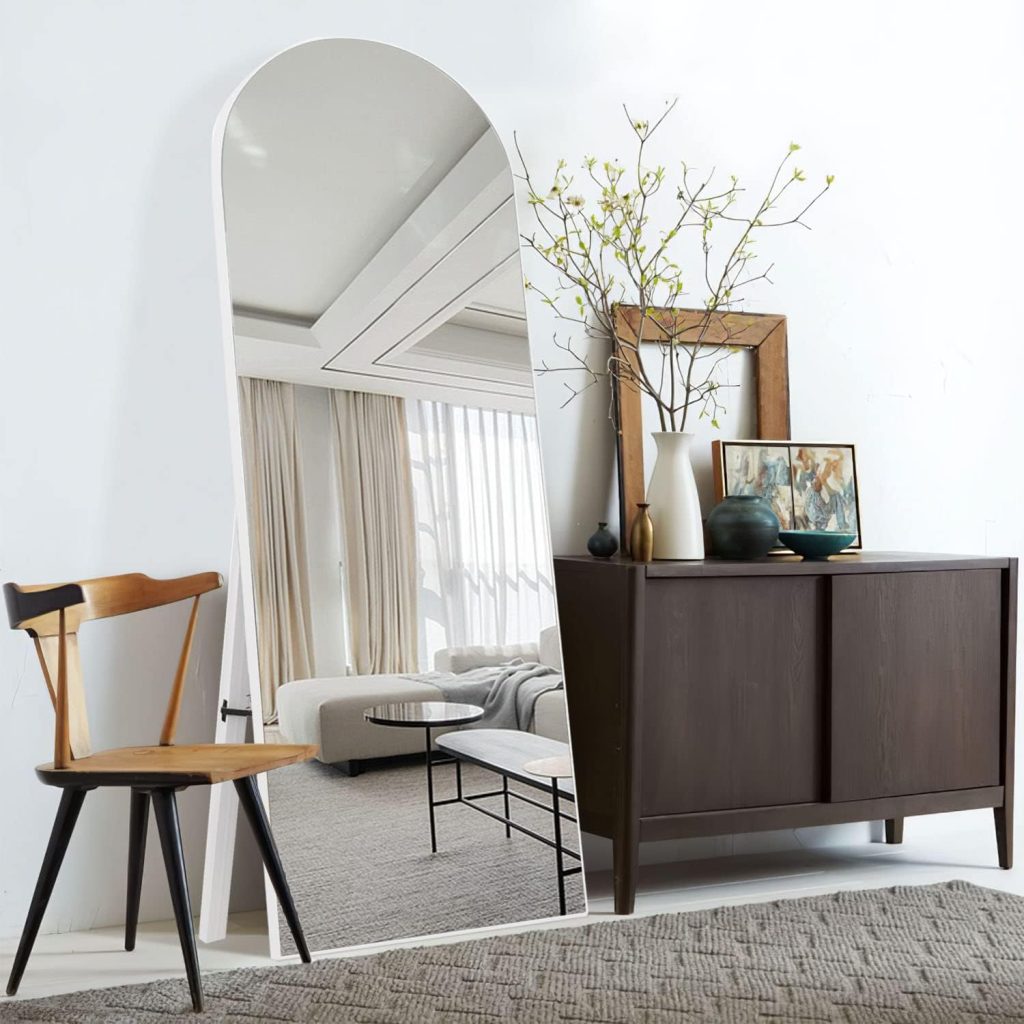
This guide anchors on the NeuType arched full-length mirror — a 65-by-22-inch arch in a thin white metal frame that can stand on its own bracket, lean against a wall, or hang — and uses it to work through the sizing maths most listings skip. Two very different arches keep the comparison honest: the oversized Otlsh 76-by-34-inch in black, built like a statement piece, and the narrow Delma arched mirror, built for corners where width is the one thing you don’t have.
Quick Answer
Buy for width first. A mirror in the low-twenties of inches wide, like the NeuType, gives most people a complete outfit view at a normal bedroom step-back distance, and its stand-lean-or-hang flexibility suits renters and owners alike. Go oversized if two people get ready side by side or the mirror doubles as a light-bouncing focal point. Go narrow only when the floor plan leaves no other choice — and know you’re accepting a cropped, one-person-at-a-time view.
Compare Top Full-Length Mirrors
Three proven picks side by side — choose the one that fits your needs.
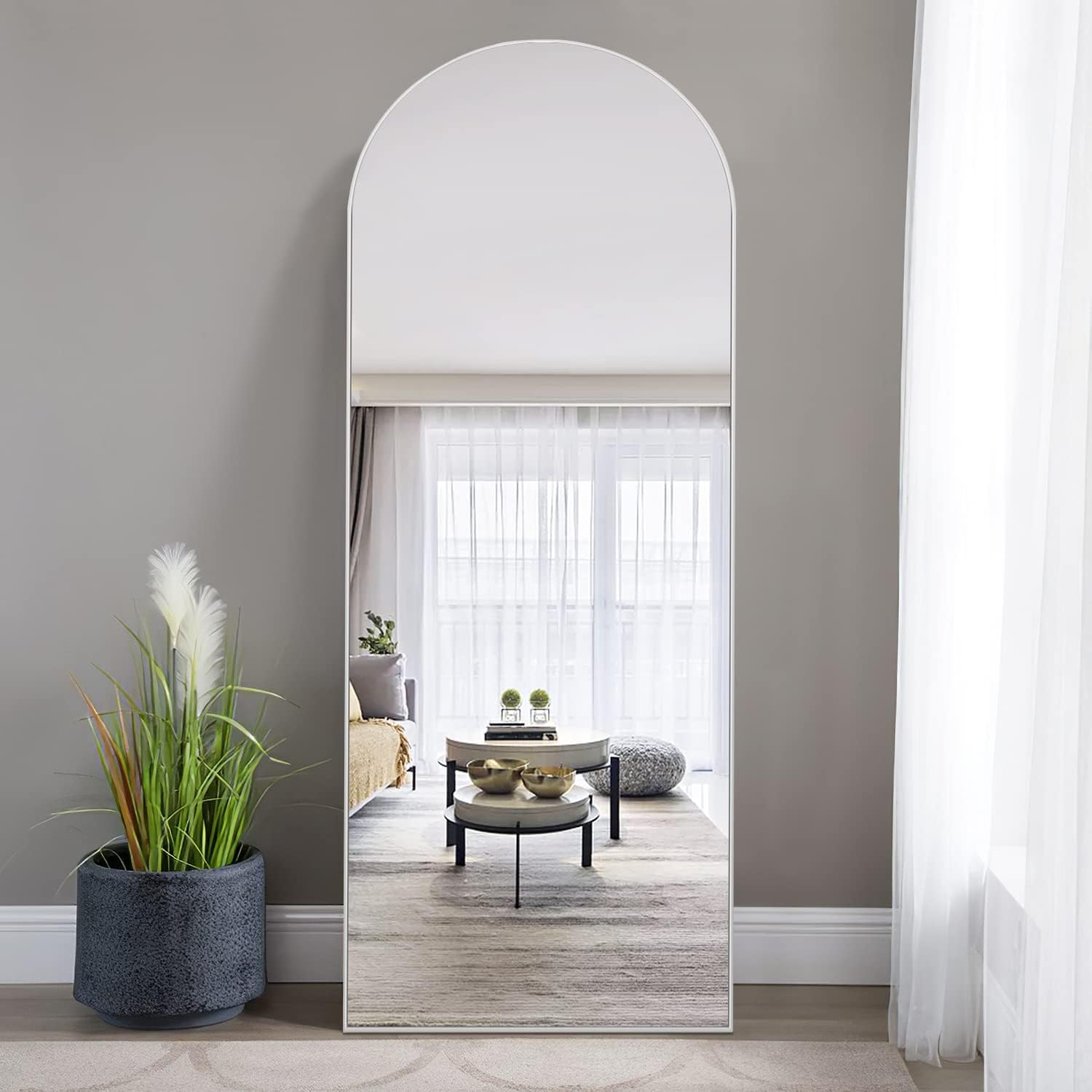
NeuType Arched Full-Length Mirror 65″x22″
Thin white metal frame that stands, leans or hangs — the balanced all-rounder for most bedrooms.
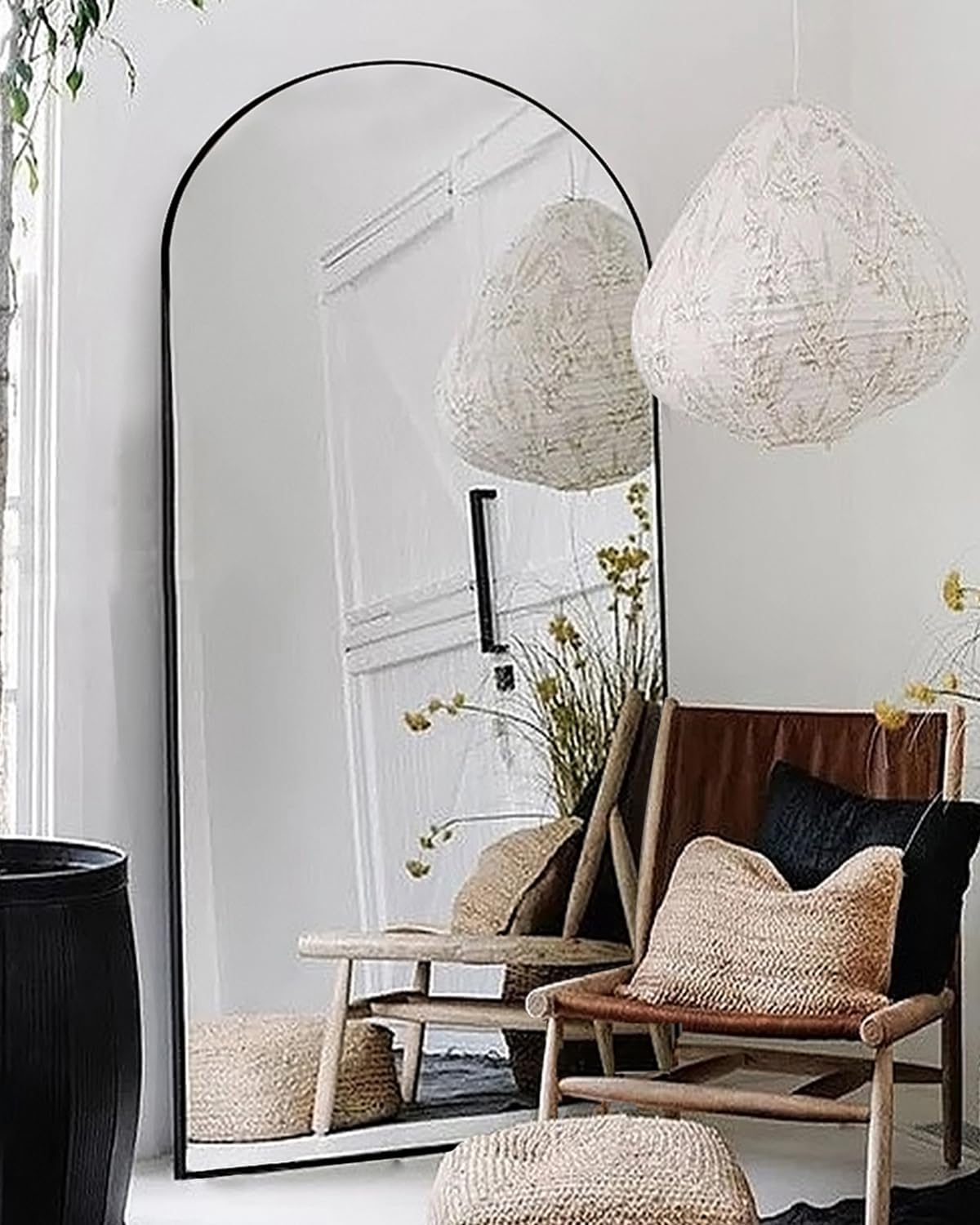
Otlsh Oversized Arched Floor Mirror 76″x34″
Oversized black aluminum arch — two people share the view and dark rooms borrow serious light.
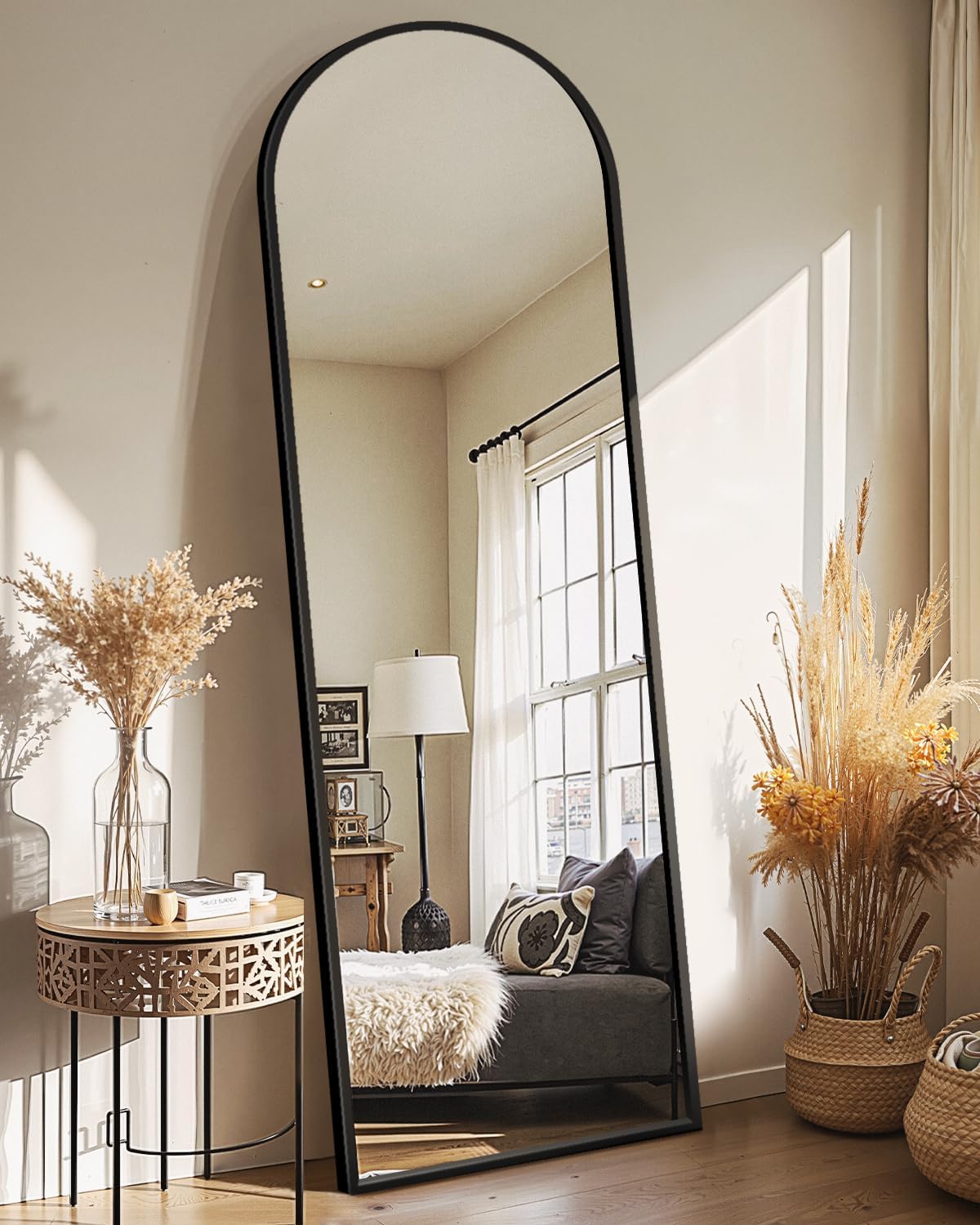
Delma Arched Full-Length Mirror with Stand
Narrow black arch for tight corners and small entryways where a wide mirror simply won’t fit.
Prices and availability may vary — tap any product to check the current listing.
What to Look For in a Full-Length Mirror
Six things decide whether a full length mirror becomes furniture or a return label. None of them is the word “oversized” in a listing title.
1. Width decides what gets cropped
An outfit is wider than it is tall in the ways that matter. Shoulders, hips, a handbag on one arm, elbows out while you fasten something — the reflection needs horizontal room, and it needs it at the distance your room actually gives you. Stand a few feet back in an average bedroom and a mirror in the mid-teens of inches wide starts trimming your sides. Move into the low twenties and the whole silhouette fits, with margin.
Width also decides how much light the mirror gathers. A wider sheet of glass facing a window pulls more daylight into the room’s dark half, which is half the reason people buy these things. The trade-off is blunt: wider glass is heavier glass. It ships in a bigger box, needs two hands and more care to move, and on a small wall it stops being an accent and becomes the wall.
2. The step-back rule — why half your height is enough
Here’s the optics nobody puts in the listing. A vertical mirror only needs to span about half your height to show your whole body, as long as it’s positioned at the right height and you can step back a little. Your eyes do the rest. That’s why a 65-inch mirror serves tall adults comfortably — it clears the half-height bar with room to spare.
But the rule has a catch, and the catch is your bedroom. Step-back distance is what makes the geometry generous. A room where the bed edge leaves you two feet of standing space shrinks the effective view, and no amount of extra mirror height buys it back. In tight rooms, width compensates for distance. In spacious rooms, almost anything works — which is why showroom impressions lie.
3. Lean, stand, or hang — the angle rewrites your proportions
A leaning mirror tilts its top away from you, and that tilt quietly re-draws your proportions: legs lengthen a touch, the head and shoulders compress. Flattering? Sometimes. Honest? Not quite. A stand holds the glass near vertical and gives you the truer read, though the bracket eats floor depth behind the mirror that small rooms notice. Hanging is the most honest angle of all and frees the floor completely — but the weight has to go somewhere, and oversized glass hung on undersized anchors is a gamble with a predictable ending.
The NeuType’s real advantage sits here: it does all three, so the mirror can lean in a rental, stand in a bedroom, and hang later in a house you own. The Delma leans and stands. The Otlsh, at its size, is happiest freestanding where its footprint is planned rather than improvised.
4. The arch tax
An arch is a decor decision that charges you in glass. Those curved shoulders remove reflective area from the top corners, so at identical outer dimensions a rectangle simply shows more — more of you, more of the room behind you. In exchange, the arch softens a boxy bedroom, echoes arched doorways and windows, and reads as a piece of furniture instead of a gym fixture.
Pay the tax gladly in a bedroom or entryway, where the mirror is part of the room’s look. Refuse it in a workout space, where you’re checking squat form and the corners are data. Shape is the one choice you can’t adjust later, so it’s worth deciding what the mirror is for before falling for a silhouette.
5. Glass that doesn’t lie
Distortion is the complaint that sounds like vanity and isn’t. Thin glass, or glass flexed slightly against its backing, bends straight lines — and your eye reads a bending door frame as a bending body. The check takes ten seconds: slide a straight edge, a door frame or shelf line, slowly across the reflection and watch it. A line that waves is a mirror you’ll distrust every morning.
Floor mirrors also live in traffic. They get bumped by vacuum cleaners, laundry baskets, children, dogs with opinions. A safety backing that holds the sheet together if the worst happens is worth weighting heavily in a busy household — and honest, flatter glass tends to be thicker and heavier, which loops back to stands and anchors having to do real work.
6. Frame, weight, and the doorway problem
Thin metal frames, like the aluminum and alloy frames on all three mirrors here, keep weight manageable and shrug off steamy rooms better than raw timber would. The frame’s second job is edge protection, and there’s the trade-off: a slim frame guards the face, not the corners, and corners are where mirrors chip — usually against a door frame, mid-move.
So measure the journey, not just the wall. A 76-inch-class mirror like the Otlsh needs door clearances, a stair turn or elevator that accepts it, and two people at the receiving end. The mid-size NeuType class is a one-person carry for most adults. The narrow Delma threads through the tightest hallways of the three — one of the few genuine advantages of going small.
Matching a Full-Length Mirror to Your Situation
The solo outfit-checker. One person, one bedroom, a bed eating most of the floor. This is the NeuType’s home turf: low-twenties width at a short step-back, stand mode so the angle stays honest, and a white frame that disappears against light walls. Pair it with decent side light rather than a ceiling spot — the height rules in our ceramic table lamp guide apply to mirrors too, because a lamp at the right height flatters a reflection more honestly than overhead light does. The limitation to accept: one person at a time. A partner squeezing in means elbows out of frame.
The entryway squeeze. Hallways and entries offer slivers of wall between doors, and that’s where the narrow Delma earns its keep — leaned or stood beside a narrow console table with drawer storage underneath, catching a last coat-and-shoes check on the way out. Entryway checks are quick and mostly frontal, so the width crop barely registers. What does register is the light: a mirror by the front door bounces hallway brightness into rooms that have none. Just don’t ask this mirror to judge a full outfit with a bag in each hand. It will crop the bags, and possibly a shoulder.
The shared dressing room, the statement wall. Two people getting ready at once changes the maths entirely — now width is doing double duty, and the Otlsh’s 76-by-34 frame is the only one of the three where two adults can stand shoulder to shoulder and both stay in the glass. It also behaves like a second window in a living room. The cost is commitment: this size needs its spot chosen in advance, its delivery path measured, and a wall that can carry the visual weight. In a small room it doesn’t look generous. It looks like the room’s landlord.
Full-Length Mirror Types Compared
| Type / Tier | Best For | Price Tier | Key Feature | Watch-Out |
|---|---|---|---|---|
| Narrow leaning arch (Delma class) | Tight corners, small entryways | Budget | Slim footprint, stand included | Crops wide outfits; one person at a time |
| Mid-size arched with stand (NeuType class) | Most bedrooms | Mid-range | Stand, lean, or hang in one design | Arch corners give up some reflective area |
| Oversized arched (Otlsh class) | Shared dressing, statement walls | Premium | Two-person width, serious light bounce | Needs floor space, two-person move, door clearance |
| Wall-mounted rectangle | Workout spaces, form checks | Mid-range | Largest honest reflection per inch | No floor option; mounting is semi-permanent |
The narrow tier is a compromise you make with your floor plan, not a preference — it works because entryways ask little of it. The mid-size arched tier is where most bedrooms land, and it’s the tier the NeuType represents: enough width, three mounting moods, no delivery drama. The oversized tier stops being a mirror and becomes architecture, which is wonderful in the right room and faintly absurd in the wrong one. And the rectangle remains the quiet professional — no arch tax, no romance, just the most reflection per inch if you can commit to a wall.
Three Rooms, Three Different Answers
The bedroom dressing corner
Bedrooms give you the least step-back and the most daily use, so placement beats size here. Put the mirror on the wall that gets side light from a window, not the wall backing the window — a mirror facing away from the light turns every outfit check into a silhouette. Stand mode helps in rentals of the room layout: a slight repositioning costs nothing, while a hung mirror commits you to the first wall you chose. The NeuType’s bracket was clearly designed by someone who has rented.
The entryway, over or beside a console
The classic pairing exists because it works. A mirror above or beside a console catches keys-down, coat-on, one-last-look in a single motion, and it doubles the light in the one part of the home that rarely has a window. Keep the mirror’s bottom edge clear of the console’s daily clutter — chargers and post creep upward — and remember that entryway mirrors reflect the front door’s chaos as faithfully as they reflect you. Tidy what it faces.
The living room, opposite a window
This is the oversized mirror’s party trick: park an Otlsh-class arch opposite a window and the room gains a second, softer source of daylight that reaches the seating instead of dying at the glass. Angle it toward a small velvet loveseat or reading chair and the light lands where people actually sit. Two cautions. A mirror opposite the television adds glare and a second, distracting picture. And it will double whatever disorder lives in its sightline — the reflection of a cluttered room is just clutter, framed.
Common Mistakes When Buying a Full-Length Mirror
Shopping by height alone. A tall, narrow mirror photographs beautifully and performs like a slot. Height past the half-your-height threshold adds almost nothing; width adds the outfit. Check the second number in the dimensions first.
Leaning it and trusting friction. On polished wood or tile, a leaning mirror creeps — millimetres a week, until the day it doesn’t creep, it slides. Grip pads, the stand bracket, or a safety strap to a stud. Pick one. A slow slide ends in a chipped corner or worse, and it never happens while you’re watching.
Hanging heavy glass on hardware meant for pictures. Mirrors in this class weigh like furniture, because they are furniture. Small picture hooks and a hope are not a mounting strategy. Match anchors to the full weight, find a stud where you can, and let the oversized class stay on the floor if the wall won’t cooperate.
Judging it in the wrong light, then blaming the glass. A mirror checked once, at noon, facing a bright window, will look harsh forever in your memory — backlit reflections always do. Live with it through a morning and an evening before deciding it’s distorted. Half of “this mirror makes me look awful” is lighting wearing a disguise.
Why, How, What
Why does a leaning mirror change how tall I look? Because tilt changes geometry. Lean the top away and the reflection’s vertical scale shifts unevenly — the lower body stretches fractionally, the upper body compresses. It’s the same reason shop mirrors are often set at a sly angle. A stand or a wall mount restores the vertical, and with it, the truth.
How do I check a mirror for distortion before keeping it? Use the straight-line test: a door frame, a shelf edge, the line of a window. Move it slowly across the glass at your normal standing distance and watch for waviness, especially near the edges where cheap glass gives itself away. Do it on day one, while the box is still in the hallway and an exchange is painless.
What size do I need if I can’t step back? Bigger than the half-height rule suggests — because that rule assumes distance you don’t have. In a tight room, spend on width before height: a low-twenties-inch-wide mirror at close range shows more of you than a taller, narrower one. If the wall genuinely can’t take width, hang the mirror so its position, not its size, does the compensating.
Questions People Ask Before Buying
Is an arched full-length mirror worth it over a plain rectangle?
An arched full-length mirror is worth it when the mirror doubles as decor in a bedroom or entryway, because the curved top softens boxy rooms and reads as furniture, but a rectangle quietly wins on pure function since it keeps the reflective corners an arch gives away. That lost corner glass sounds minor until you dress in front of it daily — the arch narrows exactly where your shoulders and the top of your head want to be. Pick the arch for rooms people see. Pick the rectangle for workout corners and form checks, where the reflection is a tool, not a picture frame.
How wide does a full-length mirror need to be to see my whole body?
For a single person checking outfits at a normal bedroom step-back distance, a full-length mirror roughly in the low-to-mid twenty-inch width range keeps shoulders, hips, and elbows inside the reflection, while noticeably narrower mirrors crop the sides unless you shuffle further back. Width works together with distance: step back and a narrow mirror shows more of you, stand close and even a wide one crops. Bedrooms rarely offer much step-back — the bed sees to that — which is why a mid-twenties width like the NeuType’s tends to feel generous while a mid-teens width feels like a slot.
Is a 65-inch mirror tall enough for someone tall?
Yes, a 65-inch full-length mirror is tall enough for most tall adults when it stands near vertical and you can step back a few feet, because a vertical mirror only needs to span about half your height, correctly positioned, to return a full-body reflection. The positioning clause does the heavy lifting. The glass has to sit at the right height relative to your eyes, and leaning the mirror back eats into that allowance, which is why a tall mirror on a stand can outperform a taller one leaned carelessly. If your room forces you to stand close, extra height stops helping and extra width starts.
Should I lean my floor mirror against the wall or use the stand?
Use the stand if the mirror will live in one spot, because a near-vertical angle gives the most honest proportions and cannot slowly slide, while leaning suits renters and quick room refreshes provided the base sits on grip, not bare polished floor, and the top rests securely. A lean is never fully still. It settles, gets bumped by the vacuum, settles again — and each small shift changes both the angle and your proportions in the glass. The stand removes that whole category of drift, at the cost of a deeper footprint behind the mirror that tight rooms feel immediately.
Why does my new mirror make me look wider or stretched?
A new mirror usually makes you look wider or stretched because of angle and glass flatness rather than your body changing overnight: a leaning tilt shifts proportions, and thin or slightly flexed glass bends straight lines, which your eye reads as a changed shape. Test it before you blame the mirror — or yourself. Slide a straight door frame or shelf edge slowly across the glass and watch whether the line stays straight; if it waves, the glass is the problem and an exchange is reasonable. If the line holds, adjust the tilt first, since a few degrees of lean is the cheapest fix in this whole category.
Frequently Asked Questions
How far should I stand from a full-length mirror?
A few feet back is the working distance most bedrooms allow, and it is enough for a mid-width mirror to show a full outfit. Standing closer fills more of the glass with less of you, so if the reflection crops your shoulders, the fix is usually distance or width — not a taller mirror. Judge any new mirror from the exact spot you will actually dress in.
Can a full-length mirror work in a very small bedroom?
Yes, if you treat it like wall art rather than furniture. Hang it, or stand it in the one corner the door swing leaves free, and accept a narrower width class as the price of the floor plan. Small rooms also benefit most from the light a mirror bounces, so the piece earns its wall space twice — once as a dressing tool, once as the brightest thing in the room.
Do arched mirrors distort the reflection more than rectangles?
No — the outline shape does not bend light. Distortion comes from glass that is too thin or slightly flexed against its backing, and that can happen in any shape at any price tier. What an arch genuinely costs you is reflective area in the top corners. Judge a mirror by the straight-line test, not by whether its top is curved or square.
How do I stop a leaning mirror from sliding?
Give the base something to grip: rubber pads or a thin grip mat under the frame, especially on tile or polished wood. Then take the slow creep out of the equation with the stand bracket if the design has one, or a discreet safety strap from the frame to a wall stud. Check the setup after the first week — most slides announce themselves early, in millimetres.
Can I hang a floor mirror that comes with a stand?
Often yes. Designs like the NeuType are built to stand, lean, or hang, with the bracket removed or folded for wall use. Use anchors matched to the mirror’s full weight and aim for a stud where the layout allows — oversized glass on small picture hooks is the one shortcut this category punishes. If the listing only promises standing and leaning, believe it and keep the mirror off the wall.
How do I clean a big floor mirror without streaks?
Mist the cloth, not the glass — liquid sprayed directly on a large mirror runs down into the frame edge and leaves tide marks. Work in a slow S-pattern with a microfiber cloth, then buff once more with the dry side. Keep ammonia-heavy cleaners away from the frame finish, and never soak the bottom edge, where moisture does its quiet damage over time.
Final Recommendation
For most people reading this, the answer is the mid-size class and the NeuType specifically: 65 by 22 inches is wide enough for a real outfit check at bedroom distance, tall enough for tall adults, and the stand-lean-hang flexibility means it survives a change of rooms or a change of address. It’s the mirror with the fewest ways to regret it.
Choose the Otlsh instead if two people share the mirror or a dark living room needs the light — size is its whole argument, and in the right room the argument wins. Choose the Delma if a narrow corner is genuinely all you have; a cropped mirror in the right spot beats a wide one blocking a door. And if the mirror’s job is honest form-checking rather than dressing, skip arches entirely and mount a rectangle.
Decision Tree: Which Full-Length Mirror Fits You?
One person, normal bedroom, step-back limited by the bed? → NeuType mid-size arch, on its stand.
Two people getting ready together, or a dark room that needs light? → Otlsh oversized arch, freestanding, spot chosen in advance.
Only a narrow corner or entry sliver available? → Delma narrow arch, and accept the one-person crop.
Workout checks where accuracy beats looks? → Wall-mounted rectangle, no arch tax.
Key Takeaways
Width, not height, decides whether a full-length mirror shows a whole outfit — shop the second dimension first.
A vertical mirror needs only about half your height to show your full body, but only when it’s positioned well and you can step back; tight rooms should buy width instead.
Leaning changes your proportions in the glass and risks a slow slide; stands and wall mounts give the honest angle.
Arches trade reflective corners for looks. Worth it in bedrooms and entryways, wasteful in workout corners.
Compare Top Full-Length Mirrors
Three proven picks side by side — choose the one that fits your needs.
NeuType Arched Full-Length Mirror 65″x22″
Thin white metal frame that stands, leans or hangs — the balanced all-rounder for most bedrooms.
Otlsh Oversized Arched Floor Mirror 76″x34″
Oversized black aluminum arch — two people share the view and dark rooms borrow serious light.
Delma Arched Full-Length Mirror with Stand
Narrow black arch for tight corners and small entryways where a wide mirror simply won’t fit.
Prices and availability may vary — tap any product to check the current listing.