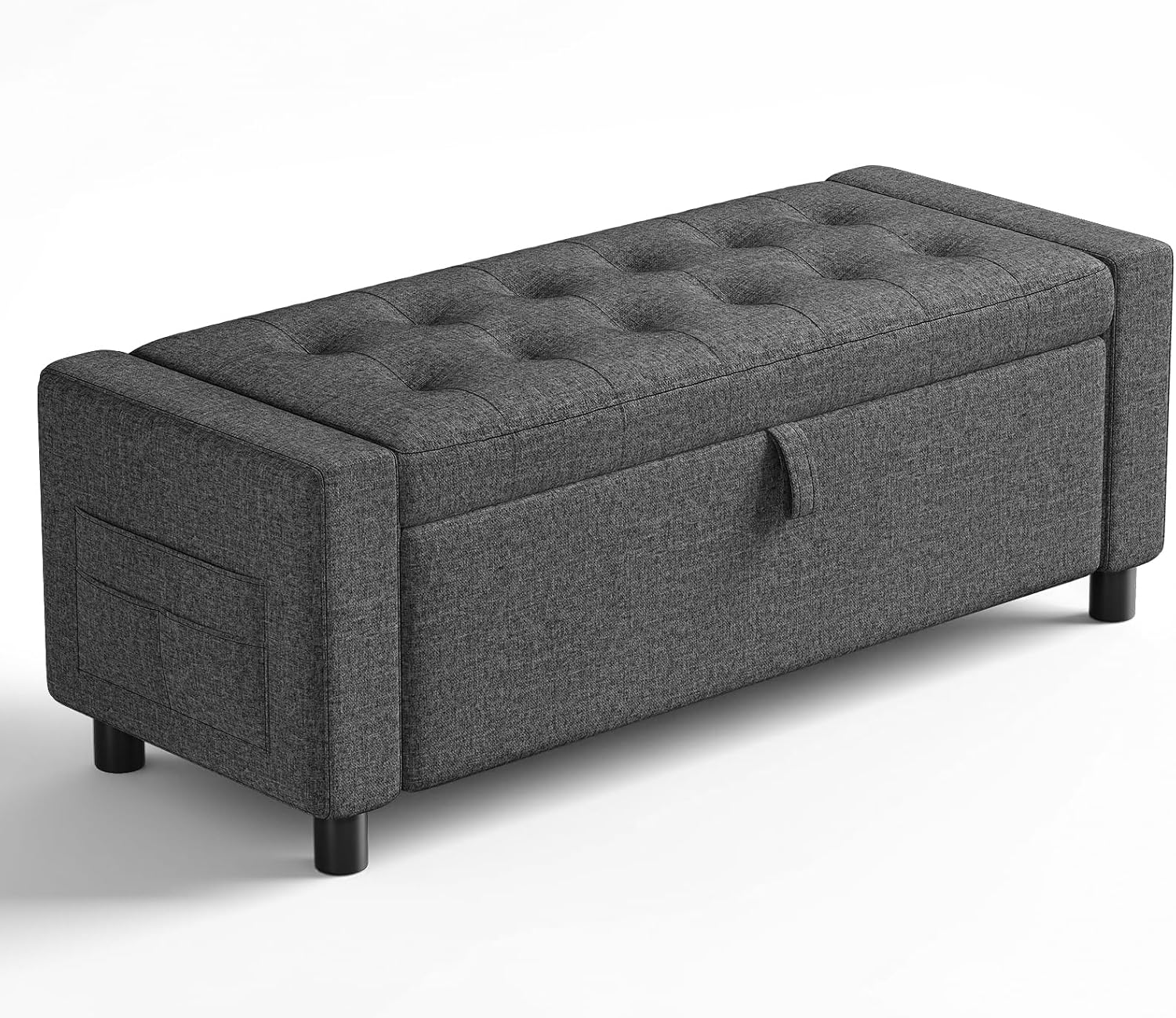
A storage ottoman is the rare piece of furniture that earns its floor space three ways at once: extra seat, footrest, and a hiding spot for the stuff you don’t want to look at. This guide centers on the Amada 46-inch storage ottoman bench — the mid-size dark-gray workhorse with a safety hinge and a side pocket — but the buying logic here applies to every storage ottoman worth your money. Deciding between a bench, a cube, or skipping the category entirely? Start here.
Quick Answer
A storage ottoman is worth it when you have one cluttered room and zero spare closet space. The Amada 46-inch bench is the safest default pick — long enough to sit at the foot of a queen bed, a hinged lid that won’t slam on fingers, and a side pocket for the remote you’re always losing. Skip it if you need daily seating for three adults. It’s built for two sitters, not a crowd.
Compare Top Storage Ottomans
Three proven picks side by side — choose the one that fits your needs.
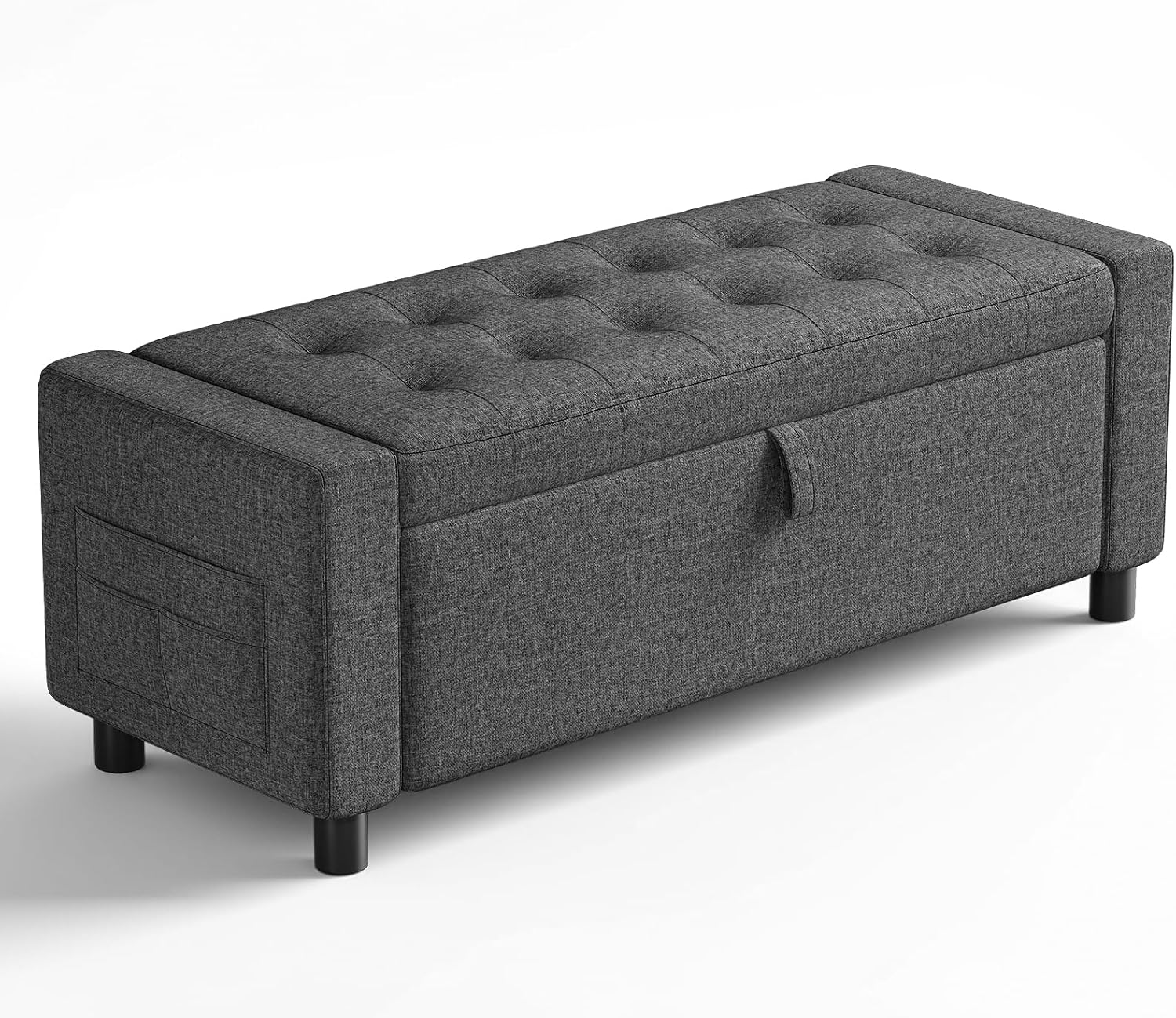
Amada 46″ Storage Ottoman Bench
Safety hinge + side pocket — the family-friendly workhorse.
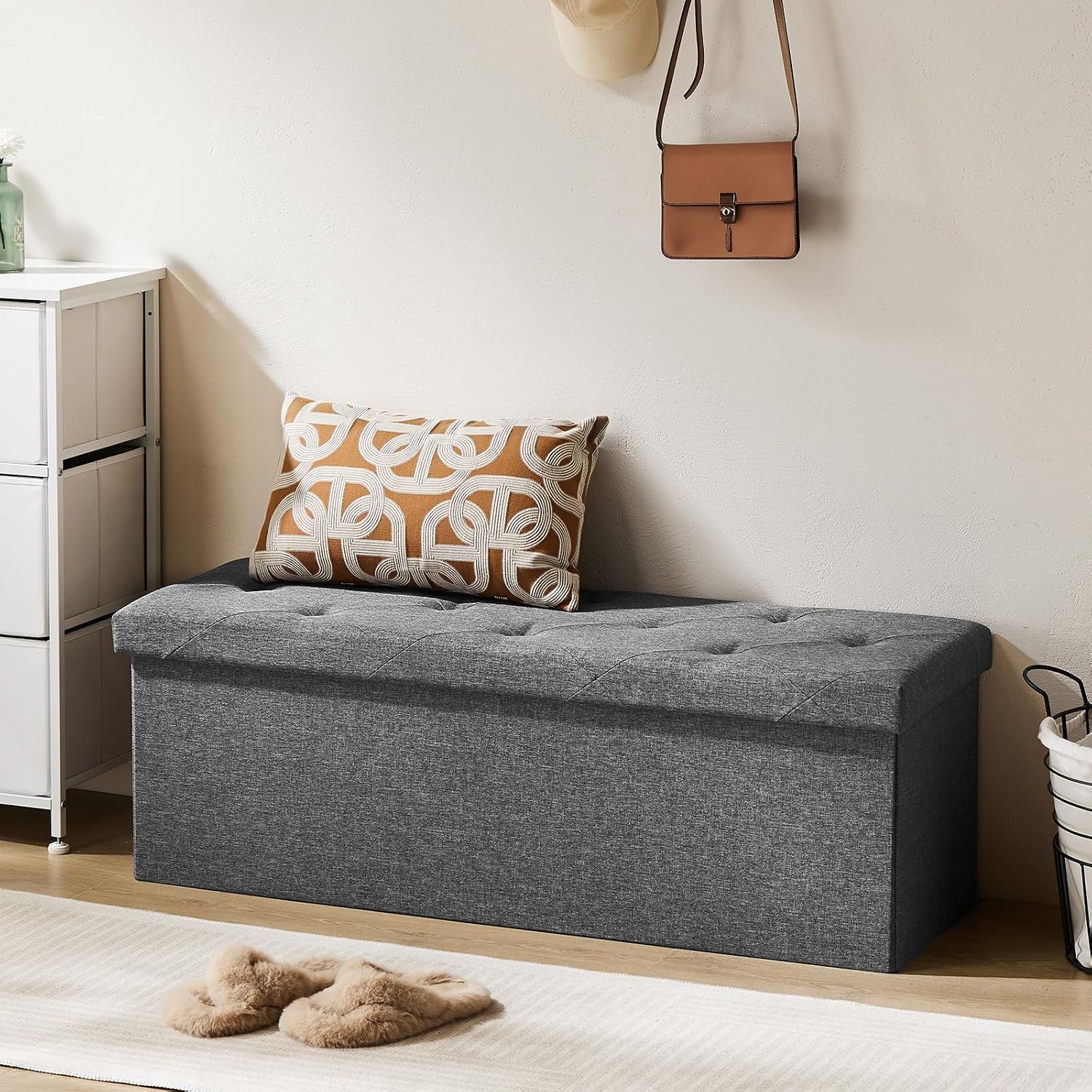
DUMOS 43″ Folding Storage Ottoman
Folds flat when you don’t need it — best for renters and tight closets.
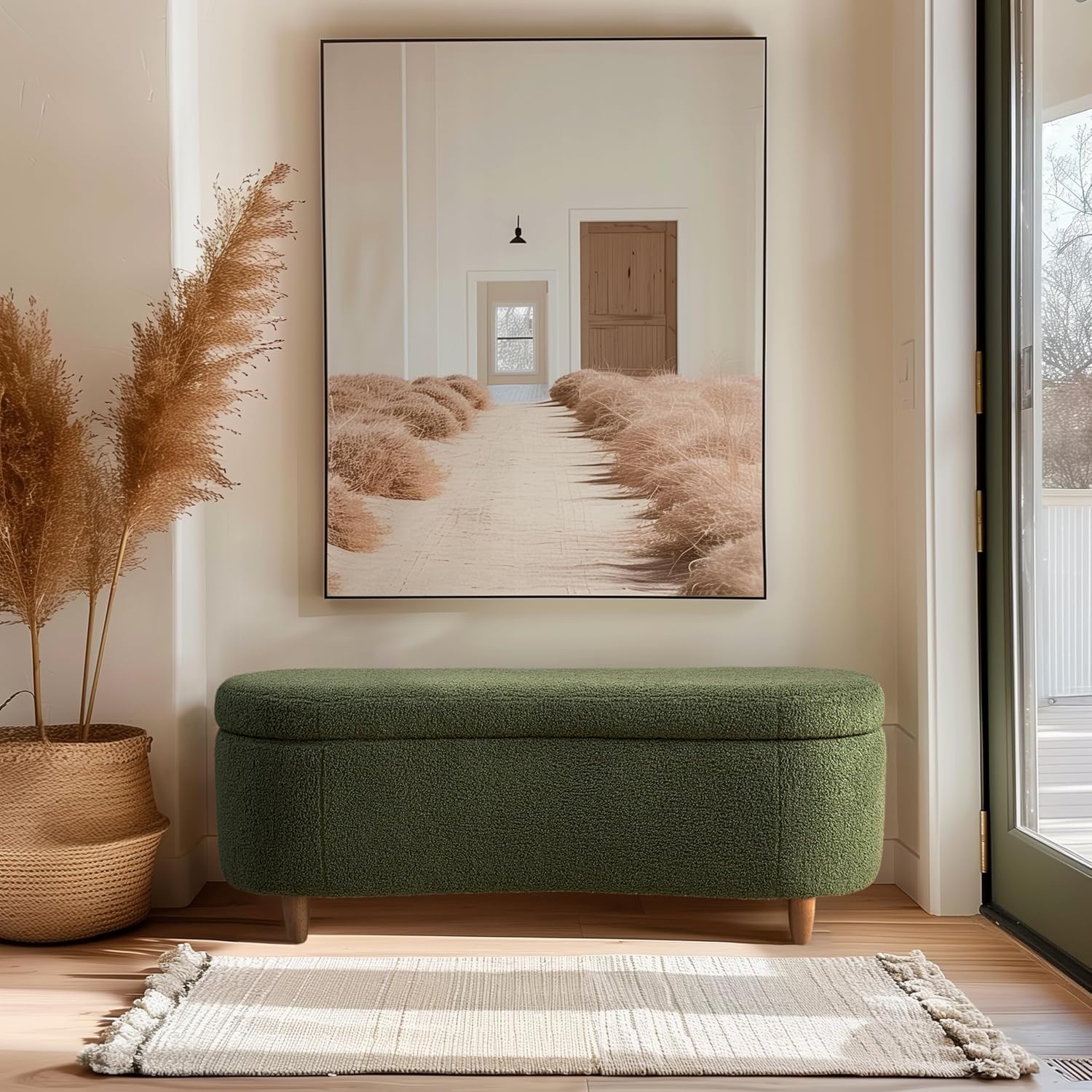
Bailey Boucle Curved Storage Bench
Sculptural accent piece that hides clutter in plain sight.
Prices and availability may vary — tap any product to check the current listing.
What to Look For Before You Buy a Storage Ottoman
Honestly, most people shop storage ottomans backwards. They pick the prettiest one, then discover the lid slams, the fabric pills, or it wobbles under a teenager. Six things actually matter — in this order.
1. Footprint vs. the room you have
A 46-inch bench sounds “medium” until it’s wedged between your bed and the wall. Measure the spot first — then subtract two inches on each side for walking clearance. That’s the real rule. For the foot of a queen bed, 43–48 inches lands in the sweet spot; anything shorter looks lost, anything longer eats the walkway.
Small cube ottomans (around 15–17 inches square) suit single-chair footrests. Benches suit rooms, not chairs. Pick the wrong scale and the piece fights the room forever.
2. The lid mechanism — this is where cheap goes wrong
Two lid styles exist: lift-off tops and hinged lids. Lift-off tops give you full access to the compartment, but you need somewhere to put the lid while you dig around. Hinged lids stay attached, which sounds better — until a basic hinge snaps shut on fingers.
Look, this is the one feature I’d pay extra for. A safety or soft-close hinge holds the lid open at any angle and closes gently. Kids, pets, tired adults at midnight — they all benefit. The Amada bench’s safety hinge is exactly this kind of hinge, and it’s the main reason it’s the default pick here.
3. Weight capacity you can trust, not the number on the box
Listings throw around big load numbers. What matters is the frame construction underneath: solid wood frames and reinforced corners hold up; thin particleboard sides with a fabric shell flex and eventually crack at the joints. If two adults will sit on it daily, favor benches with legs and a rigid internal frame over fold-flat designs. Fold-flat ottomans are brilliant for occasional use and terrible as your everyday dining bench. Different jobs.
4. Fabric that survives real life
Linen-look polyester is the category standard for a reason — it resists stains better than cotton and costs less than performance weaves. Velvet and boucle look richer but show wear faster in high-traffic spots. Dark gray, like the Amada bench, hides dust and pet hair better than beige or white. A light-colored ottoman in a house with a dog? You’ll be lint-rolling it weekly. Choose with your actual household, not the listing photos.
5. How deep the storage really is
Marketing photos show neatly folded throws. Real life throws in board games, spare bedding, and a tangle of charging cables. A bench-depth compartment (roughly 12–15 inches deep) swallows folded blankets; shallow cubes barely hold magazines. Some benches add dividers or side pockets — the Amada’s side pocket, for instance, is where the remote and the book you’re reading actually live, instead of under the cushions. Small thing. Big daily difference.
6. Seat height and leg design
A bench that doubles as seating should sit around 17–19 inches high — standard chair height. Lower cubes (13–15 inches) work as footrests but feel like sitting on the floor for adults. Wooden legs look better and lift the piece off the floor for robot vacuums; legless folding designs sit flush and trap dust underneath. And yes — if your vacuum can’t get under it, you’ll be moving it every time you clean. Ask me how I know.
Which Storage Ottoman Fits Your Room?
Three buyers, three right answers. See which one is you.
The end-of-bed buyer
You want somewhere to sit while putting on shoes, plus a place for the throw blankets that currently live in a pile on the floor. A 43–48 inch bench is your shape — it visually anchors the bed and the compartment handles off-season bedding. The Amada 46-inch was practically designed for this job: bench-length, neutral dark gray that doesn’t clash with bedding, and a lid you can open one-handed while holding a laundry basket. Just confirm your bed frame height — the bench should sit a couple of inches below the mattress top, not tower over it.
The entryway drop-zone buyer
Shoes, bags, the dog leash, mail you swear you’ll sort tonight. You need seating for pulling on boots plus fast-access storage. A folding bench like the DUMOS 43-inch earns its keep here: full-length storage for gloves and scarves, sturdy enough for daily sit-downs, and it collapses flat if you move or redecorate. Trade-off? Folding frames flex a little more than rigid ones, so it’s a sit-while-you-tie-shoes piece, not a guest-room extra bed.
The living-room declutter buyer
Your coffee table is drowning in remotes, coasters, and the game controllers nobody admits to owning. Here a storage ottoman replaces or supplements the coffee table entirely — footrest by day, toy box by night. If the room leans modern, the Bailey boucle bench does double duty as the “interesting piece” guests ask about, while quietly swallowing the clutter. Fair warning: curved accent benches cost more per inch of storage than plain rectangles. You’re paying for the silhouette. Worth it if the room needs a focal point; silly if you just need a box.
Pairing tip: a storage ottoman plays well with other small-space storage furniture. Our lift-top coffee table guide covers the other half of the living-room equation, and the small velvet loveseat review shows how a compact sofa plus ottoman can carry a whole small living room.
Storage Ottoman Tiers: What Your Money Buys
Four shapes dominate the category. They aren’t better or worse — they solve different problems.
| Type / Tier | Best For | Price Tier | Key Feature | Watch Out |
|---|---|---|---|---|
| Budget folding ottoman | Renters, dorms, temporary setups | Budget-friendly | Collapses flat for moves | Frame flexes under heavy daily sitting |
| Mid-range storage bench (43–48″) | End of bed, entryway, living room | Mid-range | Safety hinge, rigid frame, side pockets | Heavier — not something you shuffle around weekly |
| Statement accent bench | Design-led living rooms | Premium | Sculptural shape, rich fabrics like boucle | Less storage per dollar; shape limits placement |
| Small storage cube | Footrest for one chair, toy box | Budget-friendly | Tiny footprint, doubles as side table | Compartment fits magazines, not blankets |
Budget folding ottoman: the DUMOS-style pick — maximum practicality per dollar, and the only tier you can slide under a bed when guests arrive.
Mid-range storage bench: where the Amada sits. This tier is the value sweet spot for most households: rigid enough for daily sitting, finished enough for visible rooms.
Statement accent bench: the Bailey tier. You buy it because the room needs a moment, and the storage is a bonus that justifies the spend.
Small storage cube: perfect next to a reading chair; useless as room-scale storage. Know which job you’re hiring it for.
3 Situations Where a Storage Ottoman Pays Off (and 1 Where It Doesn’t)
Small apartment bedroom with no linen closet
Off-season bedding has to live somewhere, and under-bed bins are a dust farm. A bench at the foot of the bed holds two full sheet sets plus the winter duvet, and you sit on it every morning. This is the single highest-ROI placement for a storage ottoman. Nothing else in the category beats it.
Kids’ toys in the living room
The 6 p.m. toy sweep. Everything goes in the ottoman, lid closes, adults get their room back. A hinged lid with a safety mechanism matters more here than anywhere else — little fingers, heavy lids, you do the math. The side pocket earns a second mention: it’s where the tablet and the current bedtime book live.
Renter who moves every year or two
Furniture you can’t move is furniture you regret. Folding ottomans collapse to a flat slab that slides into a car trunk; rigid benches need a van and a friend. If your lease is twelve months, buy the folding tier and spend the savings on something you’ll keep longer.
Where it doesn’t pay off: the formal living room nobody sits in
Be honest about the room. If the space is for show, a storage ottoman becomes an expensive box nobody opens — and the one time someone does, the hinge squeaks like a haunted house. Buy the pretty accent bench for looks, or skip the category and spend on art.
4 Mistakes That Make a Storage Ottoman Annoying
1. Buying before measuring the walkway. The bench fits the wall. The bench plus your shins does not. Two inches of clearance per side, minimum — tape it out on the floor first.
2. Choosing light fabric for a high-traffic spot. That cream boucle is gorgeous in the listing. In a house with kids or a shedding dog, it’s a part-time job. Darker weaves forgive real life.
3. Treating it as a step stool. Storage ottomans are not step stools. Standing on the lid voids warranties and cracks frames — the number one way these die young. If you need the top shelf, buy a step stool.
4. Ignoring the lid in a house with kids. A heavy, unhinged lid is a finger-trap. This isn’t paranoia; it’s the most common complaint category for these products. Safety hinge or lift-off top — no third option when toddlers are around.
Why, How, What: The Short Version
Why do storage ottomans outsell regular ottomans? Because floor space is the most expensive thing in a home, and a single-purpose footrest is a luxury most rooms can’t afford. A storage ottoman converts dead footprint into seating, surface, and hidden storage simultaneously. In small homes that math is irresistible; in big homes it’s just convenient. Either way, the category keeps growing because the value proposition is brutally simple.
How do you keep a storage ottoman from becoming a junk drawer? Give every compartment a job before the first thing goes in: blankets on the left, games on the right, remotes in the side pocket. The moment it becomes “miscellaneous,” you’ve lost. A twice-a-year purge takes ten minutes and keeps the whole system working. The thing is, most people skip the assigning step and then blame the furniture.
What size storage ottoman do most people actually need? Bigger than they think for benches, smaller than they think for cubes. A bench under 40 inches looks stubby at the foot of a bed; a cube over 18 inches square starts blocking walkways. When in doubt, go one size up for benches and one size down for cubes. Weird rule. Works every time.
Questions People Ask Before Buying
Real questions, straight answers
Is the Amada 46-inch storage ottoman worth it?
Yes, for most households — it’s the rare mid-range bench that gets the safety details right. The 46-inch length fits the foot of a queen bed without crowding the room, the safety hinge keeps the lid from slamming on fingers, and the side pocket solves the eternal lost-remote problem. The main trade-off is weight: rigid benches like this aren’t furniture you shuffle around weekly. If you need something you’ll move often, a folding design makes more sense.
Storage ottoman vs. regular ottoman — which should I buy?
Buy the storage version unless the piece is purely decorative. A regular ottoman does one job — footrest — while a storage ottoman does three for roughly the same footprint and a small price premium. The only scenario where a plain ottoman wins is a formal room where you’ll never open a lid, or when the exact silhouette you want doesn’t exist with storage. For every lived-in room, storage wins.
What size storage ottoman do I need for the end of my bed?
Measure your bed’s width and subtract 6–12 inches — that’s your target bench length. For a queen bed (60 inches wide), a 46–48 inch bench looks proportional and leaves walking room on both sides. Seat height should sit a couple of inches below your mattress top so the sightline stays clean. Always tape the footprint on the floor before ordering; “it’ll probably fit” is how returns happen.
Are folding storage ottomans sturdy enough to sit on?
Yes for daily sit-downs, no for heavy-duty use. Folding ottomans like the DUMOS handle one adult sitting to tie shoes or perch with a book without complaint. What they don’t love is being treated as permanent extra dining seating or a kids’ trampoline — the folding frame flexes more than a rigid wooden frame over time. Match the tier to the job: folding for occasional sitting and easy moves, rigid bench for daily double-duty.
Can a storage ottoman replace a coffee table?
Absolutely, and in small living rooms it probably should. A bench-length ottoman gives you a footrest, hidden storage for throws and remotes, and a surface that works with a tray on top for drinks. The catch: no open display shelf, and you’ll be lifting the lid instead of reaching into a cubby. Households that hate visual clutter tend to love the swap; households that like everything within arm’s reach sometimes miss the table.
FAQ
How much weight can a storage ottoman bench hold?
It depends on the frame, not the listing’s headline number. Benches with rigid wood frames and legs comfortably handle two adults sitting; folding designs are built for lighter, occasional use. As a rule of thumb, if the product has solid legs and a reinforced internal frame, daily sitting is fine. If it’s a fold-flat fabric shell, treat it as occasional seating and it’ll last years.
Do storage ottomans need assembly?
Most arrive nearly finished — typically you just screw on the legs, which takes a few minutes with no tools beyond what’s included. Folding designs often need no assembly at all; they pop open out of the box. Check whether legs are included versus built-in, since that affects both assembly time and the final seat height.
How do you clean a fabric storage ottoman?
Vacuum with an upholstery attachment weekly — dust settles into the weave faster than you’d think. For spots, blot (never rub) with a damp cloth and mild soap, then air dry. Darker fabrics like charcoal gray hide everyday marks far better than cream or white. Skip the washing machine entirely; removable covers are rare in this category, so prevention beats cure.
Will a storage ottoman damage hardwood floors?
It can scuff floors if dragged, especially benches with hard plastic or unfinished wood feet. Stick felt pads on the feet before first use — a two-minute job that prevents 90% of scratches. Folding ottomans without legs sit flush and are less likely to scratch, but they can trap grit underneath, so lift rather than slide when moving them.
Can I use a storage ottoman outdoors?
No — these are indoor furniture. The fabrics aren’t UV-stable, the frames aren’t moisture-sealed, and one rainstorm can warp the internal structure. Even covered patios expose them to humidity swings that shorten their life. Keep it inside and it’ll serve you for years; put it outside and you’re buying twice.
What’s the difference between an ottoman and a pouf?
An ottoman has a rigid frame — often with storage inside and legs underneath. A pouf is a soft, unstructured cushion with no frame and no storage. Poufs are lighter and more casual; ottomans are sturdier and more functional. If you want hidden storage, you want an ottoman — poufs can’t offer it by design.
Final Recommendation
Buy the bench that matches the room’s real job. For most households that job is the Amada 46-inch: end-of-bed seating, blanket storage, kid-safe hinge, done. It’s the default because it has the fewest ways to go wrong.
But defaults aren’t destiny. Renters and serial redecorators should take the folding DUMOS and pocket the difference; design-led living rooms deserve the Bailey’s curves. And if you’re still unsure after all this? Measure the spot, tape it out, and sleep on it. Furniture bought in a hurry is furniture regretted at leisure.
Decision Tree: Which One Is Yours?
End of a queen or king bed + kids or pets in the house → Amada 46-inch. Safety hinge, side pocket, neutral fabric.
Entryway or small apartment + you move often → DUMOS 43-inch folding. Collapses flat, full-length storage.
Living room needs a focal point + clutter must disappear → Bailey boucle bench. Style first, storage as the bonus.
Just a footrest for one reading chair → None of these — buy a small storage cube instead and save the money.
Compare Top Storage Ottomans
Three proven picks side by side — choose the one that fits your needs.
Amada 46″ Storage Ottoman Bench
Safety hinge + side pocket — the family-friendly workhorse.
DUMOS 43″ Folding Storage Ottoman
Folds flat when you don’t need it — best for renters and tight closets.
Bailey Boucle Curved Storage Bench
Sculptural accent piece that hides clutter in plain sight.
Prices and availability may vary — tap any product to check the current listing.
Key Takeaways
✅ A storage ottoman earns its footprint three ways: seat, footrest, and hidden storage.
✅ 43–48 inches is the sweet spot for end-of-bed benches; measure and tape the floor first.
✅ Safety hinge matters more than fabric choice in homes with kids — don’t skip it.
✅ Amada 46-inch is the safest default; DUMOS folding suits renters; Bailey suits design-led rooms.
✅ Felt pads on day one. Your hardwood floors will thank you.
For more small-space storage ideas, see our entryway bench roundup — it covers the shoe-storage side of the equation this guide skips.