Anova Precision Cooker Nano 3.0 Review: Is This Compact Sous Vide Worth It?
Sous vide sounds like a restaurant trick — sealed bags, warm water baths, steaks that come out edge-to-edge pink. It’s actually one of the most forgiving ways to cook at home, because the water does the babysitting for you. The Anova Precision Cooker Nano 3.0 is the slimmed-down entry point into that world: smaller, quieter, and cheaper than its bigger siblings, aimed squarely at first-timers. This guide covers what to look for, who it suits, and how it stacks up against budget rivals.
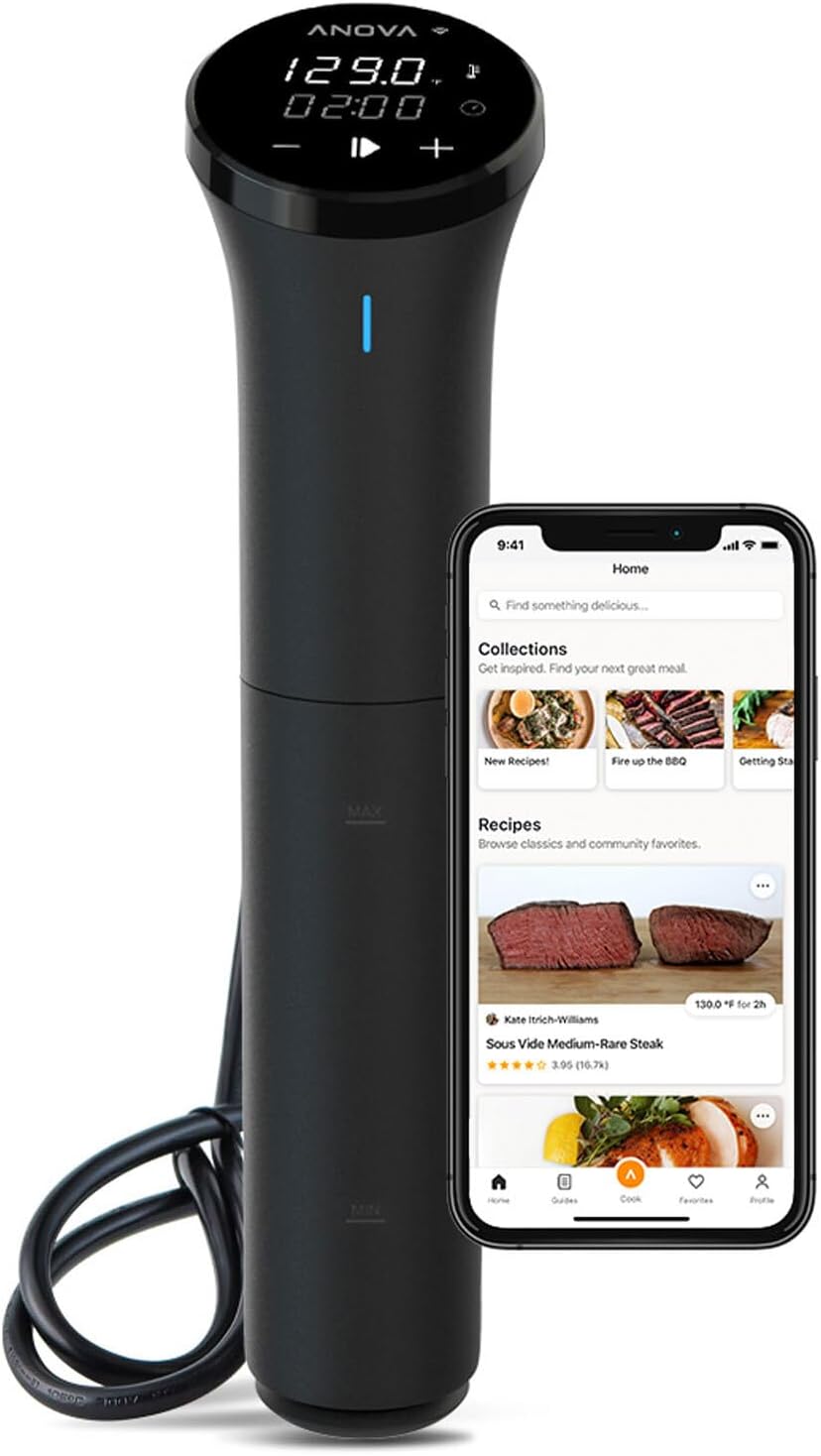
Quick Answer
Related reading: Sous vide is one precision method; our Instant Pot Duo 7-in-1 review covers the multi-cooker most kitchens start with. Prep matters as much as cooking — our Cuisinart 14-cup food processor review handles the chopping side of the equation.
A solid first sous vide cooker for one or two people: compact, clips onto any pot, and app-friendly for recipes. It heats big baths slower than higher-wattage rivals, so heavy batch-cooks may want more power — but for most beginners, it removes every excuse not to start.
Compare Top Sous Vide Cookers
Three proven picks side by side — choose the one that fits your kitchen.
Anova Precision Cooker Nano 3.0
Compact and quiet · app recipes · beginner-friendly
Prices and availability may vary — tap any product to check the current listing.
What to Look For When Buying a Sous Vide Cooker
Immersion circulators look identical at a glance — a stick, a clamp, a glowing number. The differences show up in your first month of real cooking.
Wattage and bath size
Wattage quietly governs everything. A compact cooker like the Nano 3.0 handles a stockpot beautifully and holds temperature rock-steady for hours; fill a big cooler for a party-size brisket, though, and it crawls. Higher-wattage sticks recover faster when cold meat hits the water. Buy the bath size you actually have, not the dinner party you host twice a year.
Temperature precision
Sous vide’s pitch is simple: hold water within a fraction of a degree, and food can’t overcook. Every modern circulator does this well enough — the gap between brands is narrower than marketing suggests. What separates keepers is long-cook stability, plus range: low settings for delicate infusions, high ones for vegetables and custards.
App and controls
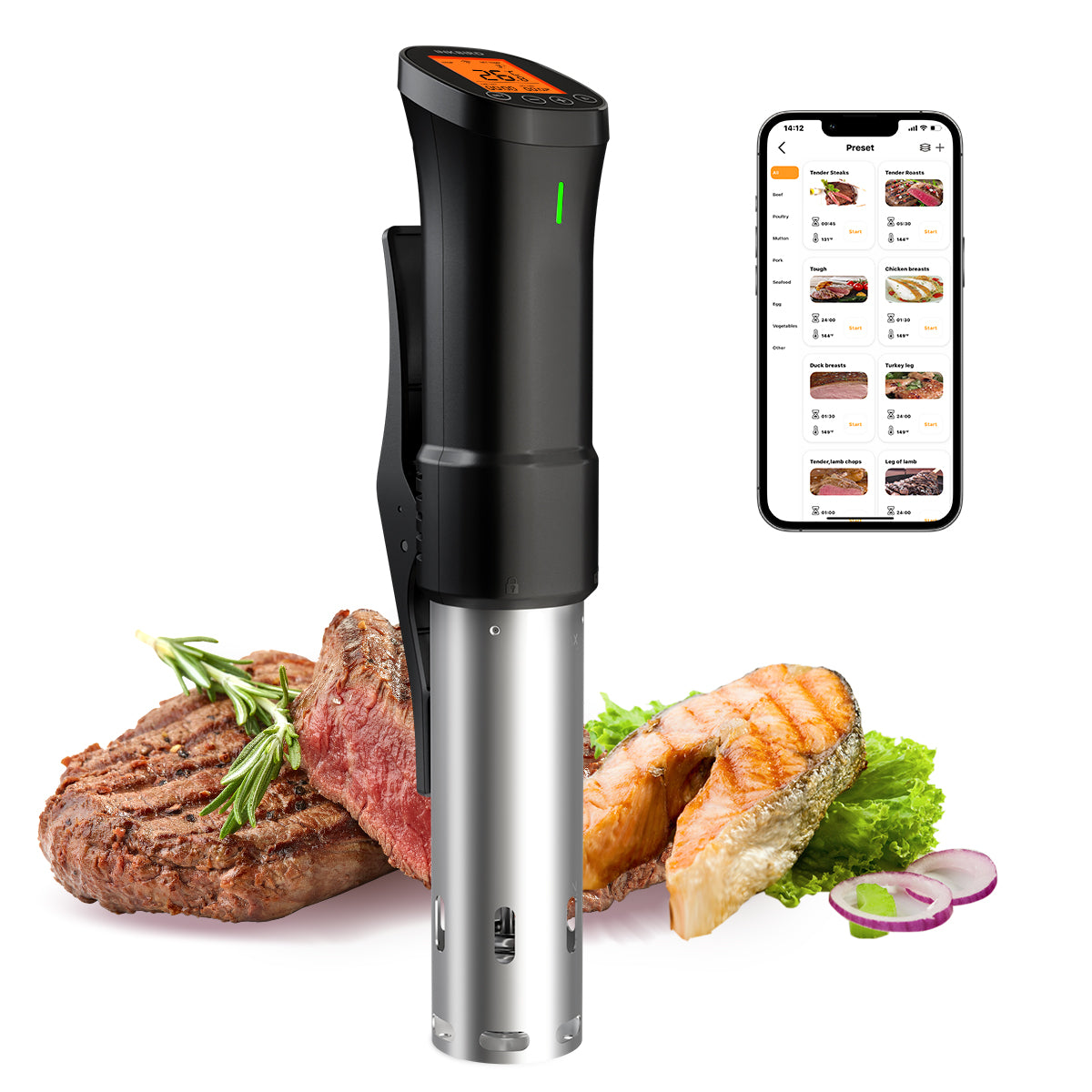
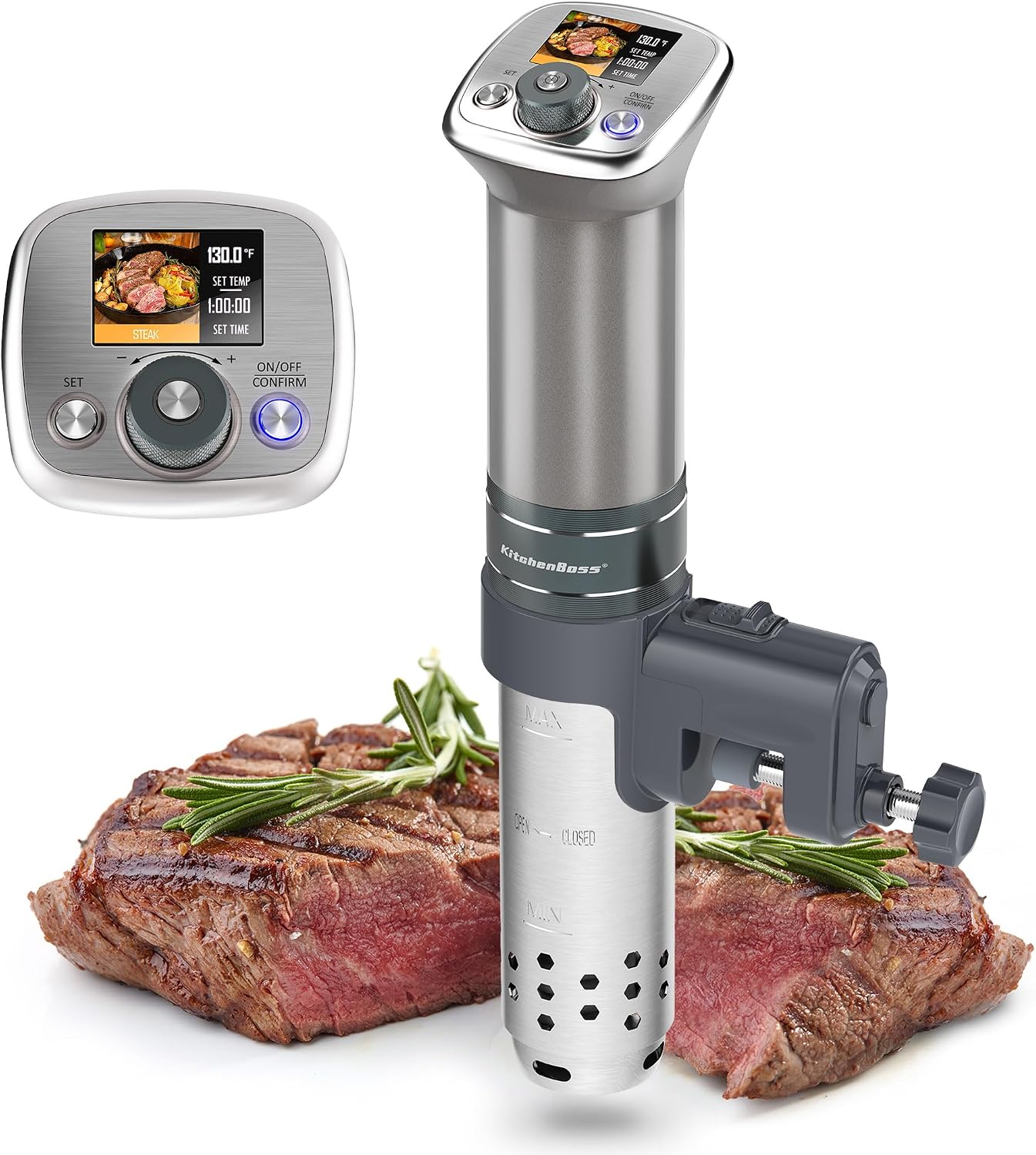
Anova’s app is the category’s reference point — recipes, step-by-step guidance, remote start. For a beginner, that hand-holding turns “what temperature is a ribeye?” into a single tap. Inkbird’s app is utilitarian: presets and timers. KitchenBoss skips the phone with built-in recipes on a color screen. App people go Anova; app skeptics go KitchenBoss.
Size, clamp, and noise
The Nano 3.0 is the slimmest of the three and fits in a drawer; the others run chunkier. Clamp strength matters more than height — all three grip standard pots, and the taller KitchenBoss gives more working depth on deep containers. On noise: compact pumps murmur, big motors drone — worth weighing in an open-plan kitchen during overnight cooks.
Durability: steam is the enemy
Heat and steam do slow violence to electronics. The honest rule for all of them: keep the head out of the steam zone and don’t submerge past the max line. Most long-term failures trace back to exactly that, not brand quality.
How to Match the Cooker to Your Situation
The right cooker has more to do with your habits than with spec sheets. Find yourself below.
The curious beginner
You’ve never sealed a bag in your life, and “thermal circulator” sounds like lab equipment. What you need is forgiveness: an app that tells you the temperature, a cooker that clips onto the pot you already own, nothing that needs a manual. The Nano 3.0 was designed for exactly this person.
The weeknight steak perfectionist
You already know you love a medium-rare ribeye; you just want it repeatable, every time, with a crust you sear in 90 seconds. Any of the three cookers delivers the bath. Your decision is control style: app recipes and guidance (Anova), simple presets (Inkbird), or a screen that keeps the phone out of the kitchen (KitchenBoss).
The batch-cooking meal-prepper
Sunday afternoons, five pounds of chicken, a cooler full of water. You’re the person who actually benefits from higher wattage — faster heat-up, quicker recovery, bigger bath capacity. The Nano 3.0 will do it, but slowly. If this is your weekly ritual, buy the power.
How the Tiers Compare
Sous vide cookers fall into loose tiers. The honest middle is where most buyers should land.
| Type / Tier | Best For | Price Tier | Key Feature | Watch Out |
|---|---|---|---|---|
| Budget no-name sticks | Trying sous vide for the first time | Budget-friendly | Cheapest way in the door | Thin build, weak apps, spotty longevity |
| Compact mid-range (Nano 3.0’s tier) | Beginners and small households | Mid-range | Slim design, strong recipe apps | Lower wattage limits big baths |
| High-wattage value (Inkbird’s tier) | Batch cooks and bargain hunters | Budget-friendly | More power for less money | Bulkier body, less polished app |
| Feature-rich displays (G320’s tier) | App-skeptics and gadget lovers | Mid-range | Built-in recipes on a color screen | Larger footprint, more to potentially break |
The compact mid-range is the sweet spot for most: small, smart, and beginner-friendly. High-wattage value picks trade refinement for raw capability per dollar; display-heavy models suit the app-averse. Budget sticks are fine for a trial run, but thin clamps and dead apps turn experiments into drawer decorations.
Questions People Ask Before Buying
These are the questions shoppers actually ask before buying their first — or second — sous vide cooker. Straight answers, no fluff.
Is sous vide cooking worth it for a regular home cook?
Yes — if you cook proteins at least a couple of times a week and you’re tired of guessing at doneness, sous vide earns its place by taking timing anxiety out of the equation, because a water bath held at an exact temperature makes overcooking nearly impossible and lets you repeat a steak, chicken breast, or pork chop every time. The catch is planning: bagging and long cook times reward meal-planners more than spontaneous cooks.
Is the Anova Nano 3.0 powerful enough, or do I need a bigger model?
For one or two people cooking in a regular pot, the Nano 3.0 is plenty powerful enough — it holds temperature accurately across steaks, chicken, eggs, and vegetables, which covers what the vast majority of home cooks ever do, so you should only consider a bigger model if you regularly fill large containers or cook for six-plus. Don’t buy wattage for the cook you might do someday — buy it for the cook you do weekly.
Anova Nano 3.0 vs Inkbird ISV-200W — which should I buy?
Pick the Nano 3.0 if you want the strongest beginner experience — slimmer body, quieter pump, and the recipe app that talks you through your first cooks — and pick the Inkbird ISV-200W if you want more heating power for less money and don’t mind a simpler app, because both cook the same steak to the same doneness. The real difference is guidance and polish versus raw capability: app people go Anova, value-and-power people go Inkbird.
Do I need a vacuum sealer to start sous vide?
No — you can start today with the water displacement method: seal food in a zip-top bag, lower it slowly into water so pressure pushes the air out, and seal it just above the waterline, which is free, works well, and is how most beginners start. A vacuum sealer earns its keep later — better seals, easier batch prep. Start with zip bags; buy the sealer once you’re hooked.
Is a cheap sous vide cooker just as good as the name brands?
The water bath doesn’t care about the logo — temperature accuracy is comparable across most modern circulators — but cheap sticks lose on everything around the heating: flimsy clamps that slip, dead-end apps with no recipes, noisier pumps, and shorter lifespans. If sous vide is an experiment you might abandon in a month, cheap is fine. If you’ll cook weekly, the mid-range buys reliability and guidance that pays off fast.
Your First Cooks: Where Beginners Win Fast
Start with chicken breasts — cheap, forgiving, and dramatically better: sous vide chicken comes out juicy in a way that ruins the pan version for you. Season, bag, set the temp, walk away for an hour or two. There’s no moment where looking away too long wrecks it.
Pork chops are cook number two — the meat most people overcook most often, and sous vide turns them from hockey pucks into the juiciest thing on the plate. Same drill: season, seal, set, sear a minute per side. That sear is non-negotiable — sous vide doesn’t brown, and brown is flavor.
Steak Night, Solved
The steak crowd’s routine: thick-cut ribeye or strip, 2 hours at your doneness, then a hard sear in cast iron. Edge-to-edge even interior, no gray band, and a real crust — sous vide hands you the hard part on autopilot.
One honest caveat: thin steaks don’t benefit much — a half-inch steak cooks through in minutes anyway. Sous vide shines on thick cuts where evenness matters. Save the setup for meat with real thickness.
Eggs, Vegetables, and the Quiet Wins
The quiet wins are eggs and vegetables: soft-yolked eggs at a jammy texture every time, no boiling-water vigilance; carrots and asparagus that cook through while staying snappy, absorbing butter in the bag instead of steaming bland.
The limitation is throughput: a small bath handles sides for two or three fine, but a holiday’s worth of vegetables is a big-bath job. For everyday cooking, these low-effort wins keep the cooker from becoming a steak-only gadget.
Common Mistakes Buyers Make
1. Buying power for a fantasy
The most common regret isn’t buying too little — it’s buying the big-wattage beast for the twelve-person cook that happens twice a year, while it hogs a drawer and handles Tuesday chicken no better than the compact one.
2. Skipping the sear
Sous vide cooks in a bag of its own juices — no browning, no crust, no Maillard magic. A screaming-hot pan, 60–90 seconds per side, transforms pale meat. The sear isn’t optional; it’s the second half of the recipe.
3. Over-seasoning the bag
In the bag, flavors concentrate with nowhere to escape. Garlic can turn harsh in a long bath; too much salt becomes an unplanned brine. Season a touch lighter than for pan cooking and adjust at the finish — you can always add, never extract.
4. Letting bags float
A floating bag steams instead of cooking evenly: air insulates food from the water. Squeeze the air out, and weigh down or clip stubborn bags. Five seconds of attention saves a disappointing dinner.
Why, How, What: Quick Answers
Why does sous vide need such low temperatures?
Because the water temperature IS the final food temperature — a steak bath held at medium-rare can’t overshoot, however long it sits. It’s the opposite of a hot oven, where you race the clock against a hotter environment. Low and exact makes overcooking nearly impossible.
How do you sear after sous vide?
Pat the surface bone-dry first, then a ripping-hot cast-iron pan with a thin film of high-smoke-point oil, about a minute per side. Dry surface, hot pan, short time: that’s the whole formula.
What container should I use for the water bath?
Any deep pot works to start — a stockpot handles most beginner cooks. Later, a polycarbonate container with a fitted lid gives better insulation and less evaporation.
Frequently Asked Questions
Can I use the Anova Nano 3.0 without the app?
Yes — temperature and timer are settable directly on the cooker, just as accurately. The app adds recipes, remote start, and notifications, but nothing about the cooking requires your phone.
How long can food safely stay in the bath?
Longer than you’d guess, since food can’t exceed the water temperature. Tough cuts go 24 hours or more; tender steaks do well at 1–4 hours and turn mushy if pushed too far. When in doubt, shorter within the recommended range beats longer.
Is sous vide safe at low temperatures?
When you follow established time-temperature guidance, yes — low temperatures held long enough achieve pasteurization, which is how restaurants serve it legally. The danger zone rules still apply: don’t leave food in the warm bath far beyond the recipe time, and chill leftovers promptly.
Do I need special bags for sous vide?
Zip-top freezer bags work for most cooks via the water displacement method. Vacuum-seal bags are better for very long cooks and sharp-boned cuts. Either way, use food-safe, BPA-free bags.
Can I cook frozen food sous vide?
Yes — just add roughly half again to the cook time. A frozen steak goes straight from freezer to bath, and the water brings it up gently and evenly.
What’s the difference between the Nano 3.0 and the bigger Anova models?
Mainly power and size: bigger models heat large baths faster and recover quicker. The Nano 3.0 trades that for a slimmer body, quieter operation, and easier storage. Accuracy is comparable across the line.
Final Recommendation
So, is the Anova Precision Cooker Nano 3.0 worth it? For beginners and small households, yes — it’s the easiest on-ramp in the category, and the app guidance genuinely shortens the learning curve.
Grab the Inkbird ISV-200W for raw heating power without hand-holding, or the KitchenBoss G320 if you’d rather never open an app. All three cook the same steak — match the cooker to how you cook, and don’t skip the sear.
OUR TOP PICK
Anova Precision Cooker Nano 3.0
Compact and quiet · app recipes · beginner-friendly
Decision Tree: Should You Buy It?
→ Cooking for 1–2 people, new to sous vide? Yes → strong candidate.
→ Want app recipes and guidance? Yes → the Nano 3.0’s ecosystem is the draw.
→ Regularly filling big containers or batch-cooking? Yes → consider the higher-wattage picks instead.
→ Hate apps, want everything on the stick? Yes → the KitchenBoss’s screen-first design fits better.
Key Takeaways
• Wattage governs bath size and heat-up speed — match the cooker to your normal pot, not your fantasy dinner party.
• Temperature accuracy is comparable across modern sticks; guidance, clamp quality, and noise separate the keepers.
• Start with zip bags and the water displacement method; the sear at the end is non-negotiable for flavor.
Common Questions About Anova Precision Cooker Nano 3.0
Is sous vide cooking hard for beginners?
No, it's one of the most forgiving cooking methods — you seal food in a bag, set the water temperature, and the circulator holds it there, making overcooking nearly impossible while you learn. The water does the babysitting, so beginners get restaurant-level consistency on day one.
The water does the babysitting.
Beginners get restaurant-level consistency on day one, which is why sous vide converts skeptics fast.
Anova Nano 3.0 vs bigger sous vide models: which should I buy?
Buy the Nano 3.0 if you're new to sous vide, cook for one to four people, and want the smallest, quietest, most affordable entry — it handles typical home batches with ease. Buy bigger if you cook large cuts or batch-cook for crowds, though most home cooks never outgrow the Nano's capabilities.
Buy bigger if you cook large cuts, batch-cook for crowds, or want faster heat-up for big water baths.
Most home cooks never outgrow the Nano's capabilities.
What do I need to start sous vide cooking?
You need the circulator itself, a pot or container deep enough to submerge it, zip-top bags or a vacuum sealer, and a cast iron skillet or torch for the finishing sear — which is where the color and crust come from.
That's genuinely the whole kit.
Start with steaks or chicken breasts; they're the most dramatic demonstrations of what sous vide does.
Is a sous vide cooker worth buying?
It's worth it if you love perfectly cooked proteins and hate the anxiety of timing — edge-to-edge medium-rare steaks, juicy chicken breasts, and foolproof eggs become routine rather than lucky. It's less compelling if you rarely cook meat, but for precision-minded cooks it's the most transformative sub-$200 kitchen tool.
It's less compelling if you rarely cook meat or already nail temperatures by feel.
For precision-minded cooks, it's the most transformative sub-$200 kitchen tool.
What foods benefit most from sous vide?
Steaks are the headline act — edge-to-edge perfect doneness with no gray band — followed closely by chicken breasts that stay juicy, pork chops, eggs at exact textures, and vegetables that keep their bite and color. Delicate proteins show the biggest gap versus conventional cooking, so start with steak night.
Delicate proteins show the biggest gap versus conventional cooking.
Start with steak night; it's the cook that sells the method.