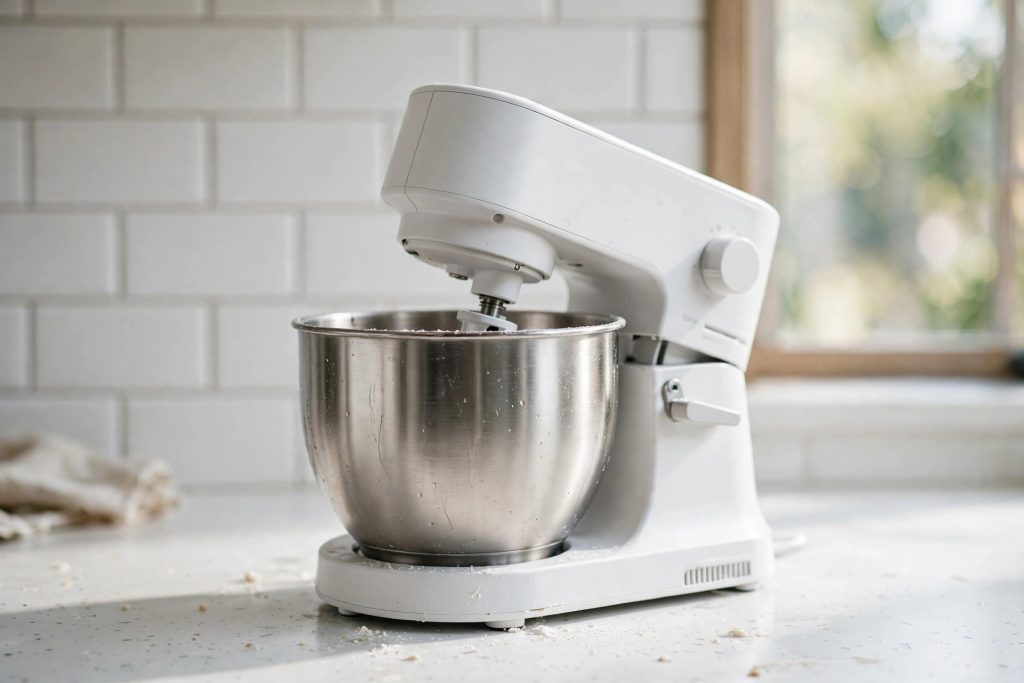
“It walked off my counter.” That is how the message started, and it is still my favorite complaint I ever handled, because the customer was not exaggerating and neither was the mixer. I spent a stretch answering customer messages for a small kitchenware seller, not this brand, and the small stand mixers taught me the physics nobody prints on the box. The Kitchen in the box 3.2-quart stand mixer weighs a little over seven pounds. A bag of flour weighs five. When a machine that light meets a stiff dough, the dough wins, and the mixer goes traveling, suction cups chirping across the laminate.
“Did you wet the suction cups?” I would ask. “The what?” they would say. There are four suction feet under that base and they are the entire contract between this mixer and your counter, and half the people I talked to never knew they existed, because they sit in a shadow under the machine and the quick-start card mentions them in a font size meant for ants. Wet them, press down, and the walking mostly stops. Mostly. On a glossy counter, yes. On the textured laminate in my own kitchen, the back left cup lets go mid-knead and the whole thing does a slow quarter turn like it is looking for the door.
The 3.2-quart bowl is the second conversation I had over and over. “It says stand mixer, my old one did two loaves.” Two loaves is roughly eight cups of flour and a motor with opinions, and this is a 300-watt-class machine with a bowl that takes, comfortably, about four cups of flour before the cloud starts. Five cups and you are wearing some of it. I know the exact number because a customer sent me a photo of her kitchen that looked like a bakery had sneezed, and she was laughing, to her credit, in the photo’s caption. The mixer was not broken. The mixer was outnumbered.
Here is a thing support people know and listing pages do not say. The first-speed problem is real on nearly every small mixer. You add flour to liquid, you start on the lowest setting the way you were taught, and the lowest setting on a light machine is still quick enough to throw a white plume up the sides of a small bowl. The fix I gave out a hundred times was to stir the flour in by hand for ten seconds first, off the machine, with the beater itself. Ten seconds. It feels like cheating and it saves your shirt, and it works because the plume is a dry-flour problem, not a power problem.
And the motor smell. “It smells like a hot vacuum cleaner, is it dying?” New motors smell. Brushes seating in, varnish warming, a faint electrical sweetness for the first few uses that fades. What I learned to ask was how long. Smell in minute two of a cookie dough, normal. Smell in minute nine of a bread dough that fills the bowl to the rim, that machine is working past its design and telling you so in the only language it has. The manual’s duty limits are the most honest page in the box and the least read.
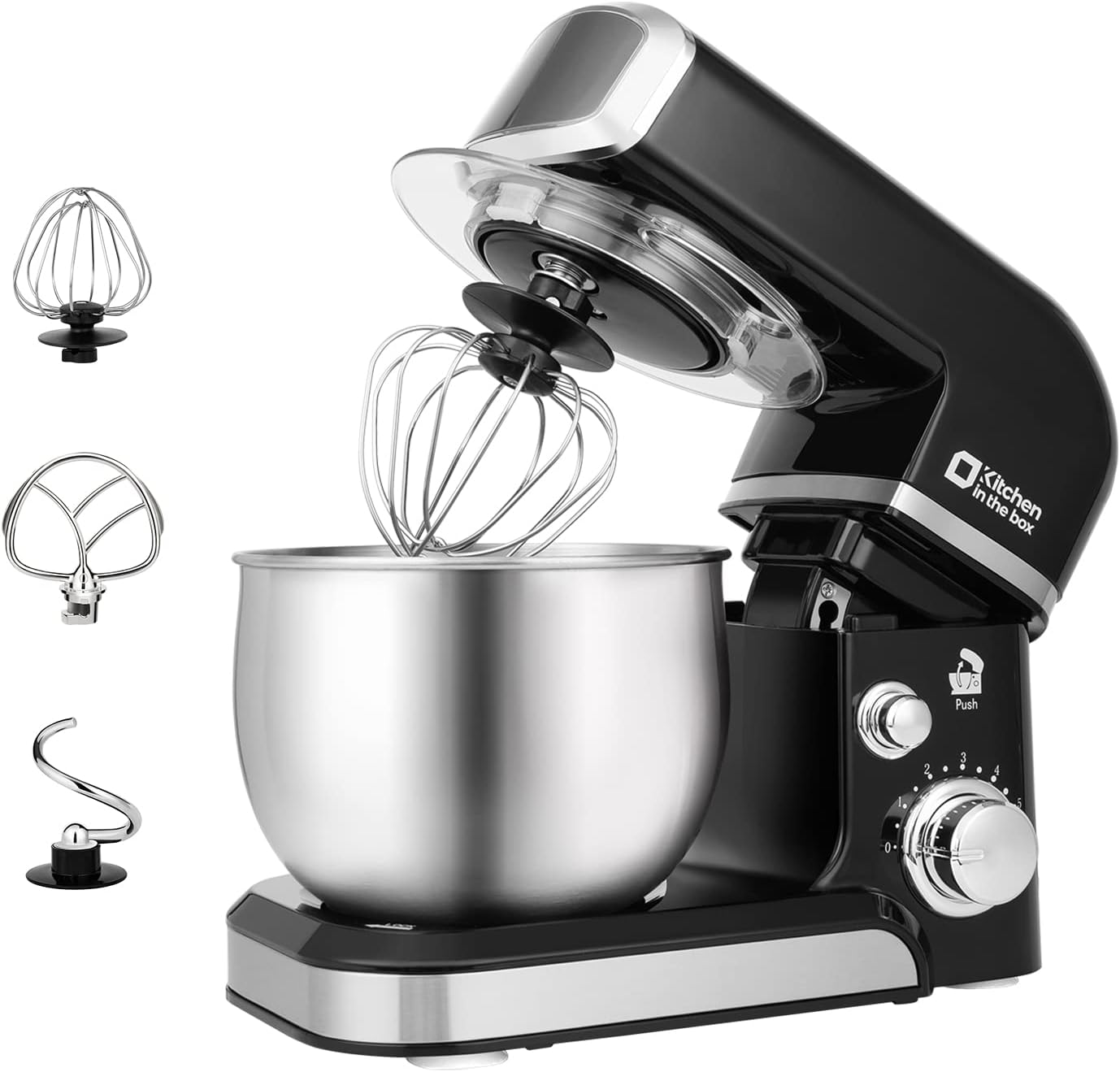
6 speeds, portable and light, whisk, dough hook and flat beater included
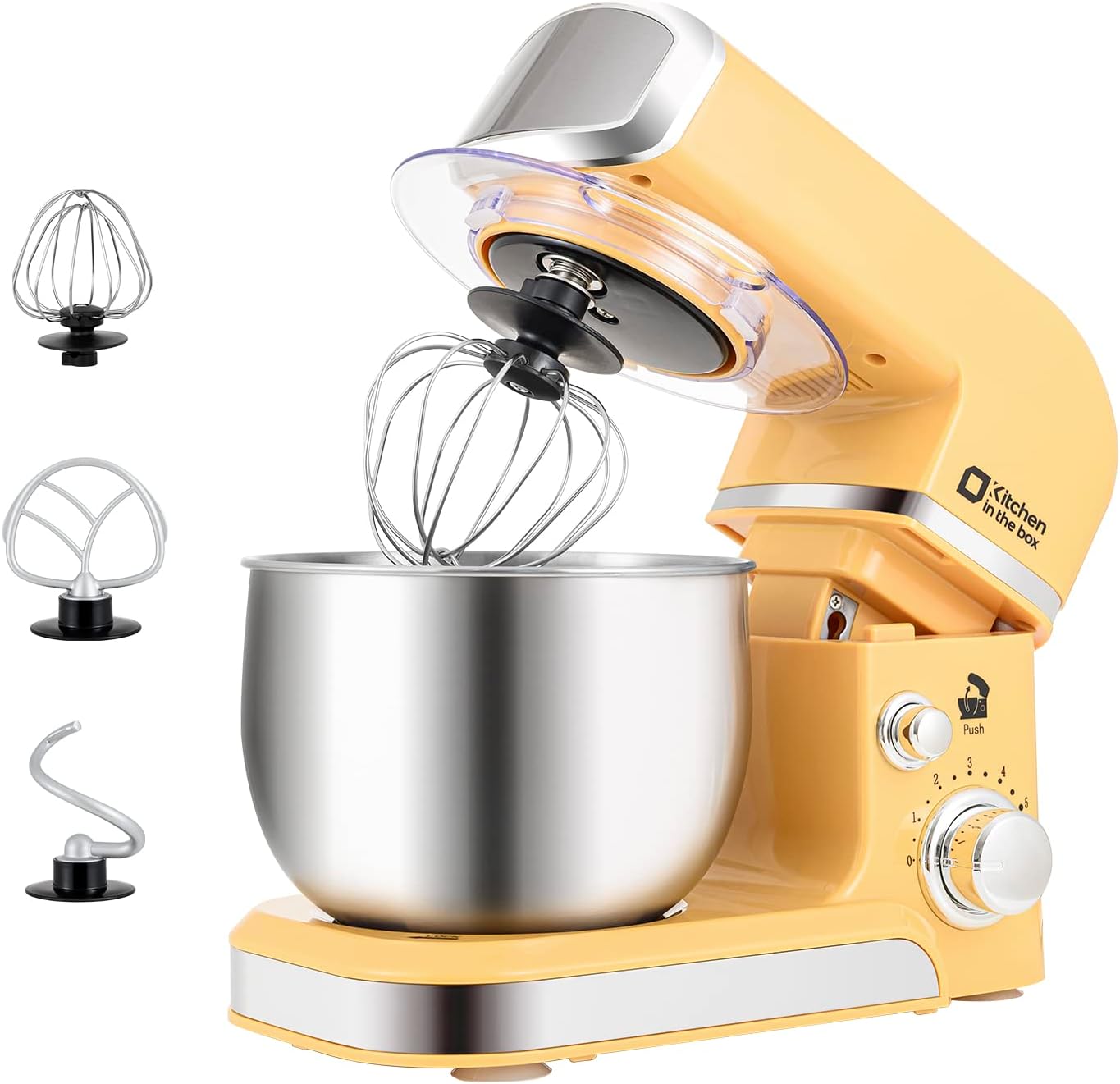
Same 3.2 Qt machine in yellow – flour dust shows less on this finish
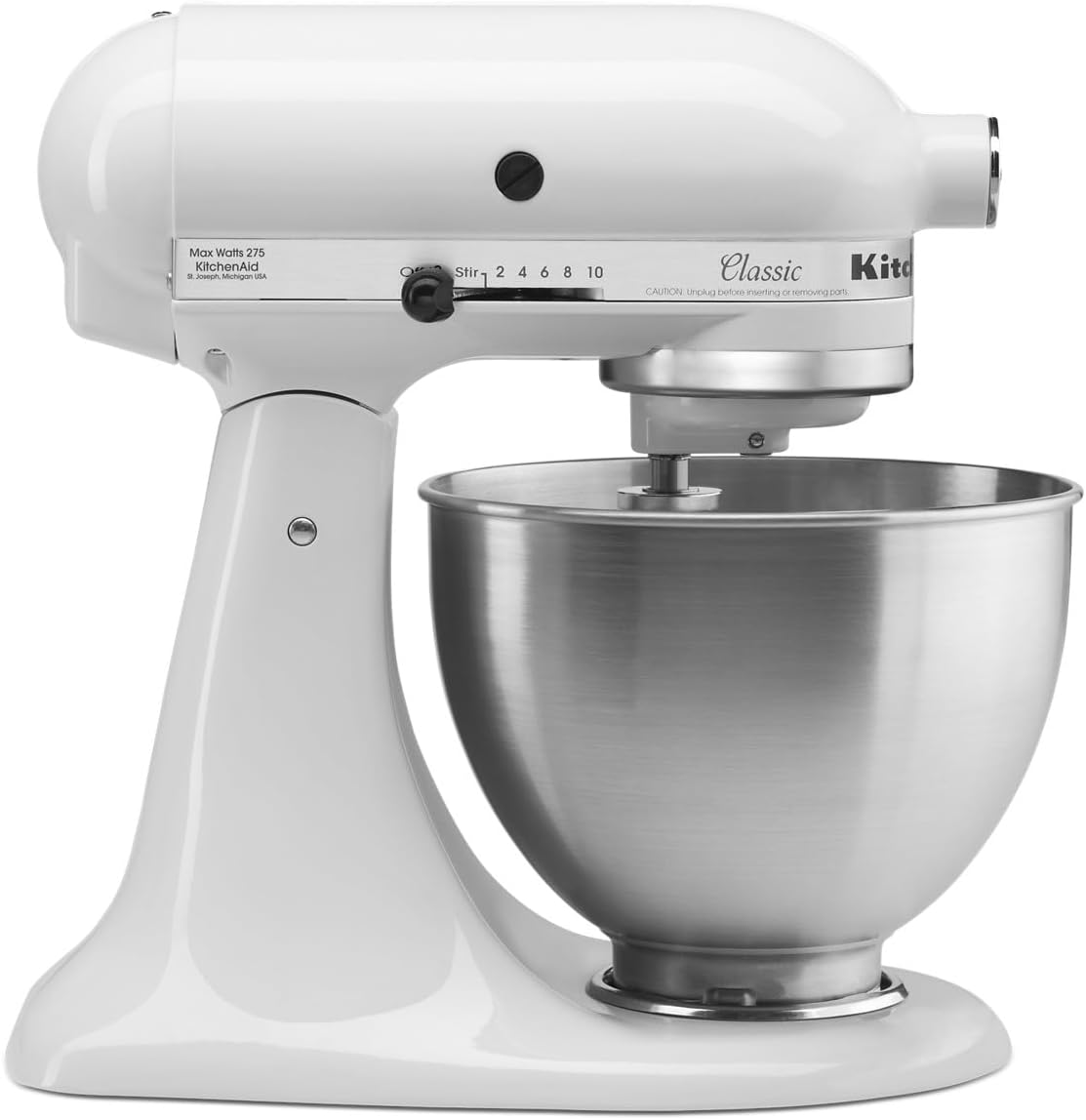
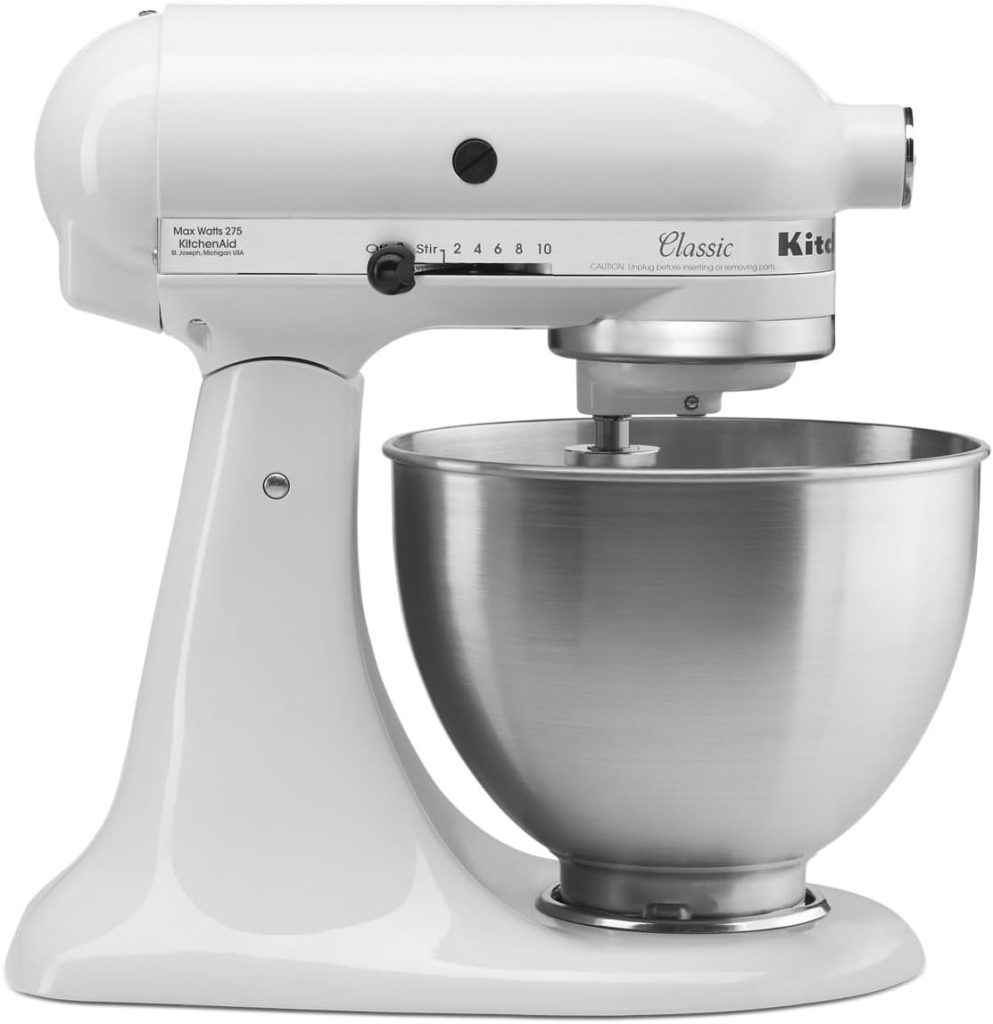
The bigger step up – 4.5 Qt bowl for double batches and heavier doughs
Prices and availability change often. The button shows the current listing.
What it does well, it does in the small daily jobs that never make it into anyone’s review photos. Egg whites to soft peaks in about two minutes, three eggs, no fuss. A single batch of cookies, creaming butter and sugar without the bowl wrestling you get from a hand mixer. Whipped cream while the coffee brews. The six speeds are really three useful speeds with neighbors, which sounds like an insult and is not, because three honest speeds cover nine-tenths of home baking and the paddles, a flat beater, a dough hook, a whisk, are shaped fine and wash without trapping batter in seams. I checked the seams. Force of habit.
The tilt head on a machine this light has a quirk I never saw written anywhere. When you tilt it back to scrape the bowl, the whole base can tip with it if the bowl is empty and you move fast, because the weight balance assumed a full bowl. Tilt it like you mean it, slowly. A customer once described catching hers “like a toddler falling off a chair” and I have never been able to improve on that sentence, so I am leaving it in hers.
Actually, I want to correct the impression I may have given with the walking story. The walking is a dough story, almost entirely. For cakes, batters, whipped things, anything pourable, the machine sits still and behaves, and in a small kitchen that is most of the week. It is only when a stiff dough climbs the hook and starts shoving back that seven pounds becomes a negotiation. I have taken that call too, the “why did nobody tell me” call, and the honest answer is that the box told you in watts and bowl size, in a language nobody learns until their second mixer. Your first mixer teaches you the language. That is its real job, in a way.
Counter space is the reason this thing exists. Twenty-four inches of counter depth in my kitchen, and the mixer lives in a corner a full-size tilt-head would evict everything else from. It lifts with one hand. It goes in a cabinet without a negotiation. If you bake in volume, if a double batch is your normal Tuesday, the KitchenAid Classic Series 4.5-quart review is the honest direction to look, and the Kitchen in the box 3.2Qt mini mixer review covers this same machine from the small-apartment angle. Those two links are the whole map, small and bigger, and most people I talked to actually needed one of the two extremes rather than anything in between.
The yellow one and the black one are identical inside. I say that because I was asked, more than once, in exactly those words, and because the yellow shows flour dust less and the black shows, well. Everything. Choose with your eyes open.
Replacement beaters exist and are cheap, the bowl is stainless and light enough that my kid carries it one-handed, and the cord is short in the way all countertop cords are short, a safety decision that reads as an insult until you picture the alternative. I have made my peace with the short cord. It took longer than it should have.
Frequently Asked Questions
The suction cups keep letting go on my counter. Is mine defective?
Probably not defective, just outmatched by your counter surface. The cups need smooth and clean and a little damp, and textured laminate or a stone top with any grain to it will break the seal slowly no matter what you do, usually the back cup first, mid-knead, when the dough starts pushing. Wipe the counter, wet the cups, press the base down hard before you start, and if it still wanders on stiff doughs, park the machine against the backsplash so it has nowhere to go. That last part is not elegant. It is what I told people and it is what I do, and the mixer has not traveled since. A machine this light needs a wall for the heavy work, the way a small dog needs a fence.
How much flour can it really handle before I am wearing it?
About four cups in the bowl behaves. Five cups is where the cloud starts and the motor begins working in a register you can hear change, and anything past that is a negotiation you will lose in stages. Start the flour in by hand for ten seconds before you switch on, even at four cups, because the plume happens in the first moments when the flour is still dry on top of the liquid. Small batches are not a limitation of this mixer so much as its native language. Two smaller batches back to back will treat it better than one heroic one, and honestly the second batch is usually the one that comes out better anyway, because by then you have stopped fighting the machine.
It smells hot and electrical when I make bread dough. Should I stop?
If the dough fills the bowl and you are past five or six minutes, yes, stop, let it rest, that smell is the motor working past what it was built to do and it will not get better by pushing through. A faint warm smell in the first few uses of any new mixer is brushes and varnish settling in and it fades, I gave that speech weekly. The dividing line is time and load together. Cookie dough at minute two, carry on. Bread dough at minute nine with the head nodding, that is the machine asking, in its one language, for a smaller batch. Listen the first time and it will keep answering questions for years.
Can it knead a pizza dough for two people, or is that already too much?
That is close to its best job, actually. A two-person pizza dough is roughly two and a half to three cups of flour, inside the comfortable range, and the hook will bring it together in a few minutes without the counter travel, as long as the cups are sealed down first. Wetter doughs are kinder to it than stiff ones. A tight, low-hydration dough at the same flour weight works the motor noticeably harder, which confused me until I watched the head movement, the stiff dough climbs and shoves in a way a slack dough never does. Same cups of flour, completely different afternoon for the machine.
The head wobbles a little when it runs. They all do that, right?
A small amount of movement, yes, there is play in a tilt-head hinge at this price and weight and it is not a fault. What you are watching for is growth. If the wobble is bigger this month than last, or the head has started nodding forward into stiff dough, something in the hinge or the latch is wearing, and that is a conversation worth having while the warranty is still a live thing rather than a memory. I cannot judge yours from a description, nobody can, wobble needs eyes on it. Film it next to a mug for scale if you message support. That was always my trick for sorting the normal ones from the real ones, and it works embarrassingly well.
Somewhere there is a spreadsheet with my old call notes in it and “walked off counter” appears eleven times, I counted once, and the yellow mixer on my own counter has never once walked, because I wet the cups and I keep my batches small and I know where the wall is. It still does its slow quarter turn on bread day, back cup letting go like it is testing me, and I slide it home with one hand without looking up from whatever I am reading, the way you steady a thing you have made your peace with.
This site contains affiliate links. We may earn a commission on qualifying purchases.