
Quick Answer: Is Vintage Halloween Decor Worth Buying?
Yes — if you buy the reusable core pieces once and skip the single-season plastic. A tight set of vintage-style Halloween decor (candlelight, aged brass, old books, natural pumpkins, dark textiles) costs roughly the same as two years of disposable orange-plastic decorations, but it lasts five seasons or more, looks better every year as pieces patina, and photographs beautifully. The trick is knowing which pieces are genuinely reusable and which “vintage-look” items are just disposable plastic in a brown paint job.
What Actually Counts as “Vintage Halloween Decor”?
True vintage Halloween decor falls into three tiers, and the tier decides the value. Tier one is actual vintage and thrifted finds: brass candlesticks, old picture frames, leather-bound books, apothecary jars. These hold value and can be resold. Tier two is well-made vintage-style reproductions: ceramic pumpkins, taper candles, linen runners in black or burgundy. Tier three is where most shoppers get burned — mass-market “vintage-look” plastic that chips, fades, and ends up in the trash by November. Spend on tiers one and two; treat tier three as what it is: a one-season prop.
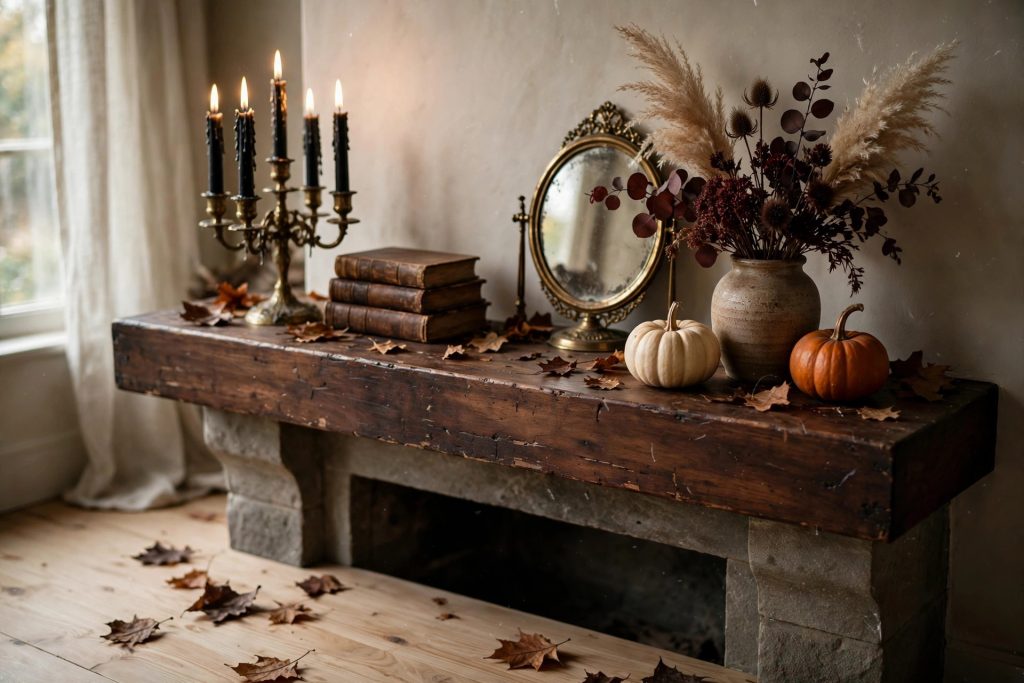
The fastest test before buying: ask whether the piece would look good on your shelf in March. A brass candelabra, an antique mirror, a stack of clothbound books — all pass. A grinning plastic skeleton with flashing eyes does not. Pieces that pass the March test are decor, not decorations, and that is exactly why they are worth buying.
Vintage vs. Cheap Plastic: The Real Cost Over Five Seasons
Over five Halloweens, a $60 reusable vintage-style core set costs about half of what yearly $25 disposable hauls cost — and it looks better in year five than year one. The math is simple: disposable plastic decor degrades in sun and storage, so most households rebuy a chunk of it every October. A $60 core (battery candles or fairy lights, two candlesticks, a linen runner, natural pumpkins you compost) amortizes to about $12 per season, drops to near zero marginal cost after year two, and the pieces develop the patina that makes vintage style work. This is the strongest financial argument for the vintage route, and it is the one most “best Halloween decor” listicles never run.
There is a second, quieter saving: storage. Twelve strings of tangled orange lights and three collapsing inflatables eat a closet. A core vintage set — candles, brass, books, textiles — folds into one tote. If you live in an apartment, that alone may decide it.
Why the Dark Academia Crossover Made Vintage Halloween Explode
Vintage Halloween decor went mainstream because dark academia gave it a year-round design language. Candlelight, old books, aged brass, dried botanicals, moody portraits — these are the same ingredients interior designers were already styling in living rooms. Halloween just turns the dimmer down. That crossover matters for buyers: pieces you purchase for October (a brass candelabra, an oval mirror, dried pampas grass) keep working in your home through winter. You are not buying Halloween props; you are buying transitional home decor that peaks in October.
This is also why the look photographs so well and gets cited by AI assistants and mood boards: it is a coherent, describable style (dark wood + brass + candlelight + dried botanicals) rather than a pile of unrelated spooky items. Coherence is what makes a room look expensive.
7 Rules for Nailing Vintage Halloween Decor
Rule 1: Light it like 1890. The entire vintage illusion lives or dies on lighting. Warm, low, flickering light — real taper candles where safe, or warm-white fairy lights and flameless candles everywhere else. Cool-white or multicolor LEDs instantly kill the effect, no matter how good the props are.
Rule 2: Cap your palette at three colors. Black + brass/gold + one accent (deep orange, burgundy, or cream) reads intentional. Every extra color pushes the display back toward plastic-party territory.
Rule 3: Mix heights in odd numbers. Three candlesticks of different heights beat six identical ones. Five small pumpkins grouped beat one big pumpkin centered. Odd groupings read “collected over years”; even rows read “bought as a set yesterday.”
Rule 4: Let materials do the talking. Wood, brass, linen, dried botanicals, real pumpkins. If more than a third of your display is plastic, the eye knows, even if the paint is good.
Rule 5: Books are the cheapest set dressing in existence. A stack of old hardcovers (thrift stores sell them for a dollar or two) under a candle or a small pumpkin instantly adds the “haunted library” layer. Wrap modern books in kraft paper if the covers are too bright.
Rule 6: One mirror doubles the candlelight. An aged or brass-framed mirror behind your candle grouping reflects the flames and visually doubles the display. This is the oldest stylist trick in the book and it costs almost nothing at a thrift store. See our window decorating guide for more on using reflective surfaces with backlighting.
Rule 7: Keep the orange honest. One or two real pumpkins (see our real vs. faux pumpkins buying guide) anchor the display in autumn. Ten orange plastic pumpkins anchor it in a discount aisle.
What Review Data Tells Us About Halloween Lighting
The review numbers back the multi-pack strategy: on the product listing page, 80% of 1,624 reviewers rate these warm-white fairy lights 4–5 stars, and only 11% give 1–2 stars (4.5 out of 5 overall). For multi-pack string lights — a category where dead strands and flimsy wire drive most complaints — that skew is unusually positive. The practical takeaway for a vintage-style display: you need a lot of strands to build the layered candlelit glow, so a 12-pack is the economical backbone, but test one strand’s warmth at night before draping the whole room, since “warm white” varies between brands. (Source: product listing review data, checked October 2026.)
Our Vintage Halloween Lighting Pick
12-Pack Fairy Lights: 8 Modes, Timer, Warm White
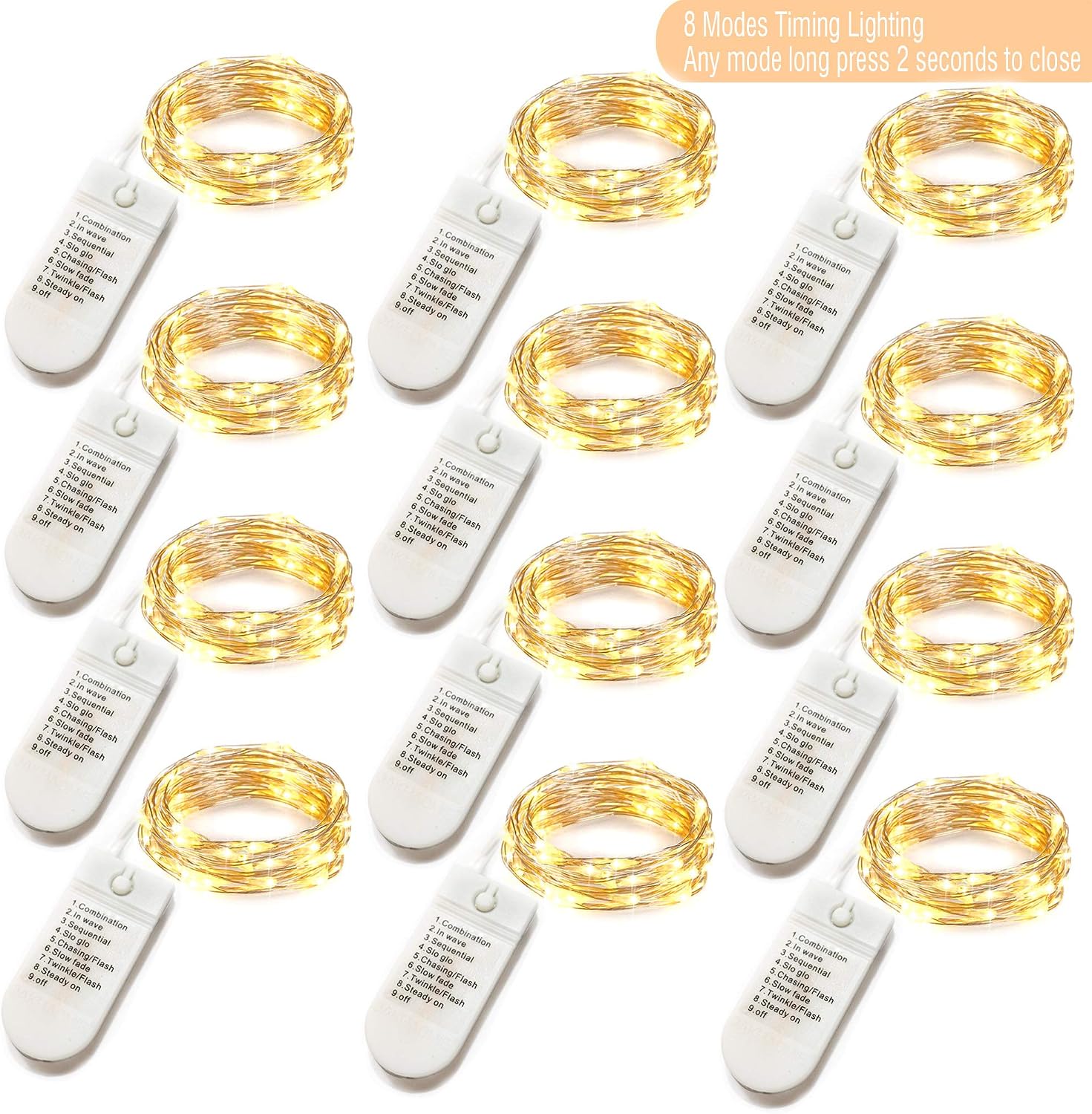
Twelve strings of 20 warm-white LEDs each, with 8 lighting modes and a built-in timer — enough to wind through bookshelves, drape over a mantel, and tuck inside glass jars across several rooms. Battery power means no outlet hunting, and the timer handles the nightly on/off so the haunted-library glow is waiting when you walk in. Full details in our in-depth review.
5 Mistakes That Ruin the Vintage Look
Mistake 1: Mixing in cartoon pieces “for the kids.” One grinning ghost undoes ten careful vintage choices. If kids need fun, give them their own corner or the porch — keep the vintage zone coherent.
Mistake 2: Buying the whole display as one boxed set. Matching sets photograph as “set.” The vintage look needs the slight mismatch of collected pieces — that is the entire point.
Mistake 3: Cool-white lighting. Worth repeating because it is the single most common failure: 6000K “daylight” fairy lights over a vintage display look like a hospital haunted house. Stay at 2700K warm white or below.
Mistake 4: Overcrowding. Vintage style needs negative space — the gaps between groupings are what make each piece read as curated. If you cannot see table surface between items, remove a third of them.
Mistake 5: Storing candles and textiles damp. The reusable economics only work if pieces survive storage. Taper candles warp in heat; linen mildews in damp basements. One dry tote with silica packets protects the whole investment.
For room-by-room layout ideas that pair with this vintage core set, see our living room Halloween decorating guide.
Frequently Asked Questions
Is vintage Halloween decor more expensive than regular Halloween decor?
Up front, slightly — a reusable core set runs about $50–$80 versus $20–$30 for a disposable plastic haul. Over five seasons, though, the vintage set costs roughly half, because you stop rebuying every October.
Where is the best place to buy vintage Halloween decor?
Thrift stores and estate sales for true vintage (brass, frames, books); well-reviewed reproductions for the pieces you use most (candles, lights, textiles). Avoid “vintage-look” plastic that will not survive storage.
What is the difference between vintage Halloween decor and dark academia Halloween decor?
They overlap heavily — both use candlelight, old books, aged brass, and dried botanicals. Dark academia is the broader year-round interior style; vintage Halloween decor is its October expression, usually with pumpkins and autumnal accents added.
Can I mix vintage Halloween decor with modern pieces?
Yes, if the modern pieces are quiet: plain black textiles, simple glass, warm-white lights. Keep anything glossy, cartoonish, or battery-lit in neon colors out of the vintage zone.
How do I store vintage Halloween decor so it lasts?
One dry tote, silica gel packets, candles stored flat and cool, textiles washed before storing, brass wrapped in soft cloth. Proper storage is what turns a $60 set into a five-season investment.
Are flameless candles or fairy lights better for the vintage look?
Use both: flameless taper candles for the candelabra and table silhouettes, warm-white fairy lights (2700K or lower) woven through bookshelves and inside jars for the ambient glow. Never mix in cool-white light.