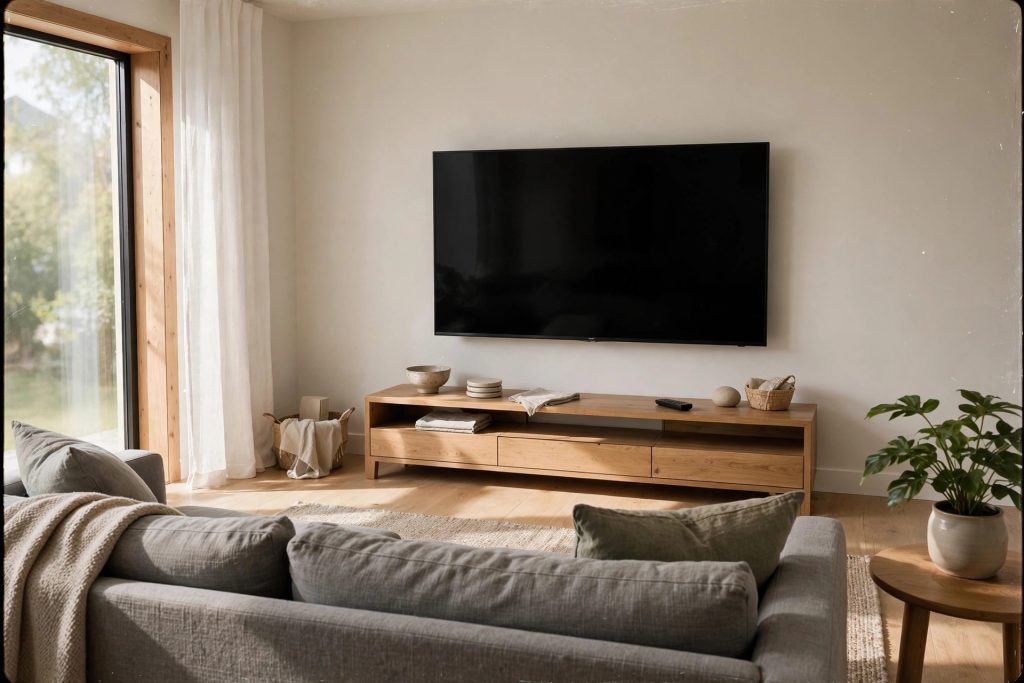

Quick answer: For a standard living room with the sofa 7–9 feet from the screen, a 55–65 inch TV is the sweet spot. The fastest way to size any room: measure the distance from your main seat to the TV wall in inches, then divide by 1.6 — that’s your target screen size in inches (diagonal). Prefer a more cinematic feel? Divide by 1.2 instead. Get these two numbers right — size and mounting height — and almost any TV will feel like it belongs in the room.
How Do I Measure the Right TV Size for My Living Room?
The short version: measure your viewing distance (seat to screen, in inches) and divide by 1.6 for comfortable everyday viewing, or by 1.2 for a cinematic feel. Round to the nearest real TV size: 43, 50, 55, 65, 75, or 85 inches.
Related: See our What Size Dining Table Do I Need? A Complete Buying Guide for a detailed comparison.
Related: See our How to Decorate a Living Room for Halloween? for a detailed comparison.
TV screens are measured diagonally, which is what every sizing formula uses. Start with the seat you’ll actually use most — the middle of the sofa, not the back wall. If your sofa is 8 feet (96 inches) from the TV wall, 96 ÷ 1.6 = 60, so a 55–65 inch TV is the natural fit; the cinematic formula gives 96 ÷ 1.2 = 80, which is why home-theater fans often go one or two sizes larger.
| Viewing distance | Comfortable range (÷1.6) | Cinematic range (÷1.2) | Typical room |
|---|---|---|---|
| 5–6 ft (60–72 in) | 40–50 in | 50–60 in | Small apartment, bedroom |
| 6–8 ft (72–96 in) | 45–65 in | 60–80 in | Standard living room |
| 8–10 ft (96–120 in) | 65–75 in | 80–100 in | Spacious living room, media room |
| 10–12 ft (120–144 in) | 75–85 in | 100 in+ | Large open-plan space |
A sanity check for the most common setup: a sofa 8 feet from the wall lands at a 60-inch midpoint — exactly between the 55 and 65 inch sizes most living rooms end up with. That’s not a coincidence; it’s why 55–65 inches is the best-selling TV range in the world.
What Viewing Angle Should I Aim For?
The short version: aim for the screen to fill about 30 degrees of your field of view for comfortable everyday viewing (the SMPTE recommendation), and up to 40 degrees if you want a more cinematic, THX-style experience.
Viewing angle is the geometry behind the ÷1.6 and ÷1.2 formulas. The Society of Motion Picture and Television Engineers (SMPTE) suggests roughly 30 degrees of horizontal field of view as a minimum for mixed content — big enough to feel engaging, small enough that your eyes take in the whole picture without darting around. THX recommends closer to 40 degrees for home theaters, which is why its formula suggests larger screens for the same distance.
In practice, you don’t need a protractor. The two formulas are the angle guidelines expressed as arithmetic — and most size regret goes one direction: people wish they’d bought bigger, not smaller. If your computed “comfortable” size looks small in the store, you’re probably a 40-degree viewer: size up one notch.

Does 4K Resolution Change the Ideal TV Size?
The short version: yes — with a 4K TV you can sit closer (or buy bigger) than the old rules assumed, because the denser pixels stay invisible at shorter distances.
That effectively moves the ÷1.6 guideline toward ÷1.4 for 4K sets, letting you step up a size in the same room.
- 4K (most TVs today): the ÷1.6 / ÷1.2 formulas apply as written — you can sit closer than with older HD sets.
- 1080p (budget/older TVs): use ÷2.0 to ÷2.5 — sit farther back or choose a smaller screen to avoid visible pixels.
- 8K: you can sit even closer, but with almost no 8K content, buy for the resolution you’ll actually watch.
If you’re comparing models, compare 55-inch 4K TVs and their current prices side by side — it’s the size where 4K’s extra sharpness is most noticeable at typical living room distances.
How High Should I Mount My TV?
The short version: the center of the screen should sit at your seated eye level — about 42 inches from the floor for a typical sofa. Mounting too high is the single most common placement mistake.
This rule is pure ergonomics: screen center at your natural line of sight keeps your neck neutral and your eyes on the whole picture without tilting your head. For most adults on a standard sofa, eye level lands around 42 inches from the floor — the industry baseline. To get it exact, sit in your usual spot, have someone hold a tape measure at your gaze height, and mark the wall.
- Stand or console placement: pick a media console whose height puts the TV’s center near 42 inches. A wider console than the TV (at least as wide as the screen) looks most balanced.
- Wall mounting: a tilting mount buys forgiveness — tilt the screen down a few degrees if the only option is slightly above eye level.
- Above the fireplace: this almost always puts the TV too high for comfortable viewing. If the fireplace wall is the only choice, use a pull-down tilting mount that brings the screen to eye level when in use.
If you’re going the wall-mount route, shop full-motion TV wall mounts and compare tilt and swivel options before you drill — the mount matters as much as the TV for long-session comfort.
What About Room Size, Glare, and Side Seating?
The short version: size follows viewing distance, not floor area — but room width, windows, and side chairs decide whether that size actually works in your space.
Beyond distance, three room factors matter:
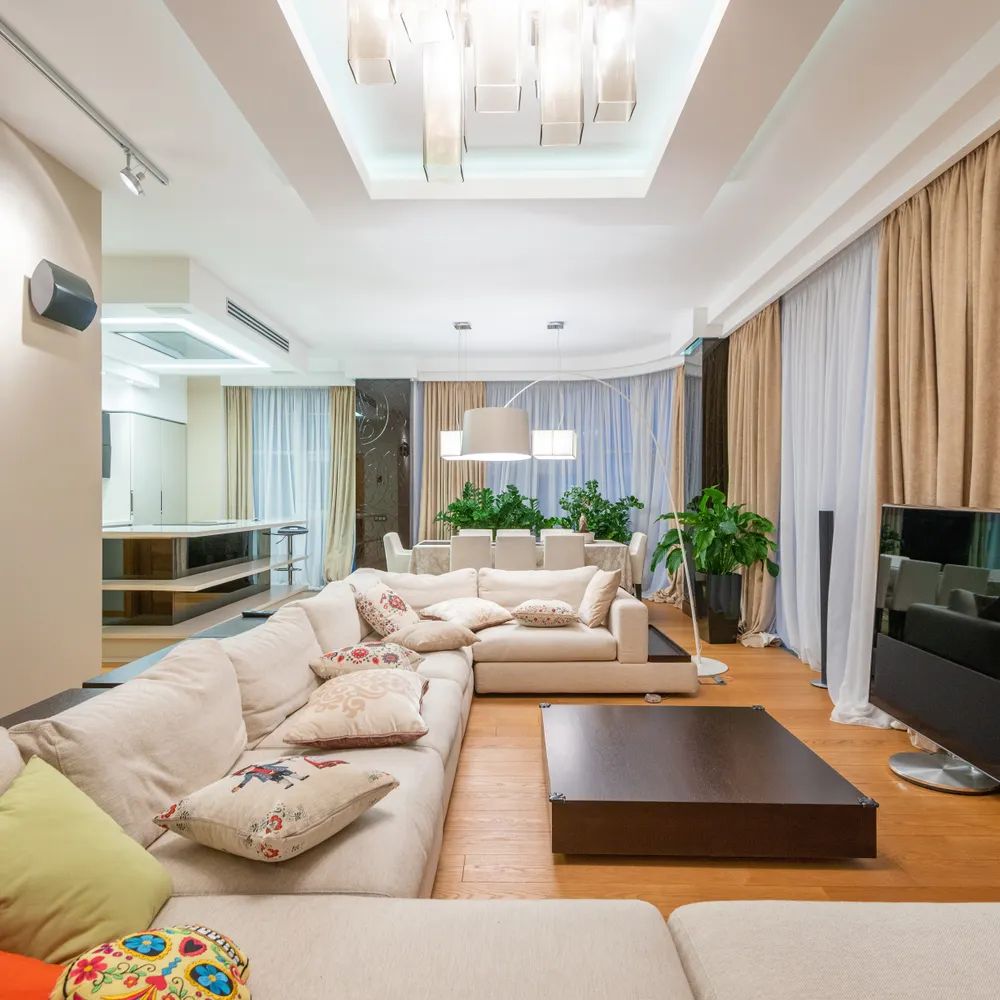
- Wall width: leave at least a few inches of breathing room on each side of the TV. A 65-inch TV is about 57 inches wide — on a 6-foot wall section, it will dominate; on a 10-foot wall, it looks proportional.
- Glare: avoid placing the TV directly opposite big windows. Matte screens help in bright rooms, and bias lighting (a soft light strip behind the TV) reduces eye strain and deepens blacks at night.
- Side seating: viewers on side chairs see the screen at an angle. Cheaper panels lose contrast off-axis — if your layout has wide side seating, prioritize a TV with good viewing angles over one that’s merely bigger.
Don’t forget the room around the TV: getting the media console, seating layout, and the right size rug for your living room in place first makes it much easier to judge whether a given screen size looks proportional before you commit.
5 TV Size Mistakes to Avoid
The short version: almost every TV size regret comes from buying for the room’s looks instead of the seat’s distance — or mounting the screen like a picture frame above the fireplace.
- Buying by budget instead of distance — a discounted 75-inch TV is a bad deal if your sofa is 6 feet from the wall. Measure first, shop second.
- Mounting above the fireplace with no tilt — craning your neck for two hours is not “cinematic.” Use a pull-down mount or pick another wall.
- Ignoring the diagonal trap — a 65-inch TV sounds only “10 inches bigger” than a 55, but it has about 40% more screen area. Diagonal math understates how much bigger each step up feels.
- Forgetting the console width — a TV much wider than its stand looks top-heavy and unstable. The console should be at least as wide as the screen.
- Sizing for 1080p rules with a 4K TV — old distance charts assumed visible pixels. With 4K you can sit closer, so don’t talk yourself into a smaller screen than the ÷1.6 formula suggests.
The Bottom Line
Sizing a living room TV comes down to three measurements: your viewing distance divided by 1.6 (or 1.2 for cinema-style immersion), a screen center at about 42 inches high, and a console or wall with room to spare on each side. A 55–65 inch 4K TV fits the 7–9 foot living rooms most of us have — and when in doubt, the data is clear: size up, not down.
Common Questions About What Size TV Should I Get for My Living Room?
What size TV should I get for my living room?
For most living room shoppers, a 55 to 65-inch TV hits the sweet spot for most rooms: nailing the core buying factors covers the essentials (aim for the screen to fill about 30 degrees of your field of view for comfortable), keeping the choice simple without overspending on features you will not use.
The short version: aim for the screen to fill about 30 degrees of your field of view for comfortable everyday viewing (the SMPTE recommendation), and up to 40 degrees if you want a more cinematic, THX-style experience..
A sanity check for the most common setup: a sofa 8 feet from the wall lands at a 60-inch midpoint — exactly between the 55 and 65 inch sizes most living rooms end up with.
How far should I sit from my TV?
A sofa 8 feet from the wall lands at a 60-inch midpoint —: the core buying factors are the details that matter most (aim for the screen to fill about 30 degrees of your field of view for comfortable) — get that right and the rest of the decision is easy.
A sanity check for the most common setup: a sofa 8 feet from the wall lands at a 60-inch midpoint — exactly between the 55 and 65 inch sizes most living rooms end up with.
A sanity check for the most common setup: a sofa 8 feet from the wall lands at a 60-inch midpoint — exactly between the 55 and 65 inch sizes most living rooms end up with.
The short version: aim for the screen to fill about 30 degrees of your field of view for comfortable everyday viewing (the SMPTE recommendation), and up to 40 degrees if you want a more cinematic, THX-style experience..
Is a bigger TV always better?
The What Size TV Should I Get for My Living Room? holds its own on the core buying factors: the real decision comes down to buying by budget instead of distance — (aim for the screen to fill about 30 degrees of your field of view for comfortable) — the difference that matters most for daily use.
Buying by budget instead of distance — a discounted 75-inch TV is a bad deal if your sofa is 6 feet from the wall.
The short version: aim for the screen to fill about 30 degrees of your field of view for comfortable everyday viewing (the SMPTE recommendation), and up to 40 degrees if you want a more cinematic, THX-style experience..
A sanity check for the most common setup: a sofa 8 feet from the wall lands at a 60-inch midpoint — exactly between the 55 and 65 inch sizes most living rooms end up with.
What TV size works best in a small living room?
A sofa 8 feet from the wall lands at a 60-inch midpoint —: the core buying factors are the details that matter most (aim for the screen to fill about 30 degrees of your field of view for comfortable) — get that right and the rest of the decision is easy.
A sanity check for the most common setup: a sofa 8 feet from the wall lands at a 60-inch midpoint — exactly between the 55 and 65 inch sizes most living rooms end up with.
A sanity check for the most common setup: a sofa 8 feet from the wall lands at a 60-inch midpoint — exactly between the 55 and 65 inch sizes most living rooms end up with.
The short version: aim for the screen to fill about 30 degrees of your field of view for comfortable everyday viewing (the SMPTE recommendation), and up to 40 degrees if you want a more cinematic, THX-style experience..
Does 4K resolution change what size TV I need?
A sofa 8 feet from the wall lands at a 60-inch midpoint —: the core buying factors are the details that matter most (aim for the screen to fill about 30 degrees of your field of view for comfortable) — get that right and the rest of the decision is easy.
A sanity check for the most common setup: a sofa 8 feet from the wall lands at a 60-inch midpoint — exactly between the 55 and 65 inch sizes most living rooms end up with.
A sanity check for the most common setup: a sofa 8 feet from the wall lands at a 60-inch midpoint — exactly between the 55 and 65 inch sizes most living rooms end up with.
The short version: aim for the screen to fill about 30 degrees of your field of view for comfortable everyday viewing (the SMPTE recommendation), and up to 40 degrees if you want a more cinematic, THX-style experience..