The first entryway I styled for October, the front door stopped closing. Not dramatically. It just scraped, every single time, with a dry coir-on-wood sound that said a half-inch Halloween doormat had won an argument against a door that had been swinging fine since August. I stood there holding a wreath, doing the math I should have done in the store.
An entryway is not a display shelf. It is a traffic machine with a door in it. Keys land there. Wet shoes land there. People carrying pumpkins, grocery bags, and one annoyed cat all pass through a space that is often four feet wide and expected to behave like a lobby. Most halloween entryway decor fails in that space for a boring reason nobody puts on the packaging. It was bought by eye, in a bright store, for a foyer that exists mostly in the dark and in motion.
If you don’t use a literal tape measure to map out the exact clearance space before buying, you will 100% stub your toe on the edge of some floor prop by the second week — or worse, you’ll train yourself to sidestep your own decorations in your own house, which is where I draw the line. Measure first. The tape takes four minutes. The sidestep lasts all month.

Before you click add to cart for a Halloween doormat, what should you measure first?
Most Halloween coir mats are listed at 0.4 to 0.5 inches thick. That number, pulled from the spec tables of the mats I shortlisted this week, is the whole ballgame. A low-profile polyester mat in the same shortlist sits at 0.28 inches. Same ghost printed on top. Nearly half the thickness. If your door sweeps low — and plenty do, especially over tile or a raised threshold — the thick coir version drags from day one, sheds fibers every time it gets kicked by the door bottom, and starts looking bald right where the swing passes over it.
The test takes ten seconds and needs no tools. Put the mat down, stand inside, and swing the door over it three times, slowly. Listen. A scrape you can hear in October becomes a groove by the 31st. Then step on the mat and swing again, because your weight compresses the pile differently than an empty mat does, and doors do not care about your intentions. Drag under load means the mat belongs outside the swing, on the porch side, or it goes back. I learned this standing in a doorway holding that wreath. Actually, no. I learned it the fourth time I heard the scrape and finally admitted the mat, not the door, was the problem.
Sizing lies run in the other direction too. In the retailer reviews for a popular 17.3-inch Halloween ornament wreath, one verified buyer wrote that it was a little smaller in person than anticipated — a small sentence that shows up in seasonal decor reviews so often it should be printed on the box. A wreath that reads generous in a listing photo, shot close and cropped tight, can look lost on a 36-inch door. My rule now: the wreath should cover roughly a third to half the door width, and I check the stated diameter against the door I actually own, not the door in the photo. That one I can’t judge from a thumbnail. Nobody can.
The console table is lying to you about how much room you have
Walkway math is unglamorous and undefeated. Keep at least 36 inches of clear passage and the entry works. Drop below that and every arrival becomes a shuffle. So the depth of whatever you put against the wall is not a style choice. In a 48-inch-wide foyer, a 12-inch-deep console leaves you exactly 36 inches — workable, no margin. Anything deeper is eating the walkway, and the first grocery bag will prove it.
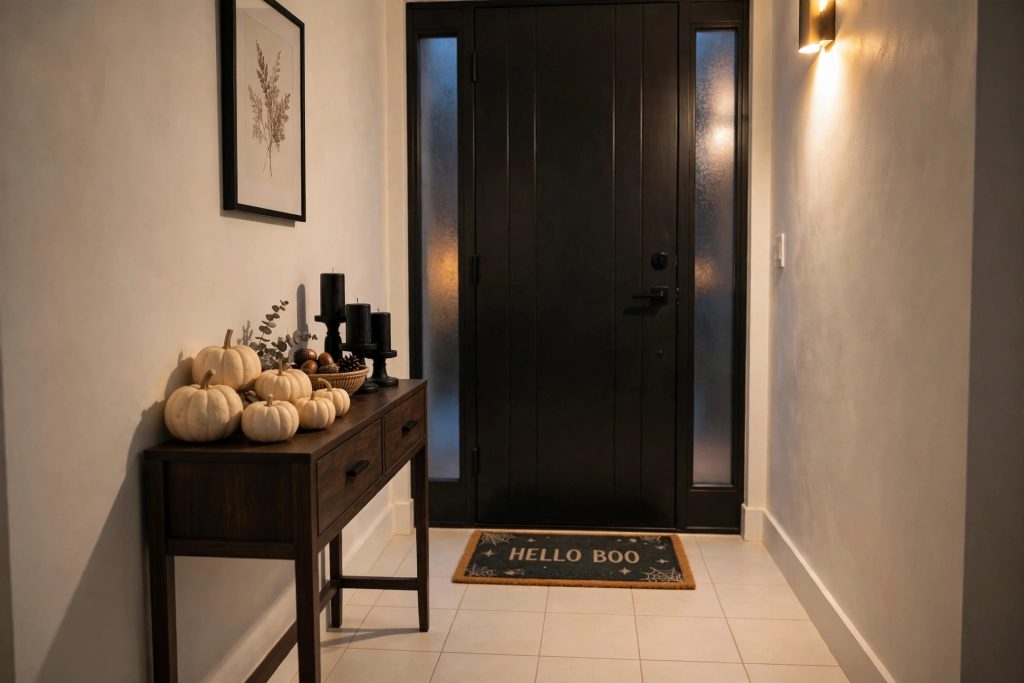
This is why I steer people toward a narrow console table with a drawer over the chunky statement pieces. Eight to twelve inches deep. The drawer swallows the mail and the spare batteries, which matters, because an entryway console is a landing strip first and a stage second. The styling rule that survives contact with real life: a tray for keys, decor grouped around the tray, and the middle of the surface left empty on purpose. The empty part is what makes the rest look chosen.
Under a warm entry bulb, by the way, half the black decor out there gives itself away. Most budget listings promise a matte finish, but under a standard overhead warm ceiling bulb it reflects light like cheap plastic — the candlesticks go shiny, the foam pumpkins go shinier, and the whole moody setup reads as a party-store haul. In a living room you can fix this with distance and lamplight. In an entryway, people stand eighteen inches from your console. There is no distance. Weight and surface finish are the whole test at that range, and a piece that feels light for its size will feel worse in your hand than it looked on the screen. Honestly, the entryway is the hardest room in the house to fake.

Is halloween entryway decor worth it if guests only see it for eight seconds?
Eight seconds is enough for light and one strong silhouette to register. It is not enough for fourteen small objects, which blur into a general impression of effort. So I spend on the two things a person actually takes in while taking their coat off: the door itself — wreath, or a mat with a graphic bold enough to read at standing height — and one source of warm light at console height. Everything between those two anchors is optional, and most of it is where the money leaks out.
The mantel taught me the same lesson from the other side of the house. When I stripped my Halloween mantel decor down to light plus a couple of shapes, it finally looked deliberate. Entries behave identically, just faster. One glowing thing, one dark shape against a light wall — bats over a mirror are the cheapest version of this that exists — and a pumpkin cluster that stays on the console instead of migrating to the floor, where it becomes a tripping hazard with a stem. Outside the door is a different job entirely, and the front porch Halloween setup can carry the big props the foyer has no business holding.
What I skip now: floor lanterns in the swing path, garlands draped where coat sleeves catch them, and anything scented near the door, because the first smell of a house sets a tone that pumpkin-spice spray gets wrong in a small space almost every time. What survives in my own entry, year after year, is embarrassingly short. A mat that clears the door. A wreath I measured. A tray, two pumpkins, one light. That’s the list.

Cool-running plug-in glow at console height · the light layer guests actually register

Pumpkins, berries & leaves · works over a door frame or along a console — measure it the day it arrives

Plug-in jack-o-lantern glow · weave it loose along the console, never across the walkway

Frequently Asked Questions
My front door scrapes over every thick doormat I buy. Is my door the problem, or the mats?
Usually the pairing, not either one alone. Standard coir mats run 0.4 to 0.5 inches thick, and a door hung tight to tile or hardwood may clear less than that at the lowest point of its swing, which is rarely at the hinge side where people test it. I test at the latch side, standing on the mat. If it drags there, I stop shopping coir for that door and buy a low-profile mat around 0.28 inches instead. Shaving a door for a seasonal mat is a sentence I refuse to type as advice.
Our foyer is barely four feet wide and there is no console table. Where does Halloween decor even go?
On the door, and only on the door, if that is the honest answer. A measured wreath plus a mat with a bold graphic covers the two sightlines a guest actually gets — eye level coming in, floor level leaving — and asks nothing from the walls or the walkway. Wall space above a door frame takes a short garland if the door swing clears it. Floor props in a four-foot foyer are not decor. They are obstacles with a theme, and someone carrying a laundry basket will find that out before Halloween does.
Can I layer a Halloween mat over the rug that already lives in our entry?
You can, and the layered sets sold for exactly this look fine in photos, but stacking is where thickness goes to hide. A plaid rug under a coir mat can push the combined stack past half an inch, and the door test has to be run on the stack, not on either piece alone. The other failure is quieter. Two loose layers walk. The top mat creeps toward the door a fraction every day until it bunches at the threshold, usually discovered by a toe, at night, in the dark I created on purpose for atmosphere.
The scrape is gone. The low-profile mat fixed it in a day, which annoyed me more than the noise did — a month of sidestepping, solved by 0.28 inches. The wreath still hangs a fraction off-center. I notice it every time I come home. It can stay wrong until November.
This site contains affiliate links. We may earn a commission on qualifying purchases.