Most accent chairs get bought on width. The listing photo looks tidy, the measurements fit the corner on paper, and then the chair arrives and nobody sits in it. The problem is rarely width. It’s that the chair faces the wrong way for conversation, the seat is too shallow to read in, or it needs dragging around every time someone wants to talk to the sofa instead of the wall.
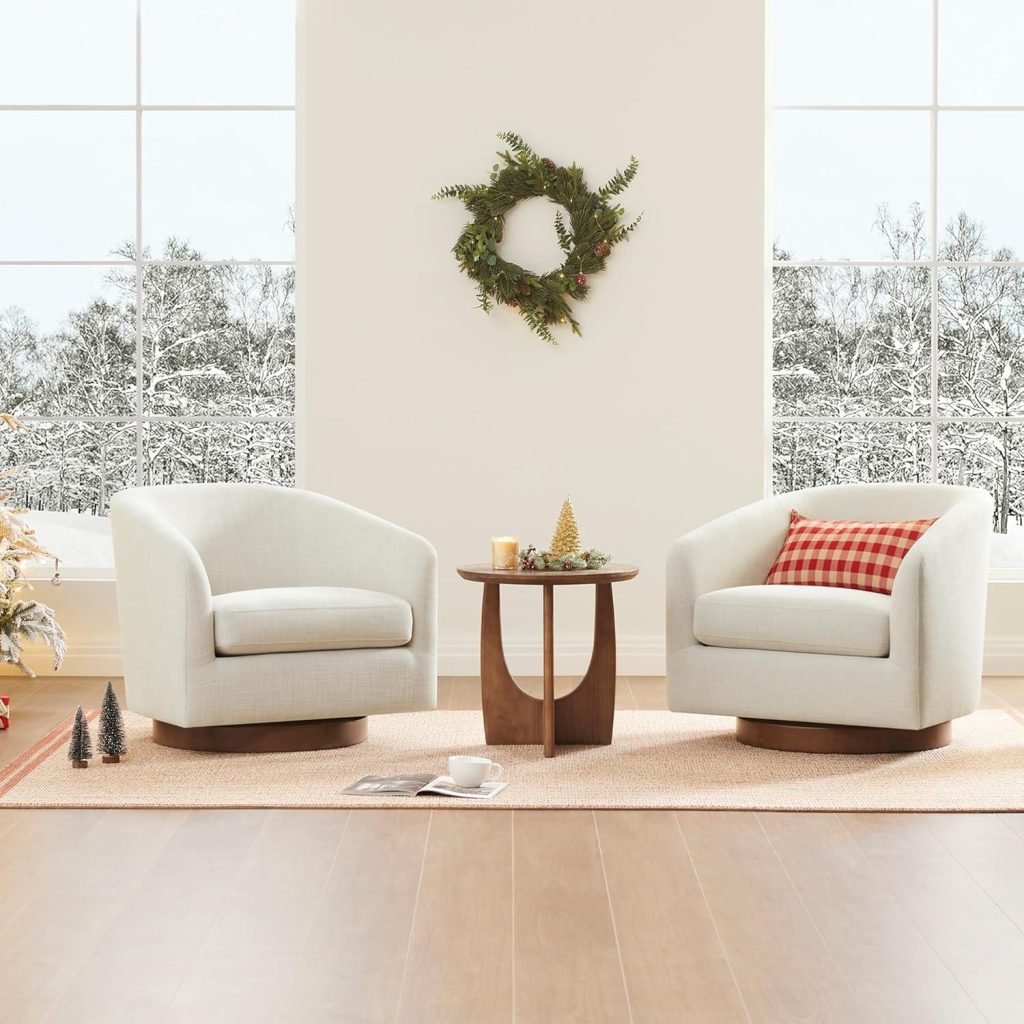
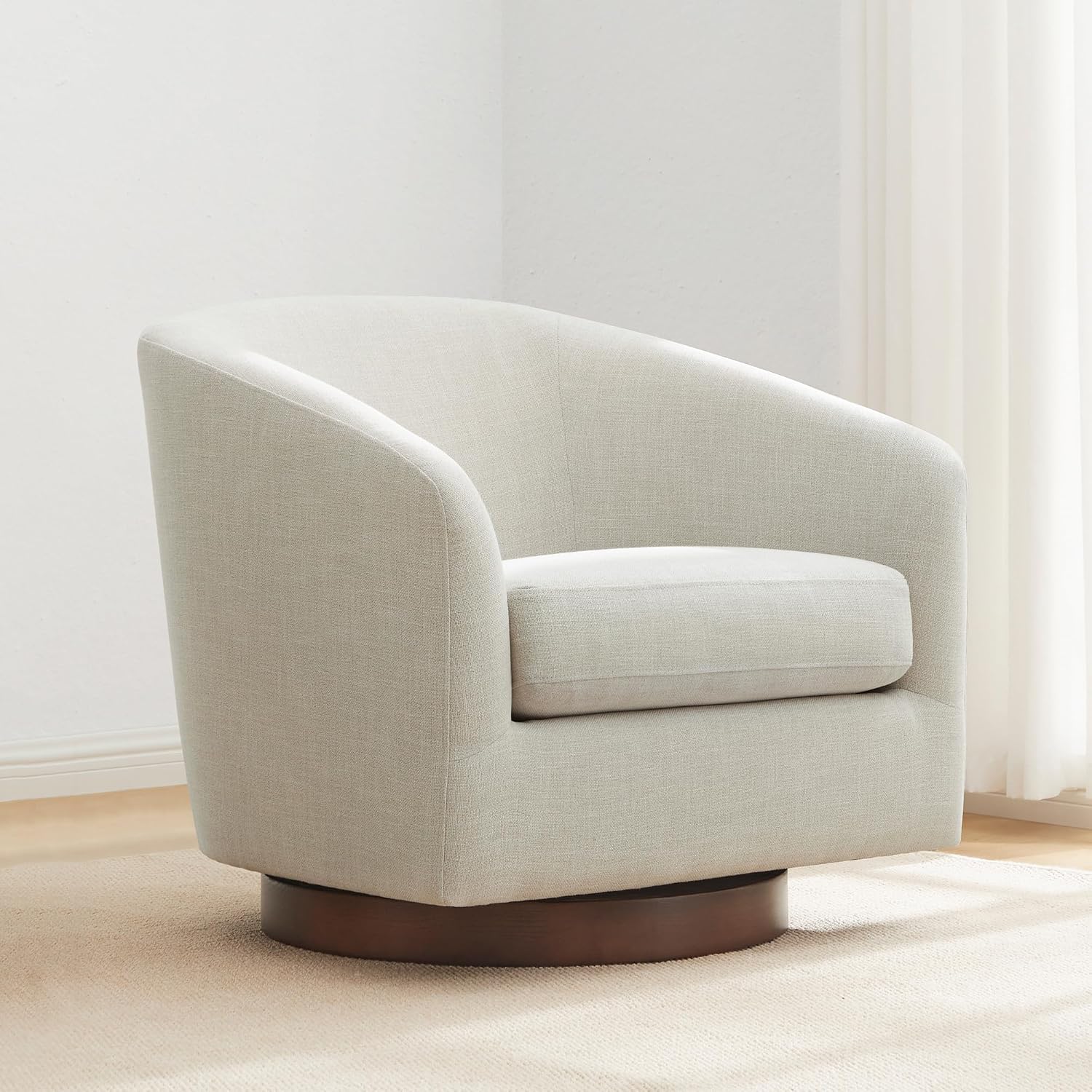
This guide anchors on the CHITA swivel accent chair — a linen barrel chair on a round wood-tone disc base that turns a full circle and, unusually for this category, arrives fully assembled. Two very different chairs keep it honest: the VINGLI accent chair, a fixed mid-century armchair in dark grey linen with scooped arms and a taller back, and the DUOMAY accent chair with ottoman, a beige chenille lounge chair on an open black metal frame with a matching footrest. Swivel, fixed, or feet-up lounge — those are the three real choices hiding inside the words accent chairs. Everything else is fabric.
Quick Answer
Decide how the chair will be used before you look at fabric. If the seat needs to serve two directions — sofa conversation one minute, window or TV the next — a swivel barrel like the CHITA earns its footprint and asks only for a few inches of turn clearance. Pick the VINGLI if the chair has one fixed job facing one fixed direction and you want a taller back behind you. Pick the DUOMAY set if reading means feet up, and you have the floor space an ottoman quietly consumes.
Compare Top Accent Chairs
Three proven picks side by side — choose the one that fits your needs.
CHITA Swivel Barrel Accent Chair
Full-circle swivel on a disc base, reading-depth seat, and it arrives fully assembled — the two-direction living room pick.
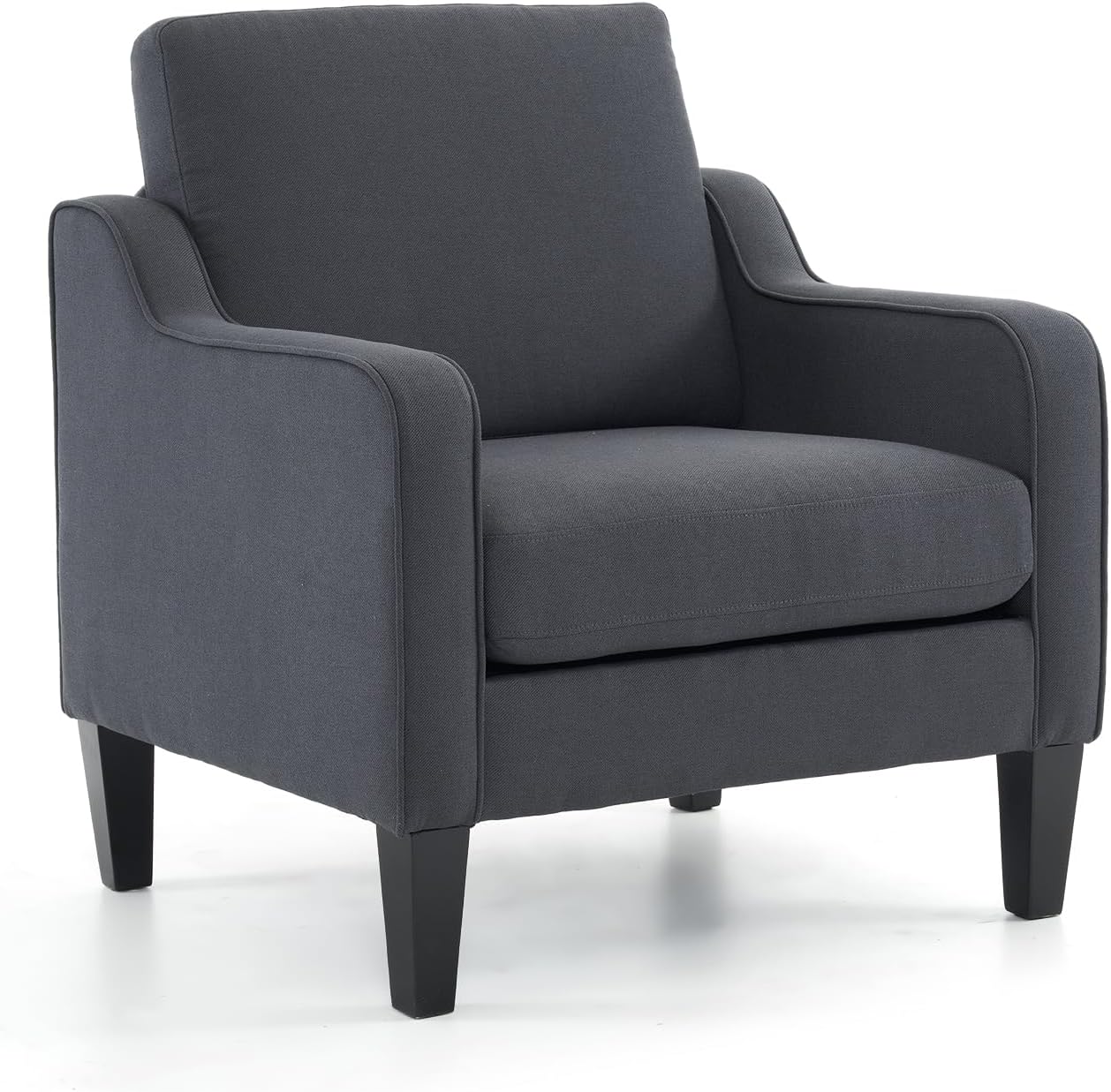
VINGLI Linen Accent Chair
Taller back, scooped arms, and legs that keep the floor visible — the small-room, single-direction pick.
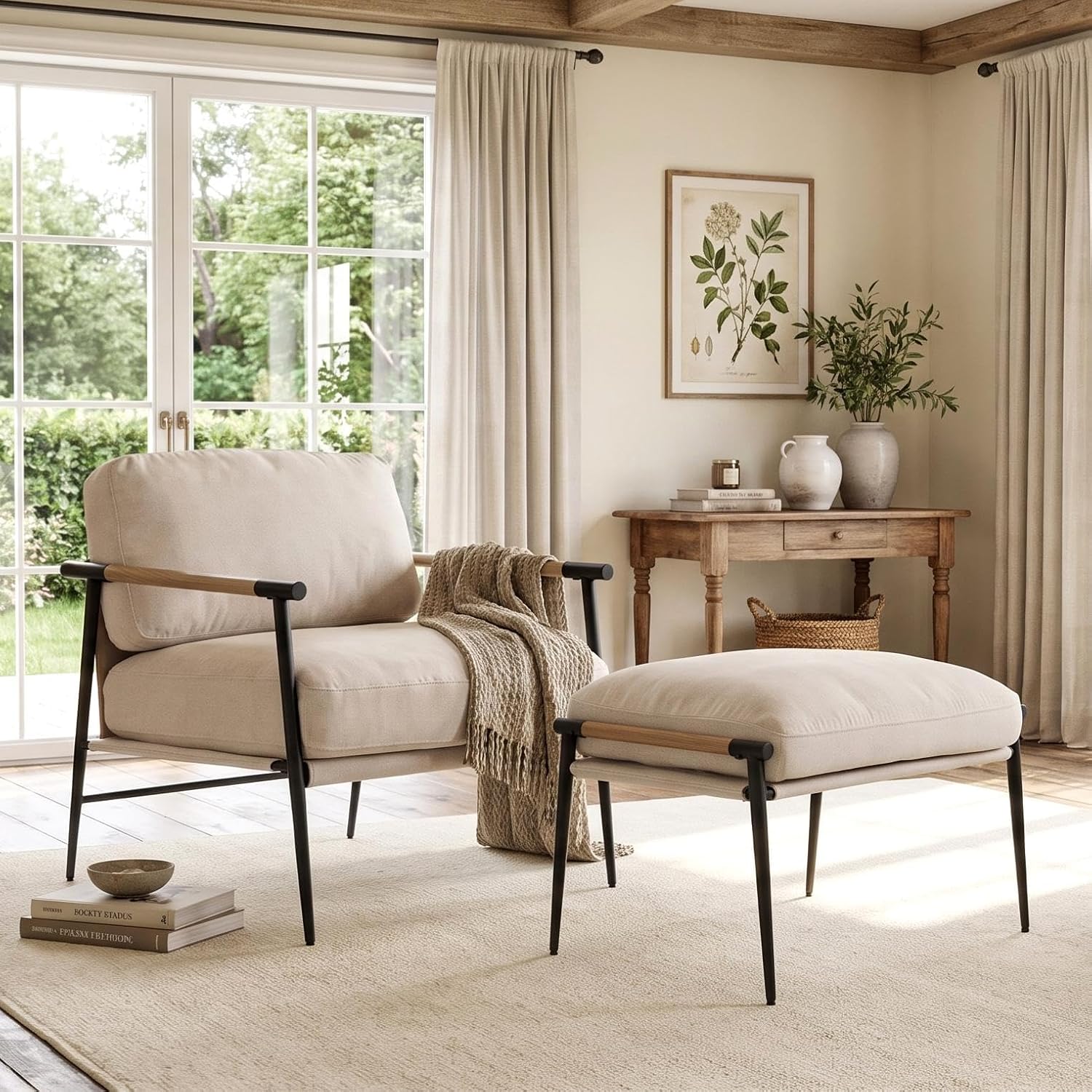
DUOMAY Accent Chair with Ottoman
Deep lounge seat plus a matching footrest on an open metal frame — the dedicated reading corner pick.
Prices and availability may vary — tap any product to check the current listing.
What to Look For in Accent Chairs
Six things decide whether an accent chair becomes the seat everyone fights over or the expensive place coats land. Fabric color is not one of them.
1. Swivel clearance, not just footprint
A fixed chair occupies its outline. A swivel chair occupies a circle. The CHITA’s body is listed at roughly 31 inches square, but the space it truly needs is the diagonal of that square, swept through a full turn, plus a margin so the back doesn’t kiss the wall or clip the side table mid-rotation. In practice, leave a hand’s breadth beyond the widest swing point on every side. Corners forgive swivel chairs. Tight gaps between a sofa arm and a bookcase do not — the chair still turns, it just reminds you of the furniture every time it does.
There’s a trade hiding here. Swivel buys flexibility in open layouts and steals it back in tight ones, because a fixed chair can be shoved flush against a wall and a swivel chair can’t — push it back and you’ve deleted the feature you paid for.
2. Seat depth decides reading comfort
Width gets the headline; depth does the work. A seat around 20 inches deep sits you upright, feet planted — fine for conversation, tiring after a chapter. Deeper seats, up toward 22 inches and beyond, let you tuck a leg under or lean into the corner of a barrel back with a book. The CHITA’s barrel shape wraps that depth around you: the listing’s own size diagram puts the seat depth at roughly 22 inches, which is reading depth, not perching depth.
Shorter readers should test the opposite edge of this. Too deep, and your knees bend past the cushion front or your lower back floats unsupported. A throw pillow behind the back is the standard fix, and honestly, most deep chairs end up styled with one anyway.
3. Back height and shape — barrel wrap vs tall back
Barrel backs are low by design. The CHITA’s curved back rolls straight into the arms at one height, so support lands at the shoulder blades and the look stays open and low-slung next to a sofa. Nobody’s head gets supported. For TV slumping, that’s a mark against it.
The VINGLI plays the other side: a separate, taller back cushion that reaches higher up the spine, with scooped arms that step down from it. It reads more like a small armchair and less like a tub. If the chair is going in a bedroom corner for long evening reads, that extra back height matters more than any swivel. If it’s a living-room conversation seat used in 20-minute bursts, the barrel’s openness usually wins the room visually.
4. Base type — disc, legs, or open frame
The base changes cleaning, stability, and floor manners. A disc base, like the CHITA’s round wood-tone plinth, spreads weight evenly, doesn’t catch on rug edges, and slides surprisingly well when you do need to shift it. It also hides dust underneath itself, which you’ll discover exactly once, months later.
Legs — the VINGLI’s black tapered set — lift the chair so a vacuum and your toes pass underneath, and the footprint feels lighter in a small room. The cost is four point-loads on your floor and a chair that stays where it’s put. The DUOMAY’s open metal frame splits the difference: airy like legs, but the chair-plus-ottoman pair means two pieces to shuffle instead of one.
5. Assembly — the honest line item
Fully assembled is a genuine feature in this category, not a luxury badge. Barrel chairs are bulky, curved assemblies; the ones that ship flat ask you to build that curve out of panels and hope the seams land flush. The CHITA arrives in one piece — you unbox it and sit down. The trade is delivery bulk: a one-piece chair needs a doorway it fits through in its finished size, so measure the tightest turn between your front door and the chair’s corner before ordering any no-assembly piece.
The VINGLI and DUOMAY follow the normal route — legs and frame parts attach at home. That’s an evening with an Allen key, not a weekend. But seams, leg alignment, and your patience all become part of the finished product.
6. Upholstery you can live with
Linen-look fabrics, like the CHITA’s and the VINGLI’s, hide everyday dust well and read calm next to most sofas. They also wrinkle honestly and show dark spills faster than you’d like. Chenille, the DUOMAY’s beige pile, feels warmer and disguises light wear in its texture — then holds pet hair with real commitment. None of these are performance fabrics in the outdoor sense. If the chair will host toddlers with juice boxes, choose the darkest colorway on offer and keep expectations where they belong: this is a seat, not a shield.
One more thing people skip. Check whether the seat cushion is loose or fixed. A loose cushion — the CHITA’s thick seat pad sits as its own piece — can be flipped, plumped, and spot-cleaned on a sink edge. Fixed upholstery looks tidier on day one and gives you fewer options on day four hundred.
How to Match an Accent Chair to Your Situation
The two-direction living room
Your sofa faces the TV. Guests, awkwardly, also face the TV. A swivel accent chair placed at the end of the rug solves the geometry: turned one way it joins movie night, turned the other it’s a conversation seat facing the sofa. This is the CHITA’s home turf. It also pairs naturally with a small velvet loveseat in tighter rooms, where a full sofa plus two fixed chairs would seal the layout shut. The limit? One swivel chair helps. Two, facing off across a lift-top coffee table, can start to feel like a talk-show set.
The dedicated reader
You read in the same corner, at the same hour, facing the same lamp. Direction never changes, so swivel buys you nothing — spend on the seat instead. That means depth, a back that supports a long sit, and your feet sorted. The DUOMAY set is built for exactly this: a deep, loose-cushioned lounge chair with the ottoman ending the nightly search for somewhere to put your heels. Add a reading floor lamp behind the shoulder and the corner is done. The trade is permanence. An ottoman corner is furniture geography; rearranging around it takes commitment.
The small-room single chair
One chair, one job, not much floor. The VINGLI’s fixed legs and upright back waste the least space: no swing circle to reserve, no ottoman to house, and the raised base keeps the floor line visible so the room reads bigger. It faces one direction and does it properly. Skip swivel here even if you like the idea — in a small room the clearance a swivel needs is usually the walkway, and a chair that taps the wall on every turn gets its swivel used less and less until it’s just a heavy fixed chair with a secret.
Accent Chair Types Compared
| Type / Tier | Best For | Price Tier | Key Feature | Watch-Out |
|---|---|---|---|---|
| Swivel barrel chair | Two-direction living rooms, conversation corners | Premium | Full-circle turn on a disc base; wrap-around low back | Needs swing clearance on all sides |
| Fixed mid-century armchair | Single-direction seating, small rooms | Budget to mid-range | Taller back, legs that keep the floor visible | Stays facing where you put it |
| Chair-and-ottoman lounge set | Dedicated reading corners, feet-up relaxing | Mid-range | Matching footrest; deep, loose cushions | Two-piece footprint eats floor space |
| Oversized swivel / cloud chair | Large rooms, curl-up loungers | Premium | Extra-wide seat you can sit cross-legged in | Swings a very wide circle; dwarfs small rugs |
The swivel barrel is the flexible one. Its whole value is directional — the seat serves the sofa, the window, and the TV without being lifted. Take away the turning and it’s just a tub chair.
The fixed mid-century armchair is the honest budget-to-mid option. You give up movement and get back support, a smaller footprint, and a chair that disappears politely into a corner. For a guest-facing seat that gets used in short bursts, that trade is often the right one.
The chair-and-ottoman set competes with recliners, not with other accent chairs. Judge it on total footprint with the ottoman pulled up, not the chair alone — listings photograph the pair close together and the combined depth still surprises people.
The oversized swivel tier tempts everyone and fits fewer rooms than it promises. Cross-legged sitting is lovely. A chair whose swing circle overlaps the coffee table is not. Measure the circle, not the chair.
Three Rooms, Three Different Right Answers
Open-plan living area
Open layouts are where swivel earns its keep, because zones in an open plan are defined by where seats face, not by walls. A barrel chair at the seam between the living and dining zones can belong to both. The CHITA’s low back helps here — it doesn’t build a visual wall across the space the way a tall-backed chair does.
Bedroom corner
Bedroom chairs collect clothes. There, I said it. The defense is choosing a chair comfortable enough that sitting beats draping: a deeper seat, an ottoman if the room takes one, and a small side surface so the chair isn’t also the nightstand. The DUOMAY’s open frame keeps a bedroom feeling light; the CHITA’s solid barrel reads calmer and more enclosed. Either works. A shallow, upright chair in a bedroom becomes a valet stand within a month — the VINGLI survives this fate mainly in rooms where it’s genuinely the reading seat, lamp already placed.
Home office guest seat
An office accent chair does double duty: visitor seating that doesn’t look corporate, and your own change-of-scenery seat for calls and reading. Fixed legs win here. Clients don’t need a chair that rotates mid-conversation, and the VINGLI’s taller back photographs as proper furniture on video calls. Swivel in an office tends to drift — you will find the chair facing a slightly different direction every morning.
Common Mistakes When Buying Accent Chairs
Measuring the chair instead of the circle
Swivel chairs get returned for a measurement nobody took. The chair fits the corner standing still; the corner doesn’t fit the chair turning. Tape the swing circle on the floor with painter’s tape before ordering. Live with the tape for a day. You’ll know.
Matching the sofa fabric exactly
A near-match is worse than a contrast. Two linens in almost-the-same beige read as a mistake under evening light, while a deliberate difference — texture against smooth, dark against pale — reads as a choice. The VINGLI’s dark grey against a light sofa, or the CHITA’s pale linen against a deeper one, both work precisely because nobody has to squint.
Buying the pair before testing one
Pairs look decisive in photos and double every mistake in person. Seat depth that suits one partner can strand the other’s feet. Order one, live in it for a week, then commit to the second. With fully-assembled pieces like the CHITA this matters twice over — returns of one-piece furniture are nobody’s idea of fun.
Ignoring arm height next to the side table
The chair goes beside a table; the mug goes on the table; your arm, resting on the chair’s arm, knocks the mug. Arms that sit well below the tabletop let you reach across naturally. Arms level with it turn every reach into a lift-and-clear maneuver. Barrel chairs fold this into the design — the arm is the back, sloping down at the front — while tall scooped arms like the VINGLI’s need a lower table beside them.
Why, How, and What
Why do barrel chairs keep showing up in living rooms?
Because the shape solves a social problem. A curved, continuous back makes the same seat comfortable facing slightly left or slightly right, so the chair tolerates imperfect placement — and most real rooms are imperfectly placed. Add a swivel base and the tolerance becomes total. Straight-backed chairs demand to be aimed. Barrels just need a neighborhood.
How should an accent chair sit in relation to the sofa?
Aim for conversation distance — close enough that two seated people can talk without raising their voices, angled slightly toward the sofa rather than lined up parallel like a waiting room. Seat heights should land within a few inches of each other so nobody talks up or down at a guest. On rugs, get at least the chair’s base or front legs onto the rug; a chair floating entirely off it looks like it wandered in from another room.
What makes an accent chair read as “accent” instead of just a chair?
One deliberate difference from the main seating: silhouette, texture, or color — pick one, not all three. The CHITA accents by silhouette (low barrel against a straight sofa). The DUOMAY accents by structure, that open black frame against upholstered everything. A chair that differs in all three ways stops accenting and starts auditioning for its own room.
Questions People Ask Before Buying
Are swivel accent chairs worth it, or is the swivel just a gimmick?
A swivel accent chair is worth it when the seat regularly needs to face two directions — toward the sofa for conversation and toward a window, fireplace, or screen the rest of the time — because turning in place replaces the daily drag-and-scrape of repositioning a fixed chair across the floor. Where the gimmick charge sticks is the single-direction room. A swivel chair parked forever facing the TV is a fixed chair carrying extra hardware, extra cost, and a slow sideways drift you’ll correct every morning. Judge the room honestly: two directions, swivel earns its place; one direction, spend the money on seat depth instead.
How much space does a swivel accent chair actually need?
A swivel accent chair needs clear floor space equal to its diagonal measurement plus a few extra inches on every side, because the corners of a square chair sweep a circle wider than the chair itself whenever it turns with someone seated in it during normal everyday use. Tape the circle on the floor before ordering — it takes two minutes and settles arguments that product photos start. Side tables, floor lamps, and plant stands all count as obstacles if they fall inside the tape. If the circle only clears when the chair is empty, it doesn’t clear.
What seat depth makes an accent chair comfortable for reading?
A seat depth of roughly twenty-one to twenty-three inches makes an accent chair comfortable for reading, because that depth lets you sit back fully, bend your knees naturally, or tuck one leg underneath without the cushion edge pressing into the backs of your thighs mid-chapter. Shallower seats around nineteen to twenty inches are conversation seats — upright, social, and quietly uncomfortable after half an hour with a novel. The CHITA’s own size diagram puts its seat at roughly twenty-two inches deep, squarely in reading territory. Shorter readers sitting in deeper chairs can close the gap with a firm pillow behind the back.
Should I get an accent chair with an ottoman or a wider chair instead?
Choose the chair with a matching ottoman when you read or relax in one dedicated corner most evenings, because a footrest supports your legs along their whole length in a way that a merely wider seat, however deep and soft, simply cannot reproduce for your ankles and calves. The honest cost is floor space: a set like the DUOMAY occupies its chair footprint plus the ottoman’s, pulled close, every single day. A wider single chair keeps everything in one outline and suits rooms that rearrange often. Fixed corner, take the ottoman. Flexible room, take the width.
Do accent chairs have to match the sofa exactly?
Accent chairs should not match the sofa exactly, because a deliberate contrast in one element only — silhouette, texture, or color — makes the chair read as an intentional design choice, while a fabric that almost matches usually reads as a purchasing mistake under warm evening light. A low barrel silhouette against a straight-backed sofa is contrast enough on its own, even in a similar pale fabric. A dark fixed chair like the VINGLI contrasts by color and can stay quiet in shape. Change one variable. Rooms where the chair differs in shape, color, and texture all at once tend to look collected by accident rather than composed on purpose.
Frequently Asked Questions
Can a barrel accent chair work at a desk or vanity?
As an occasional seat, yes; as a full workday desk chair, no. The barrel’s wrap-around arms sit at one fixed height and the base is built to turn, not to roll, so you’ll shuffle the whole chair to get in and out. For makeup, laptop bursts, or a bedroom writing corner it’s comfortable and looks far better than a task chair. Anyone working eight-hour days should keep a proper desk chair and let the barrel do living-room duty.
Is a fully assembled accent chair worth paying more for?
For curved, one-piece designs like a barrel chair, usually yes. Assembly is where flat-packed curved furniture shows its seams — panels that don’t quite meet, a back that sits a degree off. A chair that arrives finished, like the CHITA, skips that lottery entirely. The counterweight is delivery: the finished chair must pass your doorways and hallway turns at full size, so measure the route, not just the room. If the route fails, a leg-assembly chair like the VINGLI is the pragmatic pick.
How do I keep a swivel chair from drifting or creeping on hard floors?
Start with the rug. A disc-base chair placed fully on a low-pile rug stays where the rug stays, and the base spreads weight so it won’t dent the pile the way four legs can. On bare hard floors, a thin non-slip rug pad under the base stops the slow migration without visible fuss. Chairs also creep because people push off the arms to stand — a side table within easy reach gives hands somewhere better to land.
Which upholstery is easier to live with — linen, chenille, or velvet?
Linen-look weaves are the forgiving middle: they hide dust, breathe well, and suit bright rooms, though dark spills show quickly on pale colorways. Chenille feels warmer and its pile disguises light wear, but it holds pet hair and asks for regular lint-roller sessions. Velvet reads the most formal and shows every pressure mark until you brush the pile back. For a household with pets, a mid-tone linen or chenille in a textured weave hides the evidence longest between cleanings.
Should I buy one accent chair or a matching pair?
Buy one first whenever the model is new to you. Live in it for a week — seat depth and back height are personal in ways listings can’t settle — then order the second if the first earned it. Pairs make sense flanking a fireplace, a console, or a conversation rug where symmetry is the point. A single chair is the right call for a reading corner or a small room, where a second would crowd the walkway just to complete a set nobody asked for.
How tall should an accent chair be next to a standard sofa?
Aim for a back height at or a little below the sofa’s back, and a seat height within a few inches of the sofa’s seat. A chair that towers over the sofa reads as a throne; one that sits far lower makes conversation feel like talking down to a child. Low barrel chairs break this rule safely because their whole silhouette is intentionally lower and wider — the proportions read as a choice. What looks wrong is a chair that’s almost sofa height but not quite.
Final Recommendation
Buy the movement only if your room will use it. In a two-direction living room, the CHITA swivel accent chair is the pick of this trio: real reading depth inside the barrel, a disc base that’s kind to floors and rugs, and the rare relief of zero assembly — with swing clearance as the one condition you must honestly have. It is not the cheap option, and for a chair that never needs to turn, it shouldn’t be yours.
For a fixed seat with a proper back behind it, the VINGLI does the most with the least floor. For a corner that exists for one person, one book, and feet up, the DUOMAY chair and ottoman is the one that will actually get used daily. Worth it? Depends entirely on the corner. Measure the circle, check the depth, then choose.
Decision Tree: Which Accent Chair Fits?
Does the seat need to face two directions? Yes — swivel barrel (CHITA), after taping out the swing circle. No — keep reading.
Is it mainly for long reading sessions? Yes — chair-and-ottoman set (DUOMAY) if the floor space exists; the CHITA if it doesn’t. No — keep reading.
Is floor space the tightest constraint? Yes — fixed armchair on legs (VINGLI), placed once, facing its one direction well.
Key Takeaways
Swivel chairs need a clear turning circle, not just a footprint — tape it out before ordering.
Seat depth around 22 inches reads as a reading chair; shallower seats are conversation seats, and both are fine when chosen on purpose.
Fully assembled saves an evening and a few seams, but the finished chair must fit your doorway turns.
Contrast the sofa deliberately in one way only — silhouette, texture, or color.
Compare Top Accent Chairs
Three proven picks side by side — choose the one that fits your needs.
CHITA Swivel Barrel Accent Chair
Full-circle swivel on a disc base, reading-depth seat, and it arrives fully assembled — the two-direction living room pick.
VINGLI Linen Accent Chair
Taller back, scooped arms, and legs that keep the floor visible — the small-room, single-direction pick.
DUOMAY Accent Chair with Ottoman
Deep lounge seat plus a matching footrest on an open metal frame — the dedicated reading corner pick.
Prices and availability may vary — tap any product to check the current listing.