Quick answer: Buy plug-in LED string lights (orange/purple or warm white, IP65 if exposed to rain) as your backbone — one purchase that covers porch railings, bushes, and fence lines. Add one or two spotlights to wash the house or a big prop in light, use battery or solar lights only for spots far from an outlet, and keep black lights to covered porches and party areas.
Whatever you buy, it must be outdoor-rated (IP44 minimum, IP65 for exposed yards), UL or ETL listed, and plugged into a GFCI outlet with weatherproof connections.
Halloween lighting is a system of two or three layers, and each layer has a clear job. Buy the right type for each job once, and your house glows; buy the wrong types, and you’ve got an expensive pile of mismatched strands. Here’s how to choose.
The Five Types of Outdoor Halloween Lights — and Who Each One Is For
The short version: most homes need string lights plus one spotlight. The rest are optional accents, not essentials.
| Type | Best for | Power |
|---|---|---|
| LED string / fairy lights | Porch railings, bushes, fence lines, trees — the ambient glow layer | Plug-in, battery, or solar |
| Figural covers (pumpkins, ghosts, bats) | Themed accents on railings and door frames | Plug-in or battery |
| Spotlights / uplights | Washing the house, trees, or one big prop in dramatic light | Plug-in or solar |
| Black lights (UV-A) | Covered porches and party zones; makes white and neon costumes pop | Plug-in |
| Solar stake lights | Walkways and yard edges with no outlet nearby | Solar |
If you buy only one thing, make it the string lights. Everything else adds drama, but the strings provide the baseline glow that makes the whole display readable from the street.
String Lights: Start Here If You Buy Only One Thing
The short version: buy a plug-in LED strand in orange, purple, or warm white; battery only when there’s genuinely no outlet nearby.
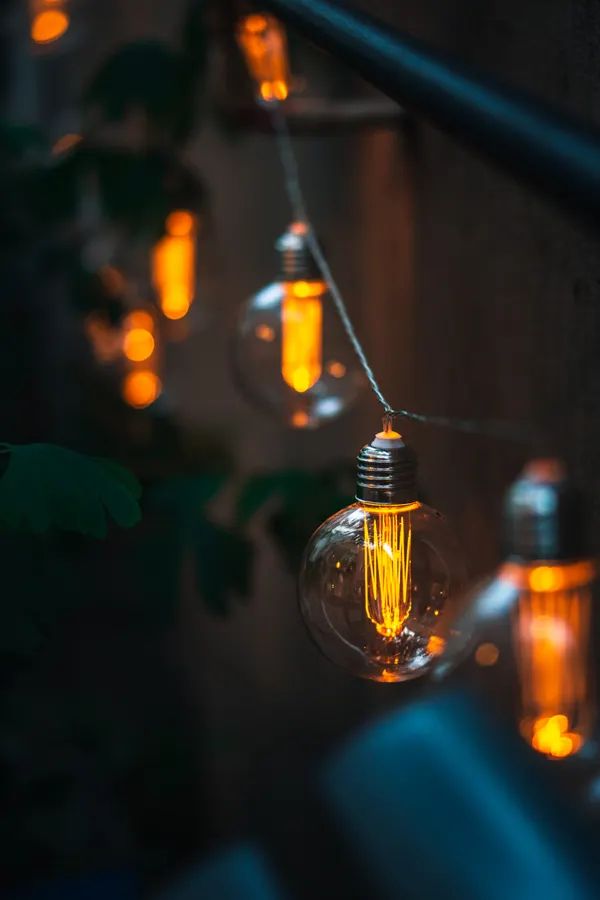
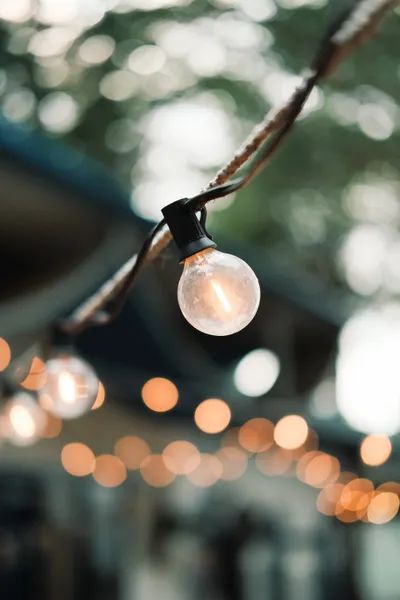
String lights are the workhorse of Halloween lighting. A few buying rules that separate good strands from frustrating ones:
- Go LED, always. LED strands draw only a few watts per string, so you can chain several together and leave them on all October without worrying about the electric bill. Old incandescent mini-lights burn hotter, use far more power, and one dead bulb can take down a section.
- Match the wire color to the background. Green wire disappears into bushes and hedges; black or brown wire is invisible against a dark porch railing at night. Clear wire looks neat indoors but glints in daylight photos.
- Check LED count and length together. “100 LEDs on 33 feet” is standard density and reads well at night. For shrubs and bushes, roughly 50–100 LEDs per plant gives an even, full look; a thin scattering of 20 looks sparse.
- Plug-in beats battery for all-season use. Battery strands fade and die — plug-in strands run consistently all night, every night. Reserve battery for places you truly can’t reach with an extension cord.
Our Porch Lighting Pick
Spooky LED Pumpkin String Lights for Halloween
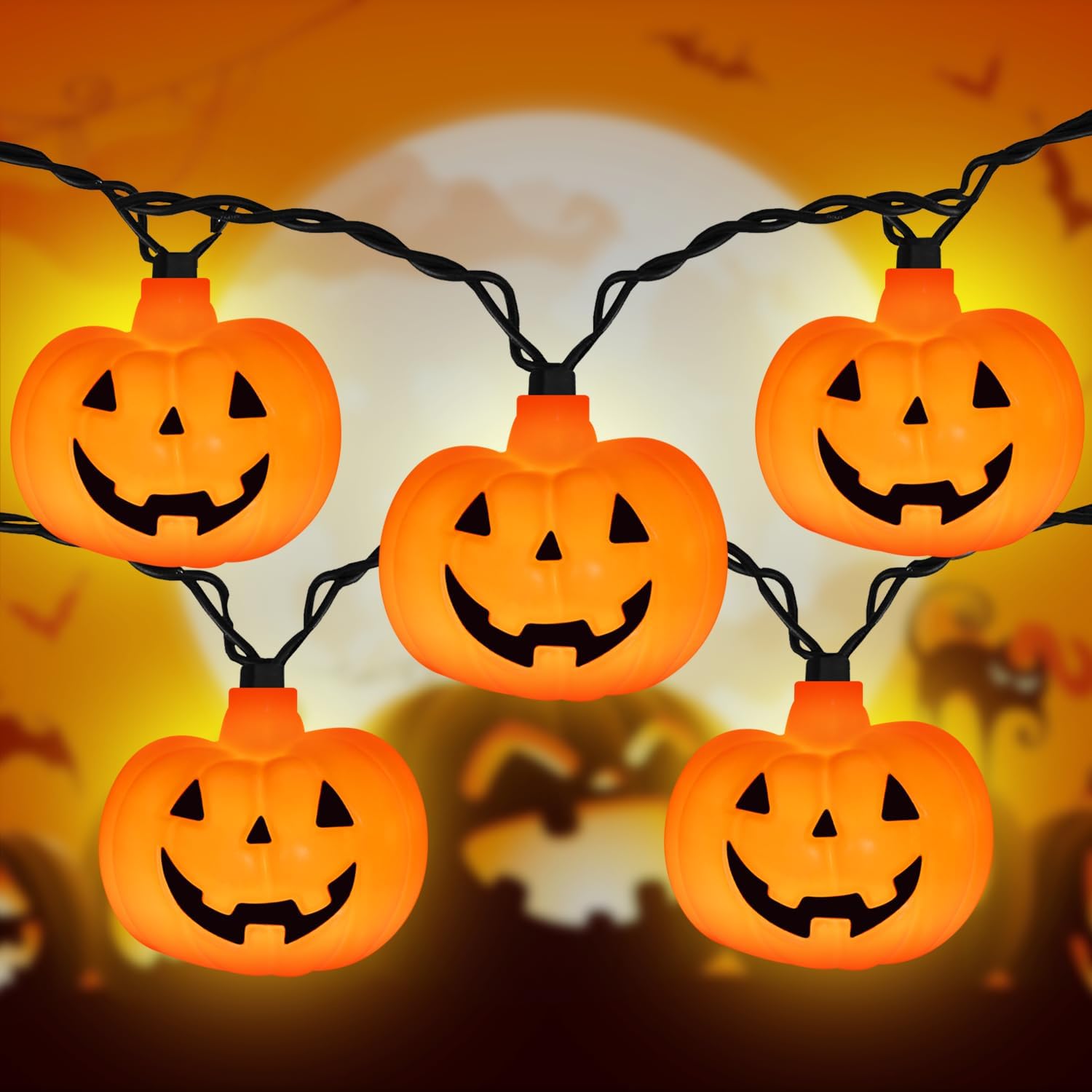
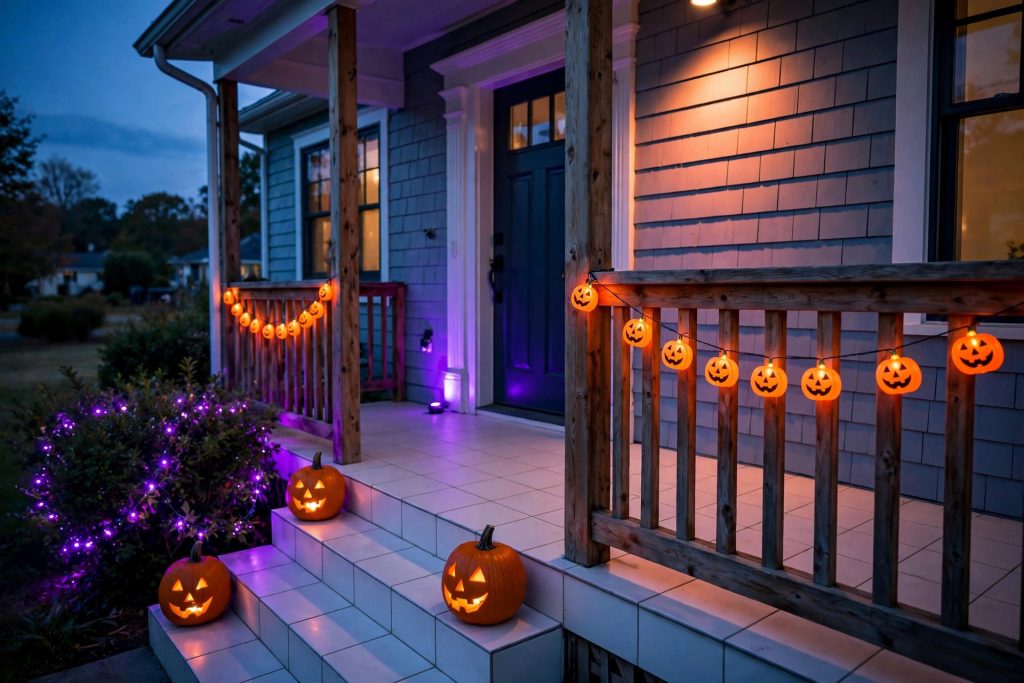
An 8.5 ft plug-in LED string of smiling jack-o’-lantern faces — exactly the kind of railing accent this guide is built around. We covered the full buying criteria (power source, weatherproofing, durability) in our in-depth review of these pumpkin string lights.
Spotlights and Uplights: The Drama Layer
The short version: one spotlight washing your house or your biggest prop does more for curb appeal than five more strands of string lights.
Uplighting is what separates “lit for Halloween” from “spooky.” Place a spotlight at the base of the house aimed upward and the whole facade becomes a canvas — then add silhouette props in front of it, and their shadows do the scary work for you. Orange light makes brick and siding look like firelight; purple reads as haunted; green is pure Halloween.
- One or two is enough. A single 10–15W LED spotlight can wash a two-story facade. More lights wash out the shadows that create the spooky effect.
- Angle and conceal. Tuck the fixture behind a bush or pumpkin so viewers see the light, not the hardware.
This layer pairs beautifully with the window silhouette displays from our earlier guide: backlit windows plus an uplight-washed house is the classic Halloween postcard look.
Black Lights: Powerful, But Only in Covered Spots
The short version: black lights are for porches, garages, and party rooms — not open yards.
A black light (UV-A) is invisible itself but makes white fabric, neon paint, and fluorescent costumes fluoresce — trick-or-treaters in white costumes will practically glow. Mount the fixture overhead or on the porch ceiling aimed down at the path, keep it out of reach, keep cords out of foot traffic, and use it in covered areas only — most black light fixtures aren’t rain-rated.
Solar Stake Lights: The No-Wiring Option
The short version: perfect for walkways and yard edges with no outlet — just don’t expect them to carry the whole display.
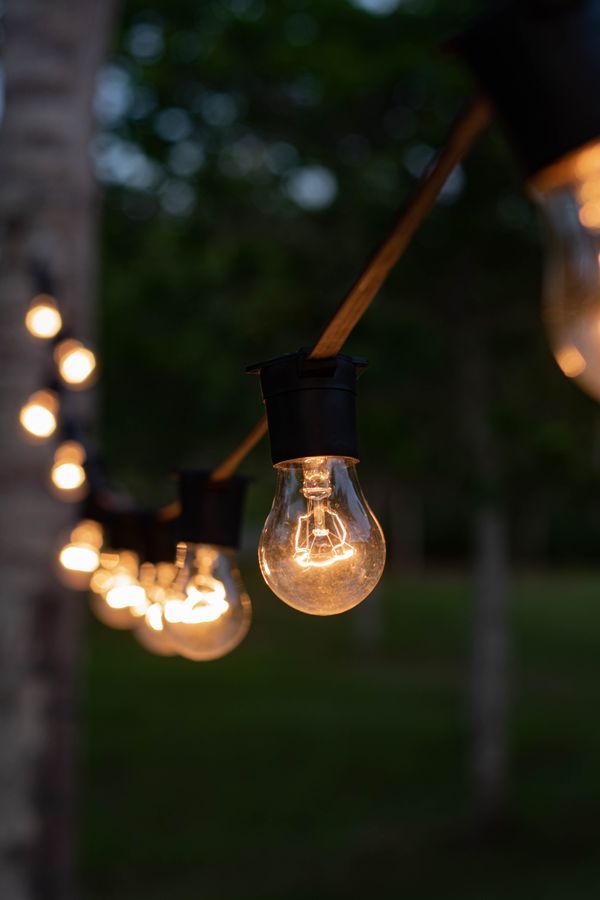
Solar Halloween lights — ghost stakes, pumpkin path markers, eyeball fireflies — exist for one job: lining a path or marking yard edges where extension cords can’t reasonably go. Typical specs: 6–8 hours of sunlight for 8–12 hours of nighttime light, and most are IP65 weatherproof.
- Place them where they actually see sun. Under the eaves or in heavy tree shade, they’ll glow dimly for an hour and quit. The sunniest edge of the yard is the right spot.
- Buy enough to matter. Two lone stakes look accidental. A run of 6–10 spaced 3–4 feet apart reads as a deliberate, spooky runway for trick-or-treaters.
Plug-In vs. Battery vs. Solar: Which Power Source Should You Choose?
The short version: plug-in wherever possible, battery where you can’t reach, solar for ground-level accents in sunny spots.
| Power source | Strengths | Weaknesses | Use it for |
|---|---|---|---|
| Plug-in | Consistent brightness all night; timers easy; cheapest long-term | Needs an outlet and extension cords | Porch, railings, roofline, spotlights |
| Battery | Goes anywhere; no cords | Batteries fade and die; costly to run all month | Wreaths, door frames, indoor-adjacent spots |
| Solar | No cords, no batteries, no bills | Dim on cloudy days; needs direct sun | Walkway stakes, yard edges, ground accents |
The Outdoor Safety Checklist — Your Buying Filter
The short version: if a light doesn’t say “outdoor rated” with a real IP rating and a UL/ETL listing, don’t buy it for outside.
Outdoor electricity plus October rain is no place for bargains. Run every candidate through this checklist before it goes in the cart:
- IP rating: IP44 minimum, IP65 for exposed yards. IP44 resists splashes and light rain — fine under a covered porch. IP65 shrugs off heavy rain and direct jets — what you want for the open yard, fence line, and ground stakes.
- UL or ETL listing (US). This mark means the light was tested to a published safety standard by an independent lab — not just self-certified by the manufacturer. A CE-only mark doesn’t substitute for a US listing.
- “For outdoor use” on the label. Indoor-rated lights lack the insulation and connector sealing to handle rain, dew, and temperature swings.
- GFCI outlet, always. Plug outdoor lights into a GFCI-protected outlet, and cover the outlet with a weatherproof in-use cover.
- Connections off the ground. Plug joints and control boxes are the #1 failure point, not the LEDs — elevate them, aim connections downward so water can’t pool, and use cord-connection boxes or weatherproof tape.
- LEDs only near flammable decor. LEDs run cool; keep any warm-running bulb well away from hay, dried corn, fabric, and paper. Never put real candles inside props with electrical cords.
How Much Light Do You Actually Need?
The short version: a porch needs one or two strands; a yard needs one spotlight plus path markers. Stop when it reads from the street.
Start small — you can always add, but returning tangles of lights is miserable. Practical rules of thumb:
- Porch railing: one 20–30 ft strand for the railing, a second for the porch ceiling or door frame. That’s a complete porch.
- Bushes: roughly 50–100 LEDs per plant.
- House facade: one plug-in spotlight at the base washes a two-story house.
- Walkway: 6–10 solar stakes, 3–4 ft apart, on both sides of the path.
The test is always the street: walk to the curb at night. If the house reads as “decorated” with visible focal points, you’re done. If it just glows uniformly, you need fewer strings and one bold focal light instead. For the full placement playbook, see our porch guide and our yard guide.
Mistakes to Avoid
The short version: most Halloween lighting failures are placement and weatherproofing, not the lights themselves.
- Mixing warm white and cool white. Two different whites side by side look broken, not festive. Pick one color temperature for the ambient layer and stick with it; use colored lights only as accents.
- Indoor lights outside “just for the night.” One rainy night is all it takes. The rule is binary: outdoor-rated or it stays inside.
- Lighting everything evenly. Uniform brightness kills the spooky effect — Halloween wants pools of light and pockets of darkness. Uplight one tree, leave the next one dark.
- Waiting until the last week. Weatherproofing and anchoring take a dry weekend — the first two weeks of October are your setup window.
- Forgetting the off switch. Every outdoor strand should end at a timer or smart plug, not a nightly walk through the rain to unplug things.
Common Questions About Which Outdoor Halloween Lights Should I Buy? A 2026
Which outdoor Halloween lights should I buy?
For most homeowners decorating for Halloween, plug-in LED string lights are the backbone to buy: nailing the core buying factors covers the essentials (two shopping trips’ worth of lights, chosen by job instead of by vibe), keeping the choice simple without overspending on features you will not use. Start there, then adjust up or down for your space.
Two shopping trips’ worth of lights, chosen by job instead of by vibe, will out-glow a garage full of impulse buys — every single October..
Are string lights or projectors better for Halloween?
The Which Outdoor Halloween Lights Should I Buy? A 2026 Buying Guide holds its own on the core buying factors: the real decision comes down to two shopping trips’ worth of lights, chosen by job instead of by vibe (two shopping trips’ worth of lights, chosen by job instead of by vibe) — the difference that matters most for daily use.
Two shopping trips’ worth of lights, chosen by job instead of by vibe, will out-glow a garage full of impulse buys — every single October..
Two shopping trips’ worth of lights, chosen by job instead of by vibe, will out-glow a garage full of impulse buys — every single October..
What should I look for in weatherproof outdoor lights?
The design details covered in this review: the core buying factors are the details that matter most (two shopping trips’ worth of lights, chosen by job instead of by vibe) — get that right and the rest of the decision is easy.
Two shopping trips’ worth of lights, chosen by job instead of by vibe, will out-glow a garage full of impulse buys — every single October..
How much should I spend on outdoor Halloween lights?
The design details covered in this review: getting the core buying factors right sets a sensible ceiling (two shopping trips’ worth of lights, chosen by job instead of by vibe), so you can stay inside it without giving up the result you want. Spend more only for durability or scale, not for looks.
Two shopping trips’ worth of lights, chosen by job instead of by vibe, will out-glow a garage full of impulse buys — every single October..
What mistakes should I avoid with Halloween lighting?
Most buyers go wrong on the core buying factors: a few practical trade-offs worth knowing. Nail those details before you spend a cent, because that is where the expensive regrets come from, not from the price tag itself.
Two shopping trips’ worth of lights, chosen by job instead of by vibe, will out-glow a garage full of impulse buys — every single October..