
Cutting Through the Countertop Clutter: Is the KitchenAid Large Capacity Dish Rack Worth It?
Let’s talk about dish racks. Specifically, that KitchenAid Large Capacity Full Size Rust Resistant Dish Rack with Angled Drain Board and Removable Flatware Caddy, Light Grey one. This guide is for anyone who’s ever stared at a mountain of hand-washed dishes, wondering if their current drying solution is truly pulling its weight, or if shelling out a bit more for a seemingly “nicer” option actually makes a lick of sense. We’re sifting through the details, figuring out if a premium dish drying rack like this KitchenAid model earns its spot in your kitchen.
Quick Answer
For many households, especially those with consistent hand-washing needs or limited dishwasher space, a robust full-size dish rack like the KitchenAid Large Capacity model often justifies its cost. Its thoughtful design, particularly the integrated drainage and sturdy construction, makes it a reliable workhorse that can genuinely streamline kitchen cleanup for the long haul.
What to Look For: The Buying Criteria
You’d think buying a dish rack would be simple, right? Just grab one. But honestly, there’s more to it if you don’t want to replace it in six months or constantly deal with puddles and wobbling dishes. Here’s what smart shoppers consider.
Capacity – How Much Can It Really Hold?
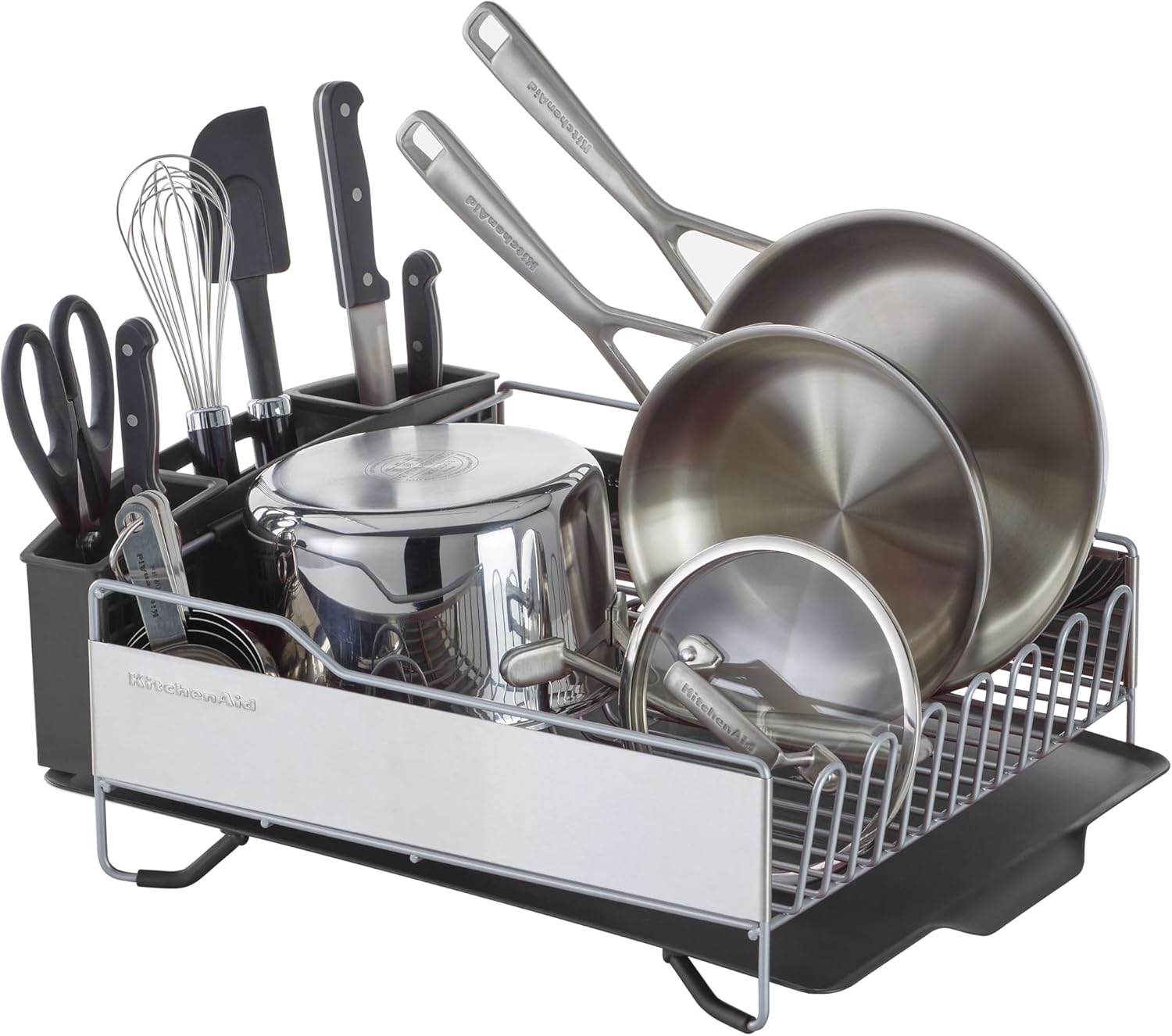
First up, how many dishes are you actually drying at once? This isn’t just about plates; think pots, pans, mixing bowls, maybe even that oversized serving platter. A compact wire rack might be fine for a single person who mostly uses their dishwasher, but for a family that cooks regularly or someone who relies solely on hand-washing, capacity is king. The KitchenAid Large Capacity rack, as its name suggests, is built to handle a significant load. We’re talking multiple dinner plates, bowls, and even some smaller pots without feeling jammed. That generous size means fewer drying cycles and less counter-cluttering while dishes air out. But here’s the rub: if you live in a tiny apartment, that “large capacity” can quickly become “large footprint,” which isn’t always a win.
Material & The Rust Resistance Promise
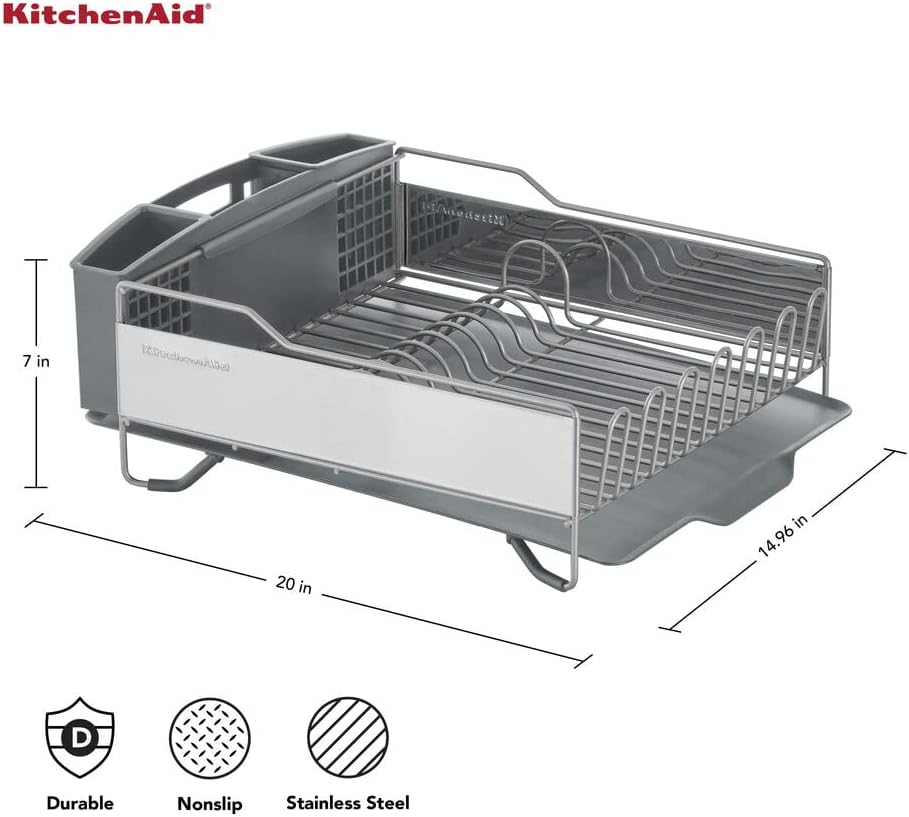
Nobody wants rusty water dripping onto their clean dishes or staining their countertop. Period. This is where material choice becomes critical. Many budget racks use simple coated steel wire that eventually chips, allowing rust to take hold. A more robust option, like the one from KitchenAid, often boasts “rust resistant” properties. This typically means a higher quality coating or, in some premium cases, stainless steel components. The “rust resistant” claim on the KitchenAid model hints at a coating designed for durability. It’s not magic, mind you – constant moisture and harsh cleaning can still wear things down – but it’s a definite step up from the cheapest options. You’ll still need to maintain it, but it should hold up far better over time. Don’t expect miracles, just reasonable longevity.
Drainage System – No More Puddles!
This is, for my money, one of the most overlooked features, and it drives me absolutely bonkers when it’s done poorly. A good dish rack needs to manage water, not just hold wet dishes. We’re talking about an effective drain board. The KitchenAid rack features an “angled drain board.” This design is crucial because it funnels water directly into your sink, rather than letting it pool under the rack and create a slimy mess. Flat drain boards are notorious for this. Sure, they catch water, but then you have to deal with emptying it. An angled board? Just set it and forget it, for the most part. Still, ensure your sink lip is lower than the board’s edge, or you’ll still have puddles. Physics, folks.
Footprint & Your Precious Countertop Real Estate
Let’s be honest, few of us have endless kitchen counter space. So, the physical size of your dish rack – its “footprint” – matters a whole lot. A “full size” rack, like this KitchenAid option, takes up a substantial chunk of space. If you’ve got a small galley kitchen, committing that much real estate to drying dishes might be a deal-breaker. You’ll need to measure your available counter and consider how much working space you’re willing to sacrifice. It’s a trade-off: more drying capacity usually means less prep area. Think hard about how often you need that entire rack versus how often you need to chop veggies.
Flatware Management – Caddies and Clarity
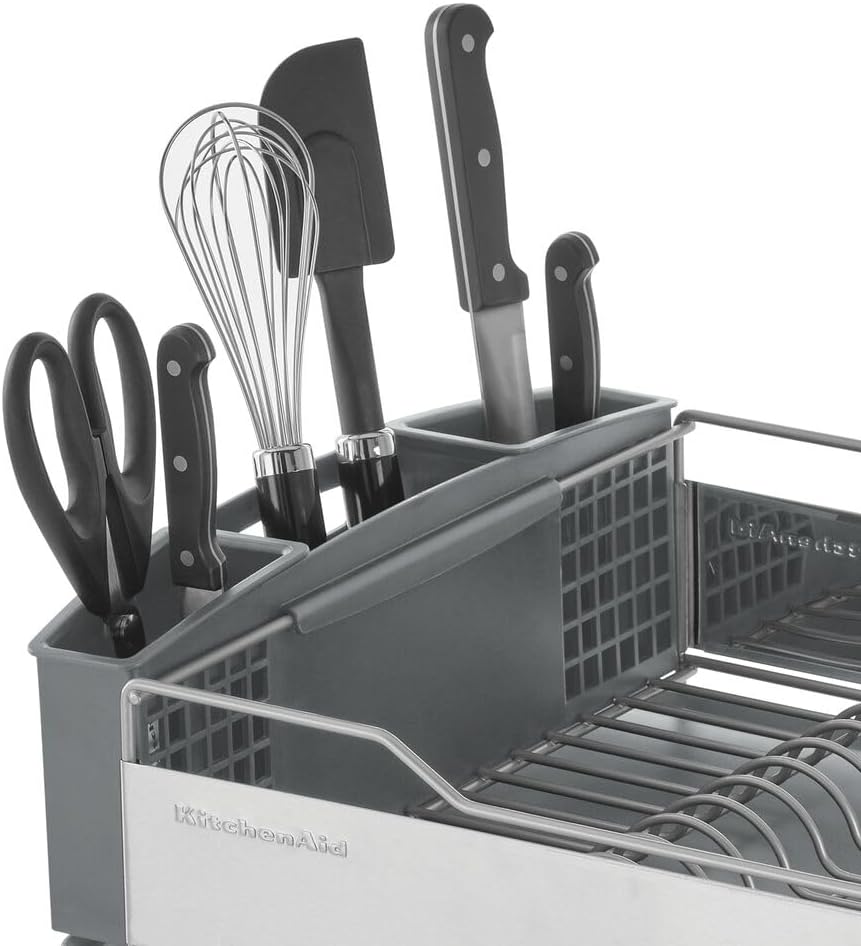
Small items like forks, spoons, and knives are the bane of many dish racks. They flop over, get stuck, or simply don’t dry properly. A dedicated “flatware caddy” is a must-have. The KitchenAid model includes a “removable flatware caddy,” which is genuinely useful. Removable means you can take it to the drawer for easy unloading, or move it around the rack depending on your load. Look for caddies with good drainage holes and enough compartments to keep different utensil types somewhat separated. A single big basket just makes a jumbled mess, and nobody has time for that.
Stability & Durability – Built to Last (or Wobbly Disaster)?
Picture this: you’ve just hand-washed a heavy ceramic pot, you place it on the rack, and the whole thing tilts precariously. Not fun. A dish rack needs to be stable. Look for sturdy construction, often indicated by thicker wires, robust joints, and a solid base. The KitchenAid rack generally feels more substantial than many budget options, suggesting better durability. It’s not just about not tipping over; it’s about not bending or breaking under the weight of everyday kitchenware. Investing in something that feels solid from the get-go often saves you the headache of replacing flimsy alternatives later. Nobody wants to buy the same thing twice because the first one couldn’t handle a soup pot.
How to Match the Product to Your Situation
Finding the right dish rack isn’t a one-size-fits-all quest. Your kitchen habits and available space really dictate what makes sense.
The Bustling Family Kitchen
You’re cooking constantly. Multiple meals, maybe baking, definitely a lot of hand-washing of pots, pans, and special cutlery that doesn’t go in the machine. For you, the sheer “large capacity” of the KitchenAid rack is a blessing. It means fewer trips to load and unload, and a less cluttered counter after a big dinner. The robust, rust-resistant build holds up to daily abuse, and that angled drain board handles the constant flow of water without creating a standing puddle problem. You prioritize utility and volume.
The Space-Conscious Apartment Dweller
Every inch of your counter is precious. A “full size” dish rack might feel like it’s eating your entire kitchen. You might be better off with something more compact, perhaps an over-the-sink model that frees up counter space, or a collapsible drying mat that can be tucked away when not in use. While the KitchenAid offers durability and drainage, its generous footprint might just be too much for your cozy culinary corner. You’re looking for solutions that vanish when not needed, not a permanent fixture.
The Occasional Hand-Washer/Minimalist
You mostly use the dishwasher, but there are always those few “hand-wash only” items: sharp knives, delicate glassware, maybe a favorite cast iron pan. You don’t need a sprawling drying station. For you, a smaller, perhaps even aesthetically pleasing, compact dish rack or a simple drying mat would suffice. The KitchenAid Large Capacity model would likely be overkill, hogging space for just a few items. You value discreetness and ease of storage over high-volume utility.
Dish Rack Tiers: A Quick Comparison
Different dish drying racks serve different masters, mostly depending on what you’re willing to spend and what you expect in return.
| Type/Tier | Best For | Price Tier | Key Feature | Watch-Out |
|---|---|---|---|---|
| Premium Full-Size | High-volume hand-washers, daily use, durability | Mid-range+ | Robust construction, integrated drainage | Significant counter footprint |
| This is where our KitchenAid Large Capacity Full Size Rust Resistant Dish Rack with Angled Drain Board and Removable Flatware Caddy, Light Grey sits, offering a sturdy build and efficient water management. | ||||
| Basic Wire Rack | Budget shoppers, occasional use, temporary needs | Budget | Low initial cost, lightweight | Prone to rust, poor drainage, flimsy |
| These are your entry-level options, fine for a few dishes but not built for the long haul or heavy loads. | ||||
| Compact/Over-the-Sink | Small kitchens, limited counter space | Budget-Mid | Space-saving, often expandable | Lower capacity, can block sink access |
| Ideal for those who need to maximize counter space, but you might find yourself wishing for more room when washing larger items. | ||||
| Collapsible/Roll-Up Mat | Occasional use, easy storage, minimalist | Budget-Mid | Disappears when not in use | Less stable for heavy items, no vertical drying |
| Great for those one-off hand washes or when you truly need everything out of sight, but don’t expect it to stand up to a stack of dinner plates. |
Scenario-Specific Needs for Your KitchenAid Rack
Not all dish-drying situations are equal. A good dish rack, especially one with thoughtful design, excels in specific scenarios.
For the Daily Dish Duty
If your sink is almost always home to a few hand-washed items, whether it’s the morning coffee mug, a lunch container, or specialty cooking tools, the KitchenAid rack shines. Its “full size” isn’t just about holding a lot; it’s about holding consistently. You can leave a few things to dry without them looking out of place or interfering with other items. The “angled drain board” means you’re not constantly wiping up pooling water, which is a huge sanity saver when it’s a daily occurrence. You want a system, not a chore.
For Entertaining & Big Meals
You know the drill. A dinner party. Thanksgiving. Suddenly, your small standard rack is overflowing with serving dishes, wine glasses, and specialty utensils that the dishwasher can’t (or shouldn’t) touch. This is where “large capacity” truly earns its stripes. The KitchenAid model can handle that surge in volume. You can stack more, organize better with that “removable flatware caddy,” and trust that the whole structure isn’t going to collapse under the weight of your grandmother’s casserole dish. It’s about recovering your kitchen quickly after a culinary onslaught.
For Minimal Countertop Visuals (Where Possible)
Now, a “full size” rack is never going to be invisible. Let’s be real. But the “Light Grey” color of this KitchenAid model, combined with a relatively clean, utilitarian design, can actually blend into some kitchen decors better than a clunky stainless steel or bright white alternative. It’s not trying to be a statement piece; it’s designed to be functional without being overtly intrusive. If your countertop is grey or light-toned, it’ll disappear just a little bit more than a contrasting color. Small victories, right?
Common Mistakes Buyers Make
Even with something as seemingly simple as a dish rack, folks make some head-scratching choices. Don’t be one of them.
- Ignoring Countertop Space: This is probably the biggest blunder. People buy a large rack without actually measuring their available counter real estate. Then it arrives, dominates the kitchen, and becomes an annoyance rather than a help. Always measure first. Please.
- Forgetting About Drainage: A dish rack that doesn’t effectively drain water is just a fancy puddle collector. Many cheaper models have flat trays that require constant emptying. This isn’t just annoying; it’s a breeding ground for mold and mildew. Always, always check for an angled, integrated drainage solution.
- Prioritizing Price Over Material & Build Quality: You can get a dish rack for a low cost. But if it’s made from flimsy, poorly coated wire, it’ll start rusting, bending, and generally falling apart in no time. You end up buying another one, negating any initial savings. A slightly higher upfront investment often means years of service.
- Neglecting the Rack’s Own Cleaning Needs: Dish racks get dirty. They accumulate mineral deposits from water, food particles, and sometimes even mildew. People buy a “rust resistant” rack and then never clean it, expecting it to stay pristine. It won’t. Plan for periodic cleaning to keep it functional and hygienic.
Why/How/What
Why invest in a good dish rack?
A quality dish rack, like the KitchenAid model we’re discussing, is more than just a place to put wet dishes. It protects your countertop from water damage, promotes efficient air drying to prevent odors and spots, and organizes your hand-washed items so your kitchen doesn’t look like a disaster zone. It’s about improving efficiency and hygiene in a high-traffic area.
How to extend its life?
Simple. Clean it regularly. Even “rust resistant” materials benefit from a quick scrub with dish soap and a rinse to remove mineral buildup and food residue. Make sure the drain board stays clear of debris, too. Also, don’t overload it beyond its capacity, as this can strain the structure over time.
What makes a dish rack “rust resistant” really?
Typically, it means the underlying metal (often steel) has been treated or coated with a material like vinyl, epoxy, or sometimes stainless steel itself is used. These coatings create a barrier against moisture and oxygen, which are the main culprits behind rust. The quality and thickness of this coating, or the grade of stainless steel, determine how long that resistance truly holds up before wear and tear take over. It’s not an impervious shield, just a strong defense.
FAQ
Is a larger dish rack always better?
Not necessarily. While a large capacity rack like the KitchenAid offers more space, it also occupies more counter real estate. The “better” rack depends entirely on your specific household’s hand-washing volume and the size of your available kitchen counter.
Can I put heavy pots on a standard rack?
You can, but it’s risky with cheaper, flimsier racks that might bend or even collapse. A well-built, sturdy model like the KitchenAid Large Capacity dish rack is generally designed to handle heavier items, thanks to its robust construction.
How often should I clean the drain board?
Ideally, you should give the drain board a quick wipe down or rinse every few days to prevent mineral buildup and mold. If you’re using a rack daily, a thorough cleaning once a week keeps things hygienic and prevents hard water stains.
What’s the deal with flatware caddies?
A good flatware caddy, especially a “removable flatware caddy” like on the KitchenAid model, organizes your utensils for better drying and easier unloading. It prevents them from flopping around or nesting together, which can hinder airflow.
Do all rust-resistant racks really last?
The term “rust resistant” is a spectrum. Higher quality coatings or better materials tend to last longer, but no material is truly rust-proof if neglected or subjected to harsh conditions repeatedly. Consistent cleaning helps any rack live its best life.
Are plastic racks really that bad?
Not always. Plastic dish racks can be perfectly functional, lightweight, and often more budget-friendly. Their main drawbacks tend to be less stability for heavy items, a tendency to stain, and sometimes a less premium aesthetic compared to coated metal options.
Where’s the best spot for a dish drying rack?
The ideal spot is usually right next to your sink, positioned so that the drain board can funnel water directly into the basin. This minimizes puddles and keeps the workflow efficient. Ensure it’s not blocking essential counter space or creating an obstacle.
Final Recommendation
So, back to the big question: Is the KitchenAid Large Capacity Full Size Rust Resistant Dish Rack with Angled Drain Board and Removable Flatware Caddy, Light Grey truly worth it? For households that regularly hand-wash a significant number of dishes—think busy families, enthusiastic home cooks, or those who simply prefer hand-washing certain items—this KitchenAid rack is a solid contender. Its construction and thoughtful features, particularly the generous capacity, reliable “rust resistant” coating, and “angled drain board,” justify its position in the mid-range or even slightly premium category. You’re paying for durability, convenience, and effective water management.
However, if your hand-washing needs are minimal, or if your kitchen counter space is truly at a premium, the sheer size might be overkill. For those scenarios, a compact, collapsible, or over-the-sink option would likely be a more appropriate, space-saving choice. But if you demand a workhorse that can handle daily demands and stand the test of time, without turning your counter into a swamp, the KitchenAid Large Capacity dish rack is a purchase you’re unlikely to regret. It solves real problems in a practical way.
#KitchenAid #Large #Capacity #Full #Size #Rust #Resistant #Dish #Rack #Angled #Drain #Board #Removable #Flatware #Caddy #Light #Grey




Reviews
There are no reviews yet.