COLAMY Tufted Dining Chairs Review: How to Match Chair Height to Your Table
Most people buy dining chairs backwards. They fall for the fabric, the legs, the look in the listing photo — and only discover the seat height is wrong after four chairs are sitting in their dining room. This guide covers dining chairs the way they should be shopped: fit first, comfort second, looks third.
I’ll walk through what actually matters when buying dining chairs — seat height versus table height, how many chairs genuinely fit, which upholstery survives real family dinners — using the COLAMY tufted parsons set as our reference point, with two honest alternatives for different budgets and styles.
Quick Answer
For most standard dining tables (about 30 inches high), you want dining chairs with a seat height around 18–20 inches, roughly 10–12 inches of clearance between seat and tabletop. The COLAMY tufted parsons set hits that sweet spot with a high, button-tufted backrest and memory-foam padding that suits long dinners. If your budget is tighter, the Yaheetech parsons set covers the same basics for less. If you want chairs that read as decor rather than furniture, the Christopher Knight Home Hilary set’s French-country round back is the statement pick.
Compare Top Dining Chair Sets
Three proven picks side by side — choose the one that fits your needs.
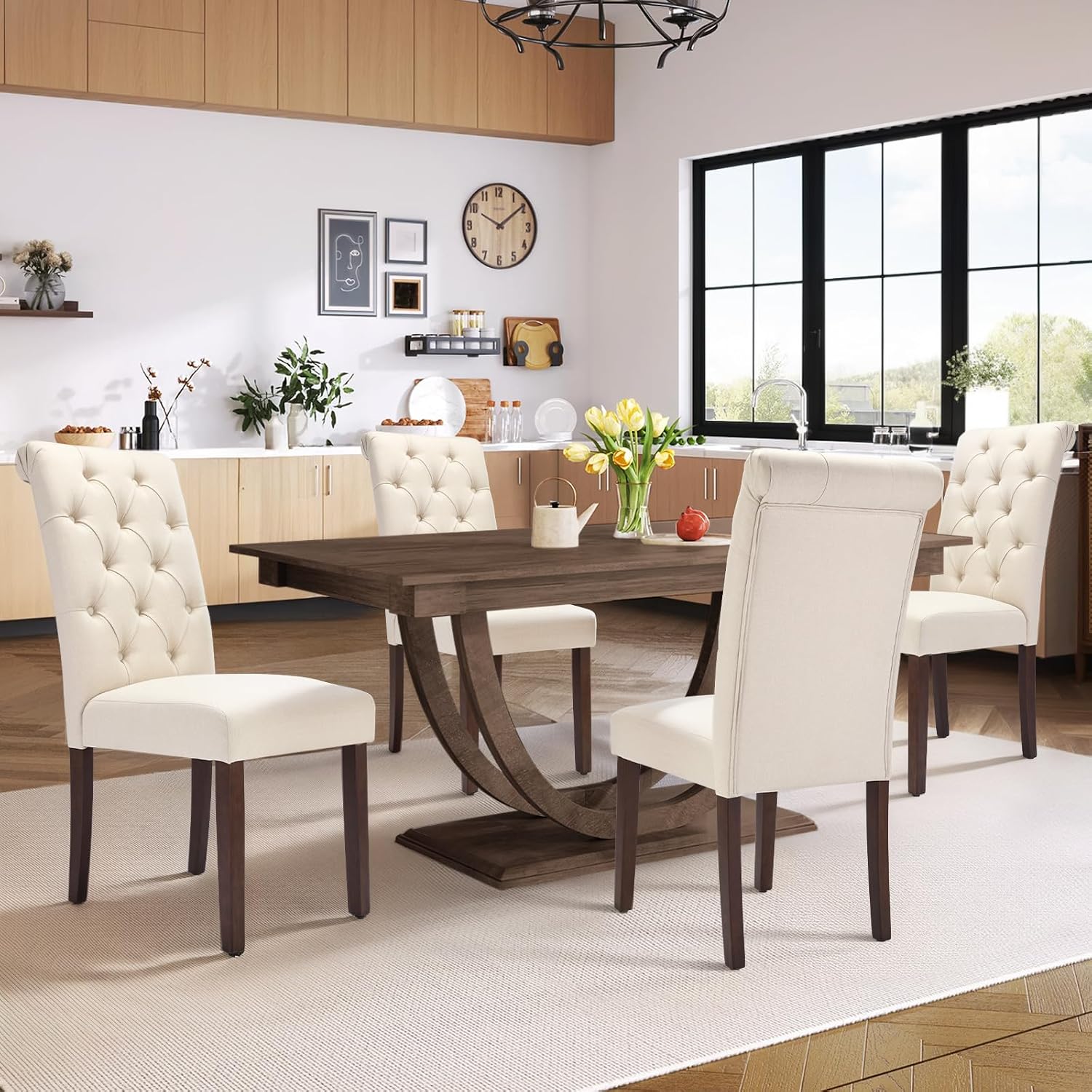
COLAMY Tufted Dining Chairs, Set of 4
Button-tufted high back + memory foam; the everyday-dinner sweet spot
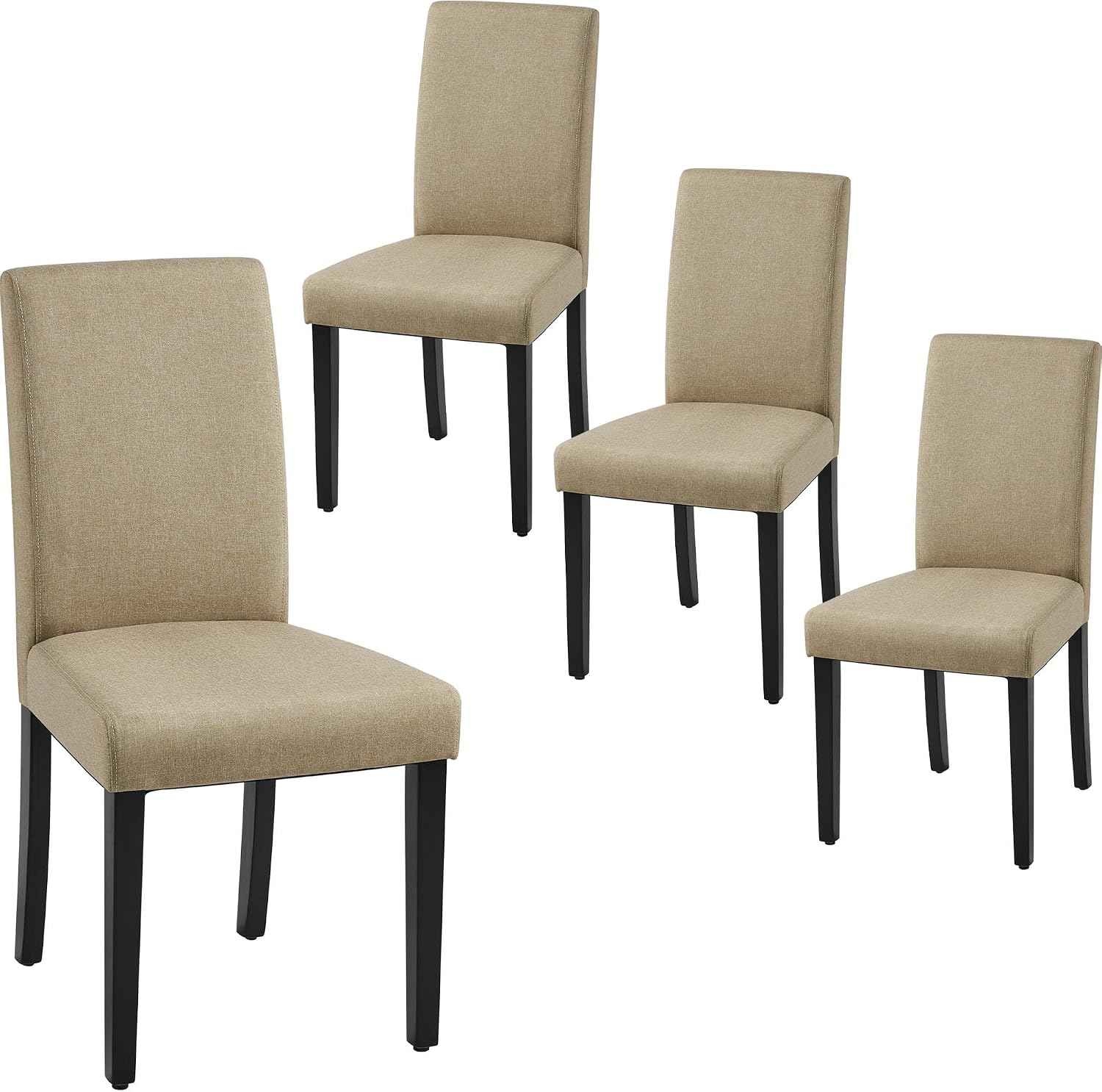
Yaheetech Parsons Dining Chairs, Set of 4
Simple khaki parsons silhouette; the budget workhorse
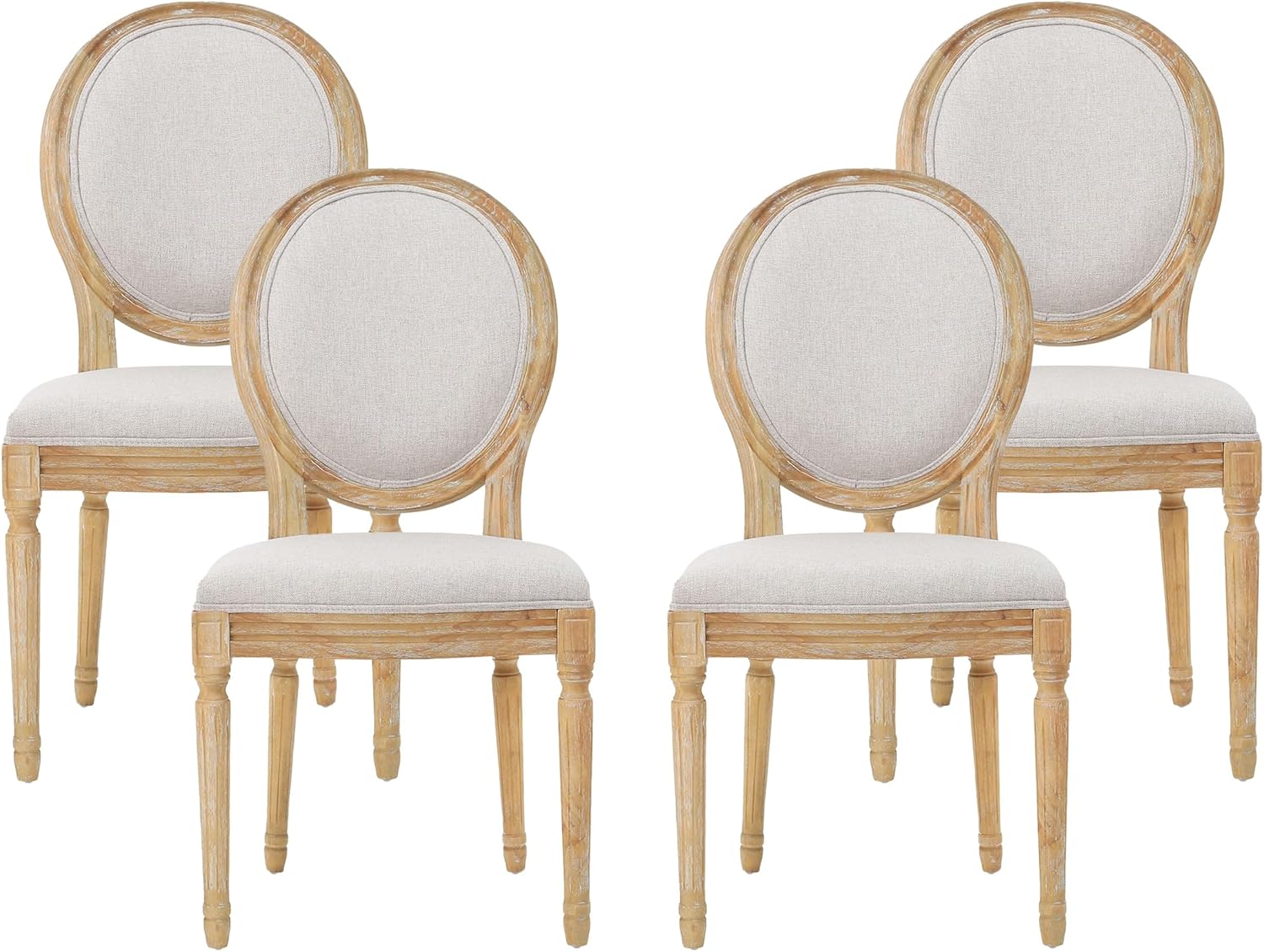
Christopher Knight Home Hilary, Set of 4
French-country round back with fluted legs; the design statement
Prices and availability may vary — tap any product to check the current listing.
What to Look For When Buying Dining Chairs
Ask anyone who has returned a set of dining chairs and the reason is rarely the color. It’s the fit. Here’s what to check before you buy — in the order that actually decides whether you’ll keep them.
1. Seat height versus your table height
The golden rule: leave about 10–12 inches between the chair seat and the underside of the tabletop. Standard dining tables sit around 30 inches tall, so a seat height of 18–20 inches works. The COLAMY set’s seat lands just under 20 inches, which pairs cleanly with a standard table.
Too little clearance and your thighs press against the table apron. Too much and you eat like a kid at the grown-ups’ table, shoulders hunched. Measure your table before you order anything. Seriously — it takes thirty seconds and it prevents the single most common dining chair return.
Trade-off: taller seat heights suit taller people but can look bulky next to a delicate table. A chair that’s right for a 6-foot diner may swallow a 5-foot one. There is no universal perfect number, only the right number for your table and your household.
2. Seat depth and backrest height
Seat depth decides whether you perch or settle. Around 16–18 inches suits most adults for dining; deeper seats feel lounge-y but push shorter diners forward so their backs never reach the backrest. The COLAMY’s seat depth sits in the standard dining zone, and its high backrest with the rolled top actually supports your upper back — unusual at this price tier, where backs are often decorative stubs.
High backs look formal and photograph well. They also collect visual weight in a small room. In a tight breakfast nook, a tall tufted back can dominate the sightline. Something to weigh if your dining area doubles as a walkway.
3. Upholstery fabric and real-life cleaning
Linen-look polyester — what the COLAMY uses — is the practical middle ground. It breathes better than faux leather, wipes down easier than cotton, and hides crumbs in its weave. But let’s be honest: no light-colored fabric is truly kid-proof. Beige shows tomato sauce. It just does.
The upside of a tight, textured weave is that minor marks blend in. The downside is that deep-set buttons and diamond tufting create little valleys where crumbs lodge. A handheld vacuum once a week solves it. If that sounds like a chore you’ll never do, consider a smoother parsons chair like the Yaheetech — fewer crevices, faster wipe-down.
4. Frame and leg construction
Solid rubberwood legs are the standard honest build in this category — all three sets here use some form of solid wood framing. What separates them is joinery and finish. Tapered legs (COLAMY) read modern; fluted, turned legs (CKH Hilary) read traditional. Functionally both hold up fine for daily dining.
Watch the weight rating as a rough proxy for frame confidence, but don’t treat it as gospel. A 250-lb rating on the COLAMY versus 300 on the Yaheetech doesn’t mean the Yaheetech is sturdier — ratings are self-declared and test methods vary. What matters more: do the legs splay slightly outward (more stable) and are there floor glides to protect hardwood?
5. Cushion fill and long-sit comfort
Memory foam over a sponge base — the COLAMY formula — gives you that initial sink-in softness plus a firmer layer underneath so you don’t bottom out after an hour. Plain foam (Yaheetech) is perfectly fine for 30–45 minute meals but compresses faster over months of daily use.
Here’s the trade-off nobody mentions: softer cushions feel luxurious on day one and tired on day four hundred. Firmer foam feels underwhelming in the showroom and holds its shape for years. For a dining room that hosts holiday marathons, err toward supportive. For a breakfast nook used twenty minutes a day, soft is fine.
6. How many chairs actually fit your table
A good rule of thumb: allow about 24 inches of table width per diner. A 60-inch table seats three per side comfortably — six total with the ends. Chairs around 17–19 inches wide (all three sets here) tuck in neatly at that spacing.
Armless chairs like the COLAMY and Yaheetech slide fully under the table, which saves floor space and looks tidy. The CKH Hilary’s rounded back flares a bit wider, so measure if you’re squeezing four across a 48-inch table. Our dining table size guide walks through the math if you’re still deciding on the table itself.
Which Dining Chair Fits Your Household?
Three sets, three households. See yourself in one of these?
The weeknight family
Two kids, one dog, dinner at 6:30 sharp and homework at the table by 7. You need chairs that wipe clean, survive being dragged across the floor, and don’t make you cry when grape juice happens. The Yaheetech parsons set is built for exactly this life — simple silhouette, no tufting valleys to trap crumbs, and a price per chair that doesn’t induce panic when one gets wobbly.
The dinner-party regular
You host. Friends linger. Conversations stretch past dessert into a second bottle of wine, and suddenly everyone’s been sitting for three hours. That’s where the COLAMY earns its keep: the high tufted backrest supports actual backs, the memory foam keeps working past the first hour, and the chairs look intentional in photos. Comfort that photographs well — a rare combo.
The style-first decorator
Your dining room is part of your home’s visual identity. Chairs are decor, not just seating. The CKH Hilary’s French-country round back and fluted legs do something the other two can’t: they make the room. You’re trading some long-sit plushness for silhouette. Worth it? If you’d notice the chairs in every listing photo — yes.
Dining Chair Types Compared
Most dining chairs fall into one of these tiers. The three sets in this guide sit in the middle two — which is where the value lives.
| Type / Tier | Best For | Price Tier | Key Feature | Watch Out |
|---|---|---|---|---|
| Budget parsons sets | First apartments, rentals, high-traffic family tables | Budget-friendly | Simple wipe-clean silhouette, easy assembly | Foam compresses faster; hardware may need re-tightening |
| Mid-range upholstered (tufted/parsons) | Everyday dining rooms, regular hosts | Mid-range | Better cushioning, real wood legs, finished look | Tufting traps crumbs; light fabrics show stains |
| Design-forward statement sets | Style-led dining rooms, open-plan spaces | Mid-range to premium | Distinctive silhouettes, furniture-grade detailing | You pay for looks; comfort is secondary |
| Solid hardwood / benchmade | Forever furniture, heirloom buyers | Premium | Joinery that outlives trends, refinishable | Heavy, costly, and honestly overkill for most renters |
Budget parsons sets like the Yaheetech are the honest workhorses — they do the job and you won’t mourn them in five years. The mid-range tufted tier, where the COLAMY sits, is where you get the biggest jump in daily comfort per dollar. Statement sets like the CKH Hilary buy you a look. And solid hardwood? Beautiful. Also the price of a used car for eight chairs.
Three Real-World Scenarios
Scenario 1: The small dining nook
You’ve got a 42-inch round table in a kitchen corner and every inch counts. Armless parsons chairs are your friend here — they tuck completely under the table when not in use. The COLAMY’s high back is the one concern: at nearly 40 inches tall it will visually fill a small nook. In truly tight spaces, the lower-profile Yaheetech keeps sightlines open.
Scenario 2: The holiday dinner marathon
Thanksgiving. Twelve people. Three hours at the table. This is the scenario cheap chairs fail — thin foam, no back support, and by pie everyone’s shifting. A high backrest with real padding (COLAMY) or at minimum a well-shaped parsons back (Yaheetech) makes the difference between guests lingering and guests “helping with dishes” as an excuse to stand up.
Scenario 3: Kids, pets, and beautiful chaos
Toddlers climb chairs like ladders. Dogs claim the seat the second you stand up. In this house, buy for replaceability and cleanability, not heirloom potential. Smooth, darker upholstery beats tufted beige every time — which points to the Yaheetech in a darker colorway. Save the tufted set for when the kids are older. Your future self says thanks.
4 Common Mistakes When Buying Dining Chairs
Mistake 1: Buying chairs before measuring the table. Seat height, table height, chair width, table length — four numbers, five minutes with a tape measure. Skip this and you’re gambling. The number one regret in dining chair reviews isn’t quality. It’s fit.
Mistake 2: Choosing fabric for the listing photo, not your life. Cream bouclé looks unreal online and heartbreaking after one spaghetti night. Match the upholstery to your household’s chaos level, not your Pinterest board. If you’re pairing chairs with a new table, check whether it’s veneer vs solid wood too — the same “photo vs reality” trap applies.
Mistake 3: Ignoring the underside. Flip the listing images to the assembly view. Are the legs bolted through solid corner blocks or screwed into particle board? Do the feet have glides? A chair is only as good as its weakest joint, and that joint is always underneath.
Mistake 4: Assuming “set of 4” means identical forever. Dye lots vary. If you buy four now and two later, the beige might not match. When in doubt, buy the full count you’ll eventually want — even if two chairs live in a closet for a year.
Why, How, What: Dining Chairs
Why do dining chair prices vary so wildly for chairs that look the same? Mostly what’s inside: foam density, frame wood versus engineered wood, and how the upholstery is attached. Two beige parsons chairs can look identical in photos while one has a solid rubberwood frame and the other has stapled-together softwood. The listing rarely shows you the difference. Leg shape, weight ratings, and assembly hardware quality are the tells you can actually read online.
How do I know if a chair will be comfortable without sitting in it? You can’t know for sure — anyone who tells you otherwise is selling something. But you can get close: check the seat height against your table, look for a backrest that reaches at least mid-back, and favor memory foam or high-density foam over unspecified “padded” fill. Then read the critical reviews, not the five-star ones. Complaints about comfort are specific (“seat too shallow”); praise is vague (“love them!”). Specificity is data.
What’s the real difference between parsons chairs and the tufted kind? A parsons chair is defined by its fully upholstered, armless slab silhouette — seat, back, and legs all wrapped in fabric. “Tufted” just describes the buttoned, diamond-pattern upholstery treatment, which can appear on a parsons frame (like the COLAMY) or on more traditional frames. Tufting adds formality and texture; it also adds crumb-trapping valleys. Pick your priority.
Questions People Ask Before Buying
Straight answers, no fluff
Are tufted dining chairs actually comfortable for long dinners?
Yes, tufted dining chairs can be genuinely comfortable for long dinners, provided the tufting sits on a properly padded high backrest rather than a thin decorative panel, because the buttons themselves don’t create comfort — the foam depth, backrest height, and lumbar curve underneath do all the real work. The COLAMY’s memory-foam layer over a sponge base with a high, slightly curved backrest is specifically built for longer sits, while thin tufted chairs with minimal padding look plush but feel hard after an hour. Check foam type, not just the tufted look.
What seat height works with a standard dining table?
For a standard dining table around 30 inches high, choose dining chairs with a seat height between 18 and 20 inches, which leaves the ideal 10 to 12 inches of clearance between the seat surface and the tabletop for comfortable legroom. Measure from your floor to the underside of your table apron, subtract 10 to 12 inches, and that’s your target seat height. The COLAMY set’s seat lands just under 20 inches, fitting standard tables cleanly, while counter-height tables need an entirely different chair — see our counter-height seating guide for those.
Should I buy dining chairs as a matching set of 4, or mix and match?
Buy the matching set of 4 if this is your primary dining setup, because identical chairs guarantee consistent seat height, matching comfort, and dye-lot color, while mixed chairs often sit at slightly different heights that guests notice the moment they sit down. Mixing works beautifully as a deliberate design choice (two statement end chairs with simpler side chairs), but only when you’ve verified the seat heights match within half an inch. For a first dining set, matching is the safer, calmer choice.
COLAMY vs Yaheetech dining chairs — which is the better buy?
The COLAMY is the better buy if you host regularly or care about long-sit comfort, because its memory-foam cushioning and high tufted backrest meaningfully outperform basic foam once dinners stretch past the one-hour mark and thinner padding starts to feel hard. The Yaheetech is the better buy if budget rules, kids and pets rule the table, or you simply need solid, good-looking chairs without paying for comfort features you’ll rarely use. Same category, different jobs — match the chair to your household, not to a ranking.
Do light-colored fabric dining chairs stain easily with kids?
Honestly, yes — beige and cream fabrics will show tomato sauce, juice, and mystery smudges faster than any darker or patterned upholstery, regardless of brand or weave, so light chairs demand quicker cleanup and more realistic expectations in a house with young kids or enthusiastic red-wine drinkers. A tight linen-look weave like the COLAMY’s resists absorption better than loose cotton and wipes down well for fresh spills, but set-in stains on light fabric are a losing battle. With young kids, choose a darker colorway or a smooth parsons chair with fewer crevices, and keep a fabric-safe cleaner within reach.
Frequently Asked Questions
How many dining chairs fit around a 60-inch table?
Plan on about 24 inches of table width per diner. A 60-inch rectangular table seats three per side comfortably, plus one at each end — eight total if you use the ends, six without. Chairs in the 17–19 inch width range, like all three sets in this guide, tuck in neatly at that spacing without elbow wars.
What’s the difference between parsons chairs and regular side chairs?
A parsons chair is fully upholstered and armless — seat, back, and legs wrapped in fabric — with a clean slab silhouette that slides under the table. A traditional side chair usually has an exposed wood frame with just the seat (and sometimes back) upholstered. Parsons chairs read more modern and casual; wood-frame side chairs read more classic and are often easier to repair.
Can I use dining chairs as home office chairs?
For short stints, sure — a padded parsons chair beats a kitchen stool for a two-hour work session. For full workdays, no: dining chairs lack lumbar tuning, armrests, and height adjustment, and your back will file a complaint by week two. If your dining table doubles as a desk occasionally, the COLAMY’s high backrest makes it the most tolerable of the three for laptop work.
How do I clean fabric dining chairs?
Vacuum weekly with an upholstery attachment — especially around buttons and seams where crumbs collect. Blot spills immediately with a dry cloth; don’t rub, which pushes stains deeper. For set-in marks, a small amount of mild soap and water dabbed on, then blotted dry, handles most food stains on polyester weaves. Always test any cleaner on a hidden spot first.
Do I need chair pads with upholstered dining chairs?
No — that defeats the purpose. Upholstered dining chairs already have built-in cushioning, and adding pads on top looks lumpy and slides around. Chair pads are for hard wood or metal seats. If an upholstered seat feels too firm, the foam density is wrong for you; a pad is a band-aid, not a fix.
Will these chairs work with a round dining table?
Yes. Armless parsons-style chairs pair beautifully with round tables because there are no arms to collide with the table edge or neighboring chairs. For a 42–48 inch round table, four chairs is the comfortable count; a 60-inch round can take six. Just confirm the seat height against your table using the 10–12 inch clearance rule.
Final Recommendation
Here’s the honest summary. The COLAMY tufted set is the one I’d point most households toward: it nails the fundamentals — right seat height for standard tables, genuinely supportive high back, cushioning that survives long dinners — while looking like it cost more than it did. The tufting is a style commitment, not a comfort gimmick, as long as you accept the crumb-vacuum trade-off.
But “most households” isn’t yours, necessarily. Buy the Yaheetech if your table sees more chaos than candlelight. Buy the CKH Hilary if the dining room is your home’s showpiece and the chairs need to perform visually. All three are legitimate answers to different questions — the mistake is buying one when you needed the other.
Decision Tree: Which Set Is Yours?
You host dinner parties or long family meals → COLAMY tufted set. The high backrest and memory foam are built for the third hour.
Kids, pets, rentals, or tight budget → Yaheetech parsons set. Simple, sturdy, easy to clean, easy to replace.
The dining room is a design statement → CKH Hilary. French-country silhouette that elevates the whole room.
Still unsure? → Measure your table first, then pick the set whose seat height and style match. Fit beats features every time.
Key Takeaways
✓ Match seat height to your table: 10–12 inches of clearance between seat and tabletop.
✓ COLAMY tufted set = best all-rounder for comfort and everyday hosting.
✓ Yaheetech parsons set = the practical pick for busy, messy, budget-conscious households.
✓ CKH Hilary = the design pick when chairs need to look as good as they sit.
✓ Allow ~24 inches of table width per diner; buy the full count now to avoid dye-lot mismatch later.
Compare Top Dining Chair Sets
Three proven picks side by side — choose the one that fits your needs.
COLAMY Tufted Dining Chairs, Set of 4
Button-tufted high back + memory foam; the everyday-dinner sweet spot
Yaheetech Parsons Dining Chairs, Set of 4
Simple khaki parsons silhouette; the budget workhorse
Christopher Knight Home Hilary, Set of 4
French-country round back with fluted legs; the design statement
Prices and availability may vary — tap any product to check the current listing.